## Diagram: Permutation Transformation Sequences
### Overview
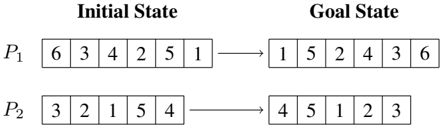
The image displays a technical diagram illustrating two distinct permutation problems, labeled **P₁** and **P₂**. Each problem shows a transformation from an "Initial State" to a "Goal State," represented as sequences of numbers within rectangular boxes. The diagram is structured in a clear, tabular format with two rows, each dedicated to one problem.
### Components/Axes
* **Header Labels:** The text "Initial State" is centered above the left column of sequences. The text "Goal State" is centered above the right column of sequences.
* **Problem Identifiers:** The labels **P₁** and **P₂** are positioned to the far left of their respective rows.
* **Data Sequences:** Each state is represented as a horizontal array of numbers enclosed in individual, contiguous rectangular cells.
* **Transformation Indicator:** A right-pointing arrow (→) is placed between the Initial State and Goal State sequences for each problem, indicating the direction of transformation.
### Detailed Analysis
The diagram presents two specific permutation examples:
**Problem P₁:**
* **Initial State Sequence:** [6, 3, 4, 2, 5, 1]
* **Goal State Sequence:** [1, 5, 2, 4, 3, 6]
* **Transformation:** The arrow indicates the sequence [6, 3, 4, 2, 5, 1] is to be transformed into [1, 5, 2, 4, 3, 6].
**Problem P₂:**
* **Initial State Sequence:** [3, 2, 1, 5, 4]
* **Goal State Sequence:** [4, 5, 1, 2, 3]
* **Transformation:** The arrow indicates the sequence [3, 2, 1, 5, 4] is to be transformed into [4, 5, 1, 2, 3].
### Key Observations
1. **Sequence Length:** The sequences have different lengths. P₁ contains 6 elements, while P₂ contains 5 elements.
2. **Goal State Order:** The goal state for P₁ ([1, 5, 2, 4, 3, 6]) is not sorted in ascending order. The goal state for P₂ ([4, 5, 1, 2, 3]) is also not sorted.
3. **Element Composition:** Both initial and goal states for each problem use the same set of distinct integers, confirming they are permutations of the same base set.
* P₁ uses the set {1, 2, 3, 4, 5, 6}.
* P₂ uses the set {1, 2, 3, 4, 5}.
### Interpretation
This diagram is a formal representation of permutation or reordering problems, commonly found in computer science, mathematics, or puzzle contexts (e.g., sorting algorithms, puzzle games like the 15-puzzle, or group theory).
* **What it demonstrates:** It defines two specific instances of a transformation task. The goal is not necessarily to sort the sequence but to achieve a specific, predefined target order from a given starting order.
* **Relationship between elements:** The "Initial State" and "Goal State" are two permutations of the same set. The arrow represents the operation or sequence of operations required to map one to the other. The lack of a sorted goal state suggests the problem may involve constraints beyond simple numerical order, such as achieving a specific pattern, solving a puzzle configuration, or demonstrating a particular algorithmic step.
* **Notable patterns:** The primary pattern is the explicit definition of a start and end point for a reordering process. The differing sequence lengths (6 vs. 5) indicate these are two independent problem instances, not part of a single sequence. The fact that neither goal state is sorted is the most significant observation, as it implies the target configuration is arbitrary or rule-based rather than based on a simple monotonic property.