## Diagram: Permutation Transformation States
### Overview
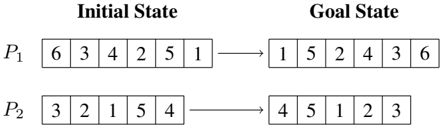
The diagram illustrates two permutation systems (P₁ and P₂) showing their initial states and goal states. Arrows indicate transformations between states, suggesting a process of rearrangement or sorting.
### Components/Axes
- **Main Elements**:
- Two labeled permutation systems: **P₁** and **P₂**
- Four state boxes per system: **Initial State** and **Goal State**
- Numerical sequences in boxed format
- Directional arrows connecting initial to goal states
### Detailed Analysis
#### P₁ System
- **Initial State**: `[6 | 3 | 4 | 2 | 5 | 1]`
- **Goal State**: `[1 | 5 | 2 | 4 | 3 | 6]`
- **Transformation**: Numbers are rearranged from descending/ascending order to a mixed sequence with 1 and 6 swapped at ends.
#### P₂ System
- **Initial State**: `[3 | 2 | 1 | 5 | 4]`
- **Goal State**: `[4 | 5 | 1 | 2 | 3]`
- **Transformation**: First three elements reversed, last two elements reversed, with 4 and 5 swapped positions.
### Key Observations
1. Both systems maintain the same set of numbers in goal states as in initial states (no additions/removals).
2. Transformations involve:
- Position swaps (e.g., 6↔1 in P₁)
- Sub-sequence reversals (e.g., 3→2→1 in P₂ initial)
- Cyclic permutations (e.g., 3→4→5→3 in P₂ goal)
3. Arrows suggest deterministic transformations rather than random shuffling.
### Interpretation
This diagram likely represents:
1. **Algorithm Visualization**: Demonstrating steps in a sorting/permutation algorithm
2. **State Transition Model**: Showing how initial configurations evolve into target states
3. **Educational Tool**: Illustrating permutation concepts through concrete examples
The consistent use of boxed numbers and directional arrows emphasizes structured transformation processes. The absence of numerical labels on arrows suggests the focus is on the *result* rather than the *method* of transformation. The systems differ in complexity (P₁ has 6 elements, P₂ has 5), indicating scalability considerations in the underlying process.