## Box Plot: Token Length Distribution Across Models
### Overview
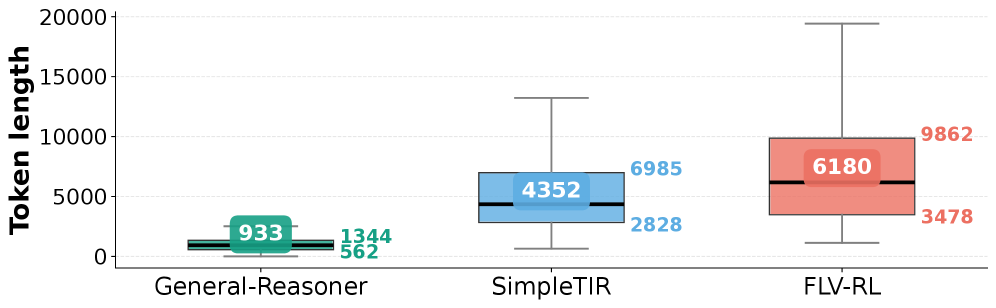
The image is a comparative box plot visualizing the distribution of token lengths generated by three language models: **General-Reasoner**, **SimpleTIR**, and **FLV-RL**. The y-axis represents token length (0–20,000), while the x-axis categorizes the models. Each box plot includes a median line, quartile boundaries, and whiskers extending to minimum/maximum values. Numerical annotations highlight key statistics.
---
### Components/Axes
- **Y-Axis**: "Token length" (linear scale, 0–20,000).
- **X-Axis**: Three categories:
- **General-Reasoner** (green box)
- **SimpleTIR** (blue box)
- **FLV-RL** (red box)
- **Legend**: Implicit color coding (no explicit legend box). Colors correspond to model names.
- **Annotations**:
- **Median values** (bold black lines within boxes):
- General-Reasoner: **933**
- SimpleTIR: **4,352**
- FLV-RL: **6,180**
- **Maximum values** (above whiskers):
- General-Reasoner: **1,344**
- SimpleTIR: **6,985**
- FLV-RL: **9,862**
- **Minimum values** (below whiskers):
- General-Reasoner: **562**
- SimpleTIR: **2,828**
- FLV-RL: **3,478**
---
### Detailed Analysis
1. **General-Reasoner** (Green):
- Narrowest distribution (IQR: ~382 tokens).
- Median token length is the lowest (**933**), with a maximum of **1,344** and minimum of **562**.
- Symmetrical distribution with no extreme outliers.
2. **SimpleTIR** (Blue):
- Wider distribution (IQR: ~4,127 tokens).
- Median (**4,352**) is ~4.7x higher than General-Reasoner.
- Maximum (**6,985**) and minimum (**2,828**) suggest variability in output complexity.
3. **FLV-RL** (Red):
- Broadest distribution (IQR: ~5,382 tokens).
- Highest median (**6,180**), ~6.6x higher than General-Reasoner.
- Extreme maximum (**9,862**) and moderate minimum (**3,478**), indicating potential for outlier token lengths.
---
### Key Observations
- **Token Length Trends**:
- FLV-RL consistently generates longer token sequences than the other models.
- SimpleTIR shows intermediate complexity, with token lengths ~4.7x higher than General-Reasoner.
- **Outliers**:
- FLV-RL’s maximum (**9,862**) is 7.3x its minimum (**1,344** for General-Reasoner), suggesting potential inefficiencies or task-specific variability.
- **Distribution Shape**:
- General-Reasoner’s box is tightly clustered, while FLV-RL’s box is elongated, reflecting greater variability in output length.
---
### Interpretation
The data suggests that **FLV-RL** prioritizes longer, potentially more detailed responses compared to **General-Reasoner** and **SimpleTIR**. The significant difference in median token lengths (933 vs. 6,180) may indicate architectural differences (e.g., FLV-RL’s reliance on chain-of-thought reasoning) or task-specific optimizations. The high maximum token length for FLV-RL raises questions about computational efficiency or the need for post-processing to trim excessive outputs.
The **General-Reasoner**’s compact distribution implies a focus on concise, precise outputs, which could be advantageous for latency-sensitive applications. However, its lower median token length might limit its ability to handle complex reasoning tasks requiring extended context.
The **SimpleTIR** model balances token length and variability, suggesting a middle-ground approach between brevity and depth. Its wider IQR highlights potential inconsistencies in output quality or task adaptability.
---
### Spatial Grounding & Color Verification
- **General-Reasoner** (green): Leftmost box, median **933**, max **1,344**, min **562**.
- **SimpleTIR** (blue): Center box, median **4,352**, max **6,985**, min **2,828**.
- **FLV-RL** (red): Rightmost box, median **6,180**, max **9,862**, min **3,478**.
All colors align with model labels, confirming accurate legend association.
---
### Final Notes
This visualization underscores trade-offs between token efficiency and response depth across models. FLV-RL’s performance may suit tasks requiring detailed explanations, while General-Reasoner excels in brevity. Further analysis of task-specific metrics (e.g., accuracy, latency) would clarify practical implications.