## Bar Chart: Comparison of Overall Accuracy between SaGe and RandTrain
### Overview
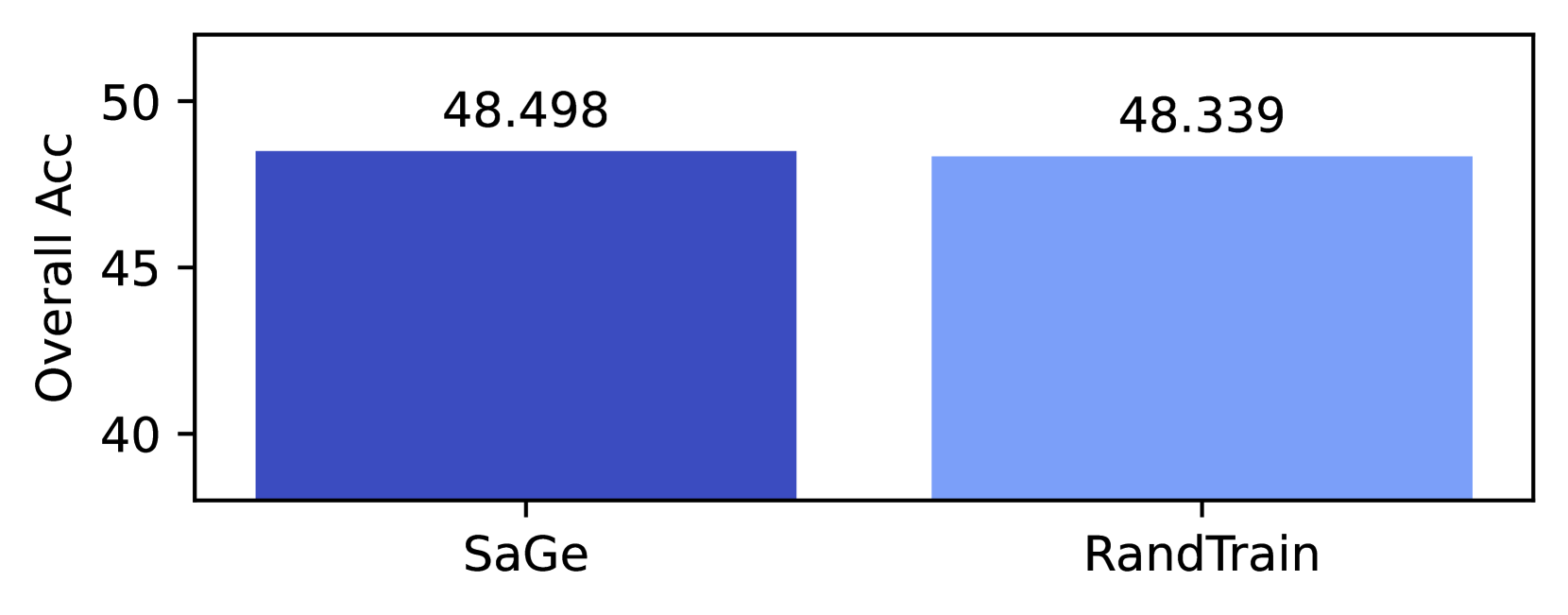
The image is a bar chart comparing the **Overall Accuracy (Overall Acc)** of two methods: **SaGe** and **RandTrain**. The y-axis represents accuracy values ranging from 40 to 50, while the x-axis lists the two methods. The chart uses two distinct colors for the bars: dark blue for SaGe and light blue for RandTrain.
---
### Components/Axes
- **Y-Axis**: Labeled "Overall Acc" with a scale from 40 to 50 in increments of 5.
- **X-Axis**: Categories labeled "SaGe" (left) and "RandTrain" (right).
- **Legend**: Positioned on the right side of the chart, associating:
- **Dark Blue** with **SaGe**
- **Light Blue** with **RandTrain**
- **Values**: Numerical annotations above each bar:
- **SaGe**: 48.498
- **RandTrain**: 48.339
---
### Detailed Analysis
- **SaGe Bar**:
- Color: Dark Blue
- Height: Reaches approximately 48.498 on the y-axis.
- Position: Leftmost bar, centered above the "SaGe" label.
- **RandTrain Bar**:
- Color: Light Blue
- Height: Reaches approximately 48.339 on the y-axis.
- Position: Rightmost bar, centered above the "RandTrain" label.
- **Spacing**: A small gap separates the two bars for clarity.
---
### Key Observations
1. **Slight Difference in Accuracy**: SaGe achieves marginally higher accuracy (48.498) compared to RandTrain (48.339), a difference of **0.159**.
2. **Visual Similarity**: Both bars are nearly identical in height, indicating comparable performance.
3. **Precision**: Values are provided to three decimal places, suggesting high granularity in measurement.
---
### Interpretation
The chart demonstrates that **SaGe outperforms RandTrain** in Overall Accuracy, albeit by a small margin. This suggests that while both methods are highly effective, SaGe may have a slight edge in this specific metric. The near-identical values imply that the choice between the two methods might depend on other factors (e.g., computational efficiency, scalability) not shown here. The use of distinct colors and precise numerical labels ensures clarity in distinguishing the two methods.