## Diagram: Flow Diagram with Labeled Nodes
### Overview
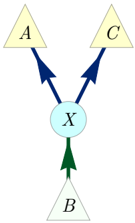
This image depicts a directed flow diagram illustrating relationships between three triangular nodes labeled A, C, and B, and a circular node labeled X. Arrows indicate the direction of influence or flow.
### Components/Axes
* **Nodes:**
* A: Represented by a light yellow triangle.
* B: Represented by a light grey triangle.
* C: Represented by a light yellow triangle.
* X: Represented by a light blue circle.
* **Arrows:**
* A dark blue arrow originates from node X and points towards node A.
* A dark blue arrow originates from node X and points towards node C.
* A dark green arrow originates from node B and points towards node X.
### Detailed Analysis or Content Details
The diagram shows a unidirectional flow:
1. An input from node B flows into node X, indicated by a dark green arrow pointing upwards from B to X.
2. Node X then appears to distribute or influence two separate outputs, one to node A and another to node C. These are indicated by dark blue arrows pointing upwards from X to A and from X to C, respectively.
### Key Observations
* Node B is an input source to node X.
* Node X acts as an intermediary or a branching point, receiving input from B and distributing influence to A and C.
* Nodes A and C are distinct outputs or recipients of influence from X.
* The colors of the arrows (dark green and dark blue) might signify different types of flow or influence, although no legend is provided.
### Interpretation
This diagram represents a simple causal or dependency relationship. Node B is a precursor or input that affects node X. Node X, in turn, has a dual effect or output, influencing both node A and node C. This could represent a system where a single input (B) triggers an intermediate process (X), which then leads to two distinct outcomes (A and C). Without further context, the specific nature of the "flow" (e.g., data, energy, control signals) is not defined, but the directional relationships are clear. The use of different arrow colors suggests a potential distinction between the input flow from B to X and the output flows from X to A and C, possibly indicating different mechanisms or types of interaction.