## Diagram: Triangular Node Network with Central Hub
### Overview
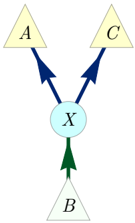
The diagram depicts a network of three triangular nodes (A, C, B) connected to a central circular node (X). Arrows indicate directional relationships: two blue arrows point from A and C to X, and one green arrow points from X to B. No numerical data, scales, or legends are present.
### Components/Axes
- **Nodes**:
- **A**: Top-left triangle (yellow fill).
- **C**: Top-right triangle (yellow fill).
- **B**: Bottom triangle (light green fill).
- **X**: Central circle (light blue fill).
- **Arrows**:
- **Blue arrows**: Connect A→X and C→X.
- **Green arrow**: Connects X→B.
- **No axis titles, legends, or numerical markers** are visible.
### Detailed Analysis
- **Textual Labels**:
- All nodes are labeled with uppercase letters (A, C, B, X).
- No additional text, annotations, or legends are present.
- **Spatial Relationships**:
- A and C are positioned symmetrically above X.
- B is directly below X, aligned vertically.
- Arrows are straight and unambiguous in direction.
### Key Observations
1. **Directional Flow**:
- Inputs from A and C converge at X.
- Output from X is directed to B.
2. **Color Coding**:
- Blue arrows (A→X, C→X) may imply a shared process or relationship.
- Green arrow (X→B) suggests a distinct or prioritized pathway.
3. **Symmetry**:
- A and C are equidistant from X, suggesting equal influence or input.
### Interpretation
The diagram likely represents a system where:
- **X acts as a central processor or hub**, receiving inputs from A and C and transmitting output to B.
- The **color differentiation** (blue vs. green arrows) could indicate:
- **Blue**: Standard or primary relationships (A and C → X).
- **Green**: A specialized or secondary relationship (X → B).
- **Symmetry** between A and C implies they play equivalent roles in the network.
**Notable Patterns**:
- No feedback loops or bidirectional relationships are depicted.
- The absence of numerical data limits quantitative analysis; the focus is on structural relationships.
**Underlying Implications**:
- This could model a decision-making process, data flow in a system, or hierarchical organization.
- The green arrow’s uniqueness (X→B) might highlight B as a critical output or endpoint.