## Stacked Bar Chart: Comparison of Search Methods Across Credibility Assessment Categories
### Overview
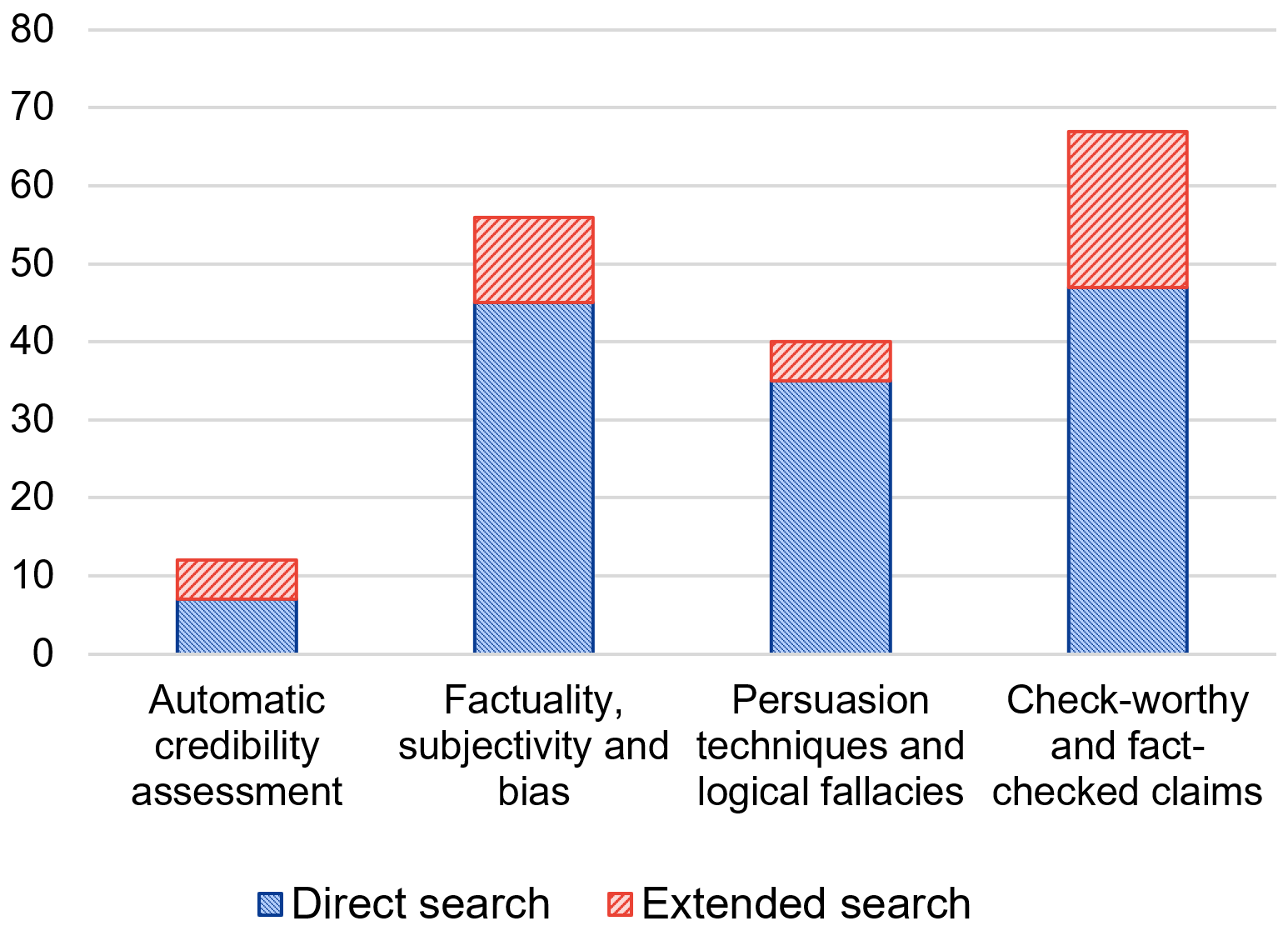
This image displays a stacked bar chart comparing the performance or frequency of two search methods—"Direct search" and "Extended search"—across four distinct categories related to information credibility and fact-checking. The chart quantifies a metric (likely a count, score, or percentage, though the unit is not specified) on the y-axis for each category on the x-axis.
### Components/Axes
* **Chart Type:** Stacked Bar Chart.
* **X-Axis (Categories):** Four categorical labels are present:
1. `Automatic credibility assessment`
2. `Factuality, subjectivity and bias`
3. `Persuasion techniques and logical fallacies`
4. `Check-worthy and fact-checked claims`
* **Y-Axis (Scale):** A linear numerical scale ranging from 0 to 80, with major gridlines at intervals of 10 (0, 10, 20, 30, 40, 50, 60, 70, 80). The axis title is not visible in the image.
* **Legend:** Located at the bottom center of the chart.
* **Direct search:** Represented by a blue bar with a diagonal hatch pattern (lines sloping down from left to right).
* **Extended search:** Represented by a red bar with a diagonal hatch pattern (lines sloping up from left to right).
### Detailed Analysis
The chart presents four stacked bars. Each bar's total height represents the combined value for "Direct search" (bottom segment) and "Extended search" (top segment).
1. **Category: Automatic credibility assessment**
* **Visual Trend:** This is the shortest bar overall. The "Direct search" segment is slightly taller than the "Extended search" segment.
* **Direct search (Blue):** Approximately 7 units.
* **Extended search (Red):** Approximately 5 units.
* **Total Height:** Approximately 12 units.
2. **Category: Factuality, subjectivity and bias**
* **Visual Trend:** This is the second-tallest bar. The "Direct search" segment constitutes the vast majority of the total height.
* **Direct search (Blue):** Approximately 45 units.
* **Extended search (Red):** Approximately 11 units.
* **Total Height:** Approximately 56 units.
3. **Category: Persuasion techniques and logical fallacies**
* **Visual Trend:** This bar is shorter than the second and fourth bars. The "Direct search" segment is significantly larger than the "Extended search" segment.
* **Direct search (Blue):** Approximately 35 units.
* **Extended search (Red):** Approximately 5 units.
* **Total Height:** Approximately 40 units.
4. **Category: Check-worthy and fact-checked claims**
* **Visual Trend:** This is the tallest bar. The "Direct search" segment is the largest single segment in the chart, and the "Extended search" segment is also the largest among all red segments.
* **Direct search (Blue):** Approximately 47 units.
* **Extended search (Red):** Approximately 20 units.
* **Total Height:** Approximately 67 units.
### Key Observations
* **Dominance of Direct Search:** In all four categories, the "Direct search" (blue) component is larger than the "Extended search" (red) component.
* **Highest Overall Value:** The category "Check-worthy and fact-checked claims" has the highest combined total (~67), indicating it is the most prominent or frequently addressed area in this dataset.
* **Largest Extended Search Contribution:** The "Extended search" method contributes the most in absolute terms to the "Check-worthy and fact-checked claims" category (~20 units).
* **Smallest Category:** "Automatic credibility assessment" has the lowest combined total (~12), suggesting it is the least represented category in this context.
* **Proportional Variation:** The proportion of "Extended search" varies. It is a relatively small part of "Persuasion techniques and logical fallacies" but constitutes a more significant portion (roughly 30%) of the "Check-worthy and fact-checked claims" bar.
### Interpretation
The data suggests a comparative analysis of two information retrieval or analysis strategies ("Direct" vs. "Extended" search) applied to different sub-tasks within the broader domain of credibility assessment and fact-checking.
* **Task Complexity & Search Strategy:** The significant increase in the "Extended search" component for "Check-worthy and fact-checked claims" implies that this specific task may benefit more from, or require, a more extensive or iterative search process compared to tasks like assessing automatic credibility or identifying persuasion techniques.
* **Resource Allocation:** If the y-axis represents effort, time, or computational cost, the chart indicates that "Direct search" is the primary resource consumer across all tasks, but "Extended search" becomes a non-trivial factor for complex claim verification.
* **Domain Focus:** The high total value for "Check-worthy and fact-checked claims" could indicate that this is a central focus area for the system or study being visualized, receiving more attention or generating more output than the other categories.
* **Potential Gap:** The low value for "Automatic credibility assessment" might point to a methodological gap, a less developed tool, or simply that this category was less frequently encountered in the analyzed data.
**Note on Uncertainty:** All numerical values are visual estimates derived from the bar heights relative to the y-axis gridlines. The exact values cannot be determined without the source data or explicit data labels on the bars.