## Bar Chart: Comparison of Direct and Extended Search Effectiveness Across Information Verification Categories
### Overview
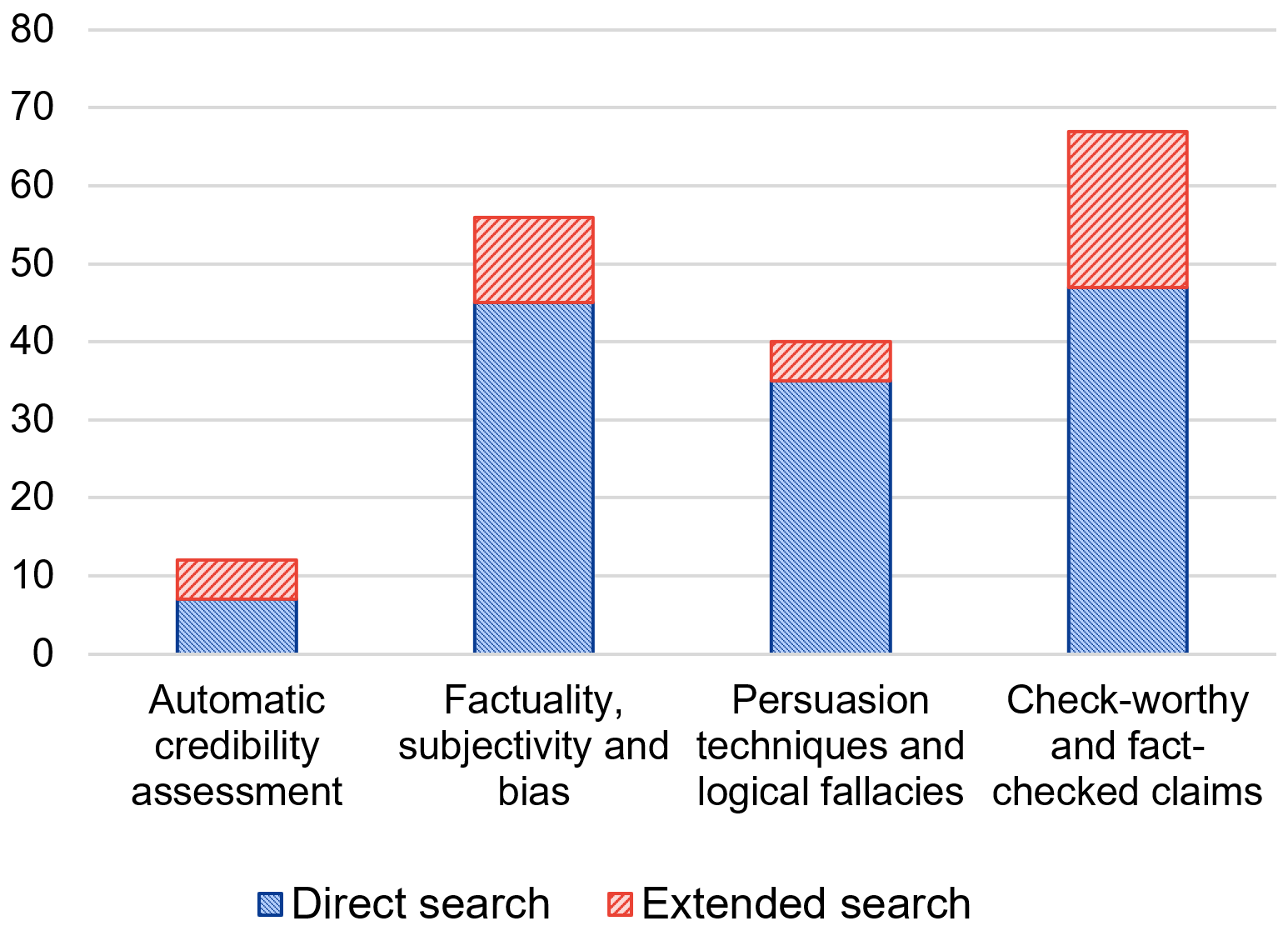
The chart compares the effectiveness of two search methods (Direct and Extended) across four information verification categories. Bars are grouped by category, with Direct search represented by blue diagonal hatching and Extended search by red diagonal hatching. The y-axis ranges from 0 to 80, likely representing a percentage or score metric.
### Components/Axes
- **X-axis (Categories)**:
1. Automatic credibility assessment
2. Factuality, subjectivity and bias
3. Persuasion techniques and logical fallacies
4. Check-worthy and fact-checked claims
- **Y-axis (Scale)**: 0 to 80 in increments of 10
- **Legend**:
- Blue diagonal hatch: Direct search
- Red diagonal hatch: Extended search
- **Legend Position**: Bottom center of the chart
### Detailed Analysis
1. **Automatic credibility assessment**:
- Direct search: ~7 (±2)
- Extended search: ~4 (±1)
2. **Factuality, subjectivity and bias**:
- Direct search: ~45 (±3)
- Extended search: ~10 (±2)
3. **Persuasion techniques and logical fallacies**:
- Direct search: ~35 (±4)
- Extended search: ~5 (±1)
4. **Check-worthy and fact-checked claims**:
- Direct search: ~47 (±3)
- Extended search: ~20 (±3)
### Key Observations
- Direct search consistently outperforms Extended search across all categories
- Check-worthy and fact-checked claims show the highest absolute values for both methods
- Extended search demonstrates its strongest performance in the "Check-worthy" category
- Persuasion techniques category shows the largest gap between methods (~30 difference)
- All Direct search values exceed Extended search values by at least 2-3x
### Interpretation
The data suggests Direct search methods are significantly more effective across all information verification tasks compared to Extended search. The most notable exception is the "Check-worthy and fact-checked claims" category, where Extended search achieves ~43% of Direct search's effectiveness (20 vs 47). This implies Extended search may have specialized value in verifying established claims but remains less effective in assessing credibility, detecting bias, or identifying logical fallacies. The consistent pattern across categories indicates fundamental limitations in Extended search's ability to handle subjective or persuasive content compared to Direct search approaches.