\n
## Image Analysis: Digit '1' Processing Stages
### Overview
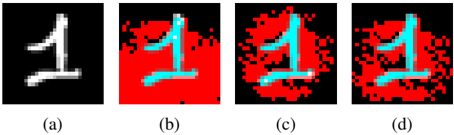
The image presents a sequence of four sub-images (labeled a, b, c, and d) depicting the processing stages of a digit '1'. The initial image (a) shows a white '1' on a black background. Subsequent images (b, c, and d) show the digit '1' rendered in a cyan/turquoise color against a red background, with varying degrees of pixelation and noise. This suggests a process of segmentation or feature extraction.
### Components/Axes
There are no explicit axes or legends. The images are labeled with letters (a, b, c, d) indicating a sequential order. The color scheme is consistent across images b, c, and d: red for the background and cyan/turquoise for the digit '1'.
### Detailed Analysis or Content Details
* **(a):** A clear, white digit '1' is displayed on a black background. The digit is slightly angled.
* **(b):** The digit '1' is now rendered in cyan/turquoise against a red background. The digit appears pixelated, with a noticeable amount of red noise surrounding the cyan/turquoise shape. The shape closely resembles the original '1' but is less smooth.
* **(c):** Similar to (b), the digit '1' is cyan/turquoise on a red background. The pixelation and noise levels appear slightly reduced compared to (b), resulting in a slightly cleaner representation of the digit.
* **(d):** Again, the digit '1' is cyan/turquoise on a red background. The pixelation and noise levels are comparable to (b), with a similar level of detail and surrounding red noise.
There is no numerical data present in the image. The information is purely visual.
### Key Observations
The progression from (a) to (b), (c), and (d) suggests a process of binary thresholding or segmentation. The initial image (a) is likely an input, and the subsequent images represent the result of applying a threshold to isolate the digit '1'. The red color likely represents the background pixels, while the cyan/turquoise color represents the identified digit pixels. The noise (red pixels surrounding the digit) indicates imperfections in the segmentation process.
### Interpretation
The image likely illustrates a step in a character recognition or image processing pipeline. The process appears to be converting a grayscale or color image of a digit into a binary representation, where the digit is represented by one color (cyan/turquoise) and the background by another (red). The presence of noise suggests that the segmentation algorithm is not perfect and may require further refinement. The sequence demonstrates a common challenge in image processing: accurately isolating the desired object (the digit '1') from the background and dealing with imperfections in the input data. The images could be used to demonstrate the effectiveness of different segmentation algorithms or the impact of noise on image processing results. The consistent color scheme across b, c, and d suggests that these images represent different iterations or results of the same segmentation process, potentially with different parameter settings or noise reduction techniques applied.