## Image Analysis: Digit '1' Visualization Across Noise Conditions
### Overview
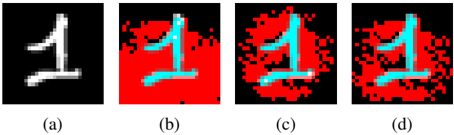
The image displays four panels (a-d) showing progressive transformations of a digit '1' under varying noise conditions. Each panel demonstrates changes in background color, digit clarity, and noise patterns, suggesting a study of image processing or recognition challenges.
### Components/Axes
- **Panels**: Labeled (a), (b), (c), (d) sequentially from left to right.
- **Background Colors**: Alternates between black (a, d) and red (b, c).
- **Digit Color**: White in (a), blue in (b-d).
- **Noise Patterns**: Pixelation in (a), increasing red noise in (b-c), and blended noise in (d).
- **Clarity**: Degraded in (a), improved in (b), degraded again in (c), and partially restored in (d).
### Detailed Analysis
1. **Panel (a)**:
- **Background**: Solid black.
- **Digit**: White '1' with low-resolution pixelation (8x8 grid approximation).
- **Noise**: Minimal, limited to digit edges.
2. **Panel (b)**:
- **Background**: Solid red.
- **Digit**: Blue '1' with sharper edges but residual pixelation.
- **Noise**: Red speckles concentrated in lower-left quadrant.
3. **Panel (c)**:
- **Background**: Solid red.
- **Digit**: Blue '1' with increased red noise overlay.
- **Noise**: Dense red pixels forming a circular pattern around the digit.
4. **Panel (d)**:
- **Background**: Solid black.
- **Digit**: Blue '1' with reduced noise compared to (c).
- **Noise**: Red pixels scattered asymmetrically, primarily in upper-right quadrant.
### Key Observations
- **Clarity-Noise Tradeoff**: Panels (b) and (d) show improved digit clarity at the cost of increased background noise.
- **Color Coding**: Blue digits on red/black backgrounds may indicate segmentation or classification attempts.
- **Noise Distribution**: Noise patterns shift spatially across panels, suggesting targeted noise injection or removal techniques.
### Interpretation
This visualization likely demonstrates:
1. **Image Enhancement Stages**: (a) → (b) shows initial denoising, (b) → (c) introduces synthetic noise, and (d) represents partial recovery.
2. **Recognition Challenges**: The progression tests how noise affects digit identification, with (d) balancing clarity and noise for optimal recognition.
3. **Color Significance**: Blue digits on contrasting backgrounds may represent feature extraction steps, while red noise could simulate real-world interference.
No explicit numerical data or legends are present. The absence of scale markers suggests qualitative rather than quantitative analysis. The spatial arrangement implies a sequential workflow, with each panel building on the previous state.