\n
## Diagram: Complex Plane with Points and Lines
### Overview
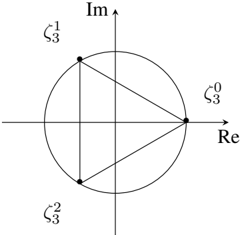
The image depicts a diagram in the complex plane. A unit circle is centered at the origin. Three points, labeled ζ₀³, ζ¹³, and ζ²³, are positioned on the circumference of the circle. These points are connected by straight lines, forming a triangle inscribed within the circle. The axes are labeled "Re" (Real) and "Im" (Imaginary).
### Components/Axes
* **Axes:**
* Horizontal axis: Labeled "Re" (Real).
* Vertical axis: Labeled "Im" (Imaginary).
* **Circle:** A unit circle centered at the origin (0,0).
* **Points:** Three points are marked on the circle:
* ζ₀³ (zeta sub 0 cubed) - Located on the positive Real axis, approximately at (1, 0).
* ζ¹³ (zeta sub 1 cubed) - Located on the positive Imaginary axis, approximately at (0, 1).
* ζ²³ (zeta sub 2 cubed) - Located on the negative Real axis, approximately at (-1, 0).
* **Lines:** Three lines connect the points, forming a triangle.
### Detailed Analysis
The points are equally spaced around the unit circle, suggesting they represent the cube roots of unity.
* **ζ₀³:** Positioned at approximately (1, 0).
* **ζ¹³:** Positioned at approximately (0, 1).
* **ζ²³:** Positioned at approximately (-1, 0).
The lines connecting these points form an equilateral triangle. The angle between each point, as viewed from the origin, is 120 degrees (360 degrees / 3).
### Key Observations
* The points are evenly distributed around the unit circle.
* The lines form an equilateral triangle.
* The diagram visually represents the cube roots of unity.
### Interpretation
This diagram illustrates the geometric representation of the cube roots of unity in the complex plane. The cube roots of unity are the solutions to the equation z³ = 1. These solutions are 1, ω, and ω², where ω = e^(2πi/3) is a complex number. The points ζ₀³, ζ¹³, and ζ²³ represent these roots. The equilateral triangle formed by connecting these points demonstrates the symmetry inherent in the solutions to this equation. The diagram is a visual aid for understanding the relationship between complex numbers, roots of unity, and geometric representation. The diagram does not contain any numerical data beyond the implicit values of the coordinates of the points on the unit circle.