## Diagram: Complex Plane Representation of Cube Roots of Unity
### Overview
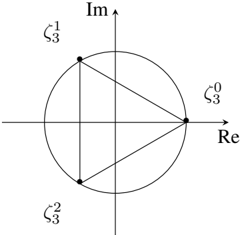
The image is a mathematical diagram illustrating the three cube roots of unity plotted on the complex plane. It features a circle centered at the origin, with an equilateral triangle inscribed within it, connecting the three roots. The diagram is a standard geometric representation used in complex analysis and algebra.
### Components/Axes
* **Coordinate System:** A standard 2D Cartesian coordinate system is used.
* **Horizontal Axis:** Labeled **"Re"** at the right end, representing the Real axis.
* **Vertical Axis:** Labeled **"Im"** at the top end, representing the Imaginary axis.
* The axes intersect at the origin (0,0).
* **Geometric Shapes:**
* **Circle:** A circle is drawn, centered at the origin. Its radius is not explicitly labeled, but based on the context of roots of unity, it is implied to be the unit circle (radius = 1).
* **Triangle:** An equilateral triangle is inscribed within the circle. Its vertices are the three plotted points.
* **Data Points & Labels:** Three distinct points are plotted on the circle, each labeled with a mathematical symbol. The labels are in Greek (ζ, "zeta") with subscripts and superscripts.
* **Point 1 (ζ₃⁰):** Located on the positive Real axis (right side of the circle). This corresponds to the complex number 1 + 0i.
* **Point 2 (ζ₃¹):** Located in the upper-left quadrant of the circle. This corresponds to the complex number -1/2 + (√3/2)i.
* **Point 3 (ζ₃²):** Located in the lower-left quadrant of the circle. This corresponds to the complex number -1/2 - (√3/2)i.
### Detailed Analysis
* **Spatial Grounding & Trend Verification:**
* The three points are spaced equally around the circle, each separated by an angle of 120 degrees (2π/3 radians). This is visually confirmed by the equilateral triangle connecting them.
* **ζ₃⁰** is positioned at 0 degrees (or 0 radians) on the unit circle.
* **ζ₃¹** is positioned at approximately 120 degrees (2π/3 radians) counter-clockwise from the positive Real axis.
* **ζ₃²** is positioned at approximately 240 degrees (4π/3 radians) counter-clockwise from the positive Real axis.
* **Component Isolation:**
* **Header/Labels:** The axis labels ("Re", "Im") and the point labels (ζ₃⁰, ζ₃¹, ζ₃²) are the primary textual elements.
* **Main Diagram:** The circle and triangle form the core visual representation of the relationship between the roots.
* **Footer:** There is no footer or additional annotation in this image.
### Key Observations
1. **Symmetry:** The diagram exhibits perfect threefold rotational symmetry about the origin. Rotating the image by 120 degrees would map each point onto the next.
2. **Equilateral Triangle:** The triangle connecting the roots is equilateral, a direct visual consequence of the roots being equally spaced on the circle.
3. **Roots of Unity:** The labels ζ₃⁰, ζ₃¹, and ζ₃² are standard notation for the *n*th roots of unity, where *n*=3. The superscript indicates the power to which the primitive root is raised (ζ₃ᵏ = e^(2πi k/3)).
4. **No Numerical Axes:** The diagram is purely geometric and conceptual. It does not contain numerical tick marks or scales on the axes, relying instead on the implied unit circle.
### Interpretation
This diagram is a fundamental visualization in complex mathematics. It demonstrates that the solutions to the equation z³ = 1 are not just the real number 1, but also two complex numbers. These three numbers (1, -1/2 + i√3/2, -1/2 - i√3/2) are the vertices of an equilateral triangle inscribed in the unit circle.
The **Peircean investigative** reading reveals:
* **Iconic Sign:** The diagram is an icon of the algebraic concept. The circle represents the set of all complex numbers with magnitude 1. The triangle's symmetry iconically represents the equal "spacing" of the roots in the complex plane.
* **Indexical Sign:** The labels (ζ₃⁰, etc.) are indices pointing to specific, well-defined mathematical objects. Their placement on the diagram indexes their geometric position (angle and magnitude).
* **Symbolic Sign:** The entire diagram is a symbol for the group of cube roots of unity under multiplication. It symbolizes concepts like cyclic groups, symmetry, and the geometric interpretation of complex multiplication (which corresponds to rotation).
The diagram matters because it transforms an abstract algebraic idea into an intuitive geometric one. It shows that finding roots of a polynomial can be understood as finding points on a circle, a powerful unifying idea in mathematics. The absence of numerical scales emphasizes that the key information is the *relative* positions and symmetry, not absolute coordinates (though they are implied).