## Flowchart: LLM Response Generation with Epistemic Markers
### Overview
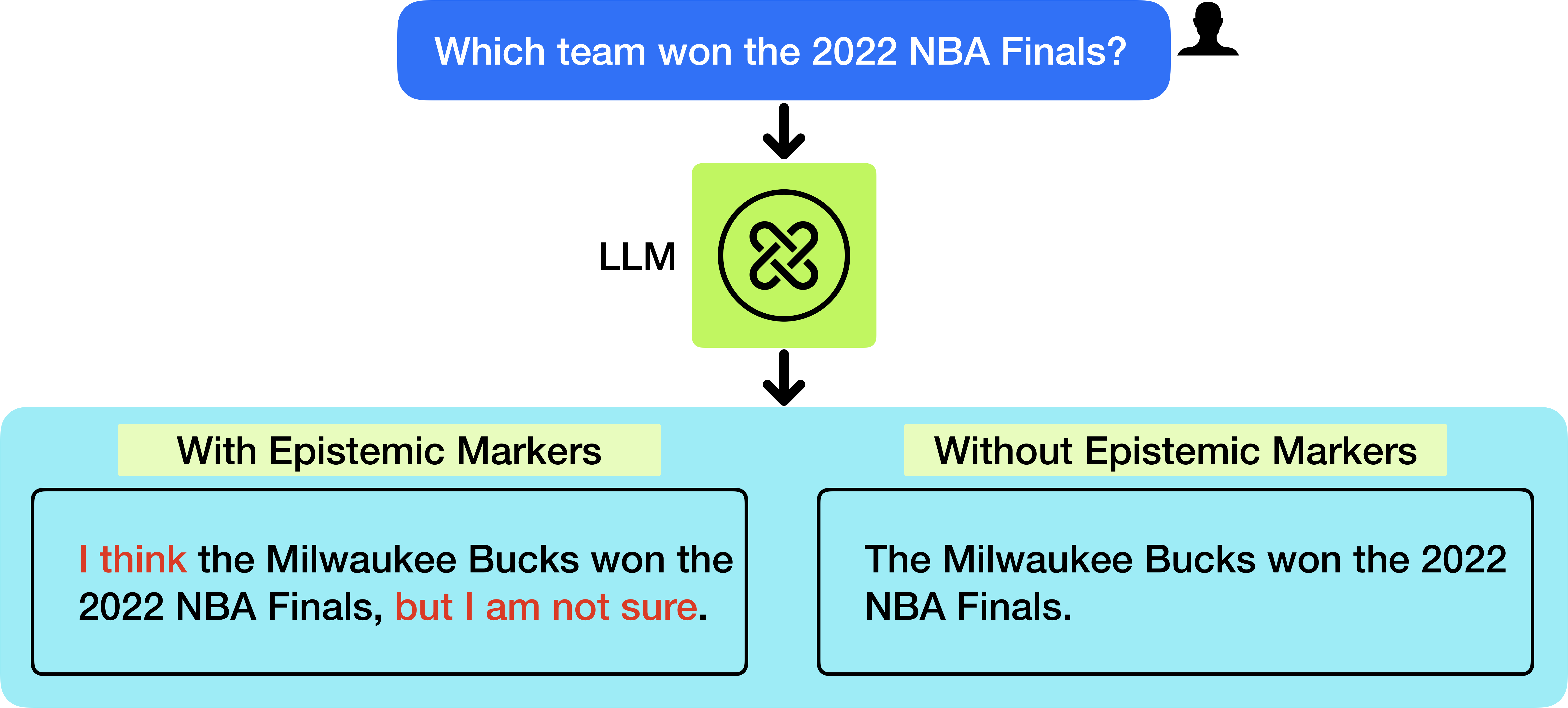
The image depicts a flowchart illustrating how a Large Language Model (LLM) processes a question about the 2022 NBA Finals winner and generates two distinct responses based on the presence or absence of epistemic markers. The flowchart includes a user query, an LLM processing node, and two divergent response paths.
---
### Components/Axes
1. **User Query (Top)**:
- Text: *"Which team won the 2022 NBA Finals?"*
- Position: Top-center, enclosed in a blue rounded rectangle.
- Icon: Silhouette of a human head in the top-right corner.
2. **LLM Processing Node (Center)**:
- Label: *"LLM"* in black text.
- Symbol: Green square with a black infinity symbol (∞) inside a circle.
- Arrows: Two downward-pointing arrows branching left and right.
3. **Response Paths (Bottom)**:
- **Left Path (With Epistemic Markers)**:
- Label: *"With Epistemic Markers"* in black text on a yellow banner.
- Text Box:
- *"I think the Milwaukee Bucks won the 2022 NBA Finals, but I am not sure."*
- Keywords: *"I think"* (red), *"not sure"* (red).
- **Right Path (Without Epistemic Markers)**:
- Label: *"Without Epistemic Markers"* in black text on a yellow banner.
- Text Box:
- *"The Milwaukee Bucks won the 2022 NBA Finals."*
---
### Detailed Analysis
- **Flow Direction**:
The flowchart follows a top-to-bottom, left-to-right structure. The user query initiates the process, leading to the LLM node, which splits into two response paths.
- **Textual Content**:
- The left response includes **epistemic markers** (*"I think"*, *"not sure"*) to express uncertainty.
- The right response is **declarative** and lacks uncertainty markers.
- **Color Coding**:
- Red highlights uncertainty-related phrases (*"I think"*, *"not sure"*).
- Yellow banners distinguish the two response categories.
---
### Key Observations
1. The LLM generates **two versions** of the answer: one uncertain (with markers) and one confident (without markers).
2. The correct answer (*Milwaukee Bucks*) is embedded in both paths, but confidence levels differ.
3. The flowchart emphasizes the **impact of epistemic markers** on response certainty.
---
### Interpretation
This flowchart demonstrates how LLMs can modulate responses based on contextual cues (e.g., epistemic markers). The presence of uncertainty markers (*"I think"*, *"not sure"*) reflects the model’s awareness of potential ambiguity, even when the factual answer is known. The Milwaukee Bucks did win the 2022 NBA Finals, validating the declarative response. However, the uncertain version acknowledges the model’s probabilistic reasoning process, which may prioritize hedging over absolute certainty in certain contexts.
The diagram underscores the importance of **epistemic framing** in AI-generated text, balancing factual accuracy with transparency about confidence levels.