## Line Chart: Test Accuracy vs. Number of Symbols
### Overview
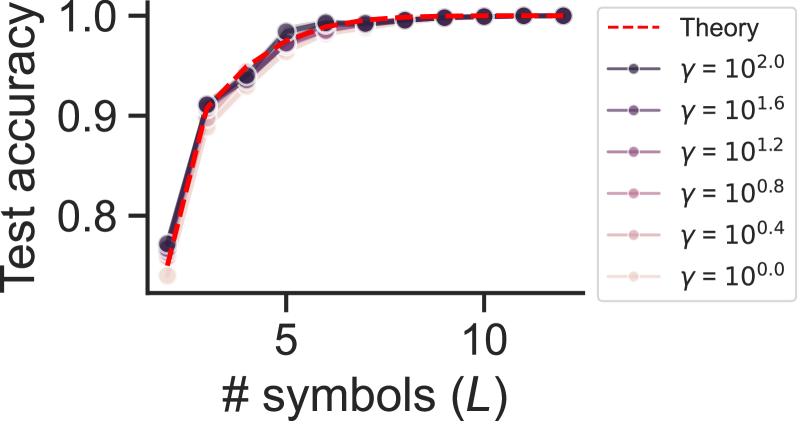
The image is a line chart showing the relationship between test accuracy and the number of symbols used, for different values of gamma (γ). It includes a theoretical curve and several experimental curves for varying gamma values.
### Components/Axes
* **X-axis:** "# symbols (L)". The axis ranges from approximately 1 to 11, with tick marks at 5 and 10.
* **Y-axis:** "Test accuracy". The axis ranges from 0.8 to 1.0, with tick marks at 0.8, 0.9, and 1.0.
* **Legend:** Located in the top-right corner. It identifies the different lines on the chart:
* Red dashed line: "Theory"
* Dark purple line: "γ = 10<sup>2.0</sup>"
* Medium purple line: "γ = 10<sup>1.6</sup>"
* Light purple line: "γ = 10<sup>1.2</sup>"
* Pink line: "γ = 10<sup>0.8</sup>"
* Light pink line: "γ = 10<sup>0.4</sup>"
* Very light pink line: "γ = 10<sup>0.0</sup>"
### Detailed Analysis
* **Theory (Red dashed line):** The theoretical accuracy starts at approximately 0.77 at 1 symbol, rises sharply to approximately 0.92 at 3 symbols, and then gradually approaches 1.0, reaching approximately 0.99 at 7 symbols and remaining near 1.0 thereafter.
* **γ = 10<sup>2.0</sup> (Dark purple line):** This line closely follows the "Theory" line. It starts at approximately 0.77 at 1 symbol, rises sharply to approximately 0.92 at 3 symbols, and then gradually approaches 1.0, reaching approximately 0.99 at 7 symbols and remaining near 1.0 thereafter.
* **γ = 10<sup>1.6</sup> (Medium purple line):** This line also closely follows the "Theory" line and the "γ = 10<sup>2.0</sup>" line. It starts at approximately 0.76 at 1 symbol, rises sharply to approximately 0.92 at 3 symbols, and then gradually approaches 1.0, reaching approximately 0.99 at 7 symbols and remaining near 1.0 thereafter.
* **γ = 10<sup>1.2</sup> (Light purple line):** This line starts at approximately 0.75 at 1 symbol, rises sharply to approximately 0.92 at 3 symbols, and then gradually approaches 1.0, reaching approximately 0.99 at 7 symbols and remaining near 1.0 thereafter.
* **γ = 10<sup>0.8</sup> (Pink line):** This line starts at approximately 0.74 at 1 symbol, rises sharply to approximately 0.91 at 3 symbols, and then gradually approaches 1.0, reaching approximately 0.99 at 7 symbols and remaining near 1.0 thereafter.
* **γ = 10<sup>0.4</sup> (Light pink line):** This line starts at approximately 0.73 at 1 symbol, rises sharply to approximately 0.90 at 3 symbols, and then gradually approaches 1.0, reaching approximately 0.99 at 7 symbols and remaining near 1.0 thereafter.
* **γ = 10<sup>0.0</sup> (Very light pink line):** This line starts at approximately 0.72 at 1 symbol, rises sharply to approximately 0.89 at 3 symbols, and then gradually approaches 1.0, reaching approximately 0.99 at 7 symbols and remaining near 1.0 thereafter.
### Key Observations
* All lines, including the theoretical one, show a similar trend: a rapid increase in test accuracy as the number of symbols increases from 1 to approximately 7, followed by a plateau near 1.0.
* The different values of gamma (γ) have a relatively small impact on the test accuracy, especially as the number of symbols increases. Lower values of gamma result in slightly lower accuracy, especially at lower numbers of symbols.
* The experimental results closely match the theoretical prediction, especially for higher values of gamma.
### Interpretation
The chart demonstrates that increasing the number of symbols significantly improves test accuracy, but the improvement diminishes after a certain point (around 7 symbols). The value of gamma (γ) has a minor influence on the test accuracy, with higher values of gamma leading to slightly better performance, particularly when the number of symbols is low. The close match between the theoretical curve and the experimental results suggests that the theoretical model accurately predicts the relationship between test accuracy, the number of symbols, and the value of gamma. The data suggests that for this particular system, increasing the number of symbols beyond a certain point provides little additional benefit in terms of test accuracy.