## Bar Chart: Refusal Ratio by Training Set and Hallucination Type
### Overview
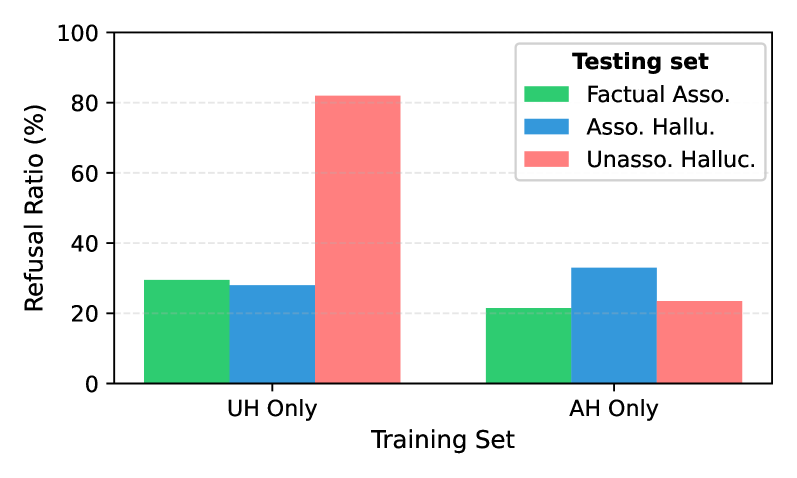
The chart compares refusal ratios (%) across three hallucination types (Factual Association, Associative Hallucination, Unassociated Hallucination) for two training sets (UH Only and AH Only). Refusal ratios are measured on a 0-100% scale.
### Components/Axes
- **X-axis (Training Set)**: Two categories: "UH Only" (left) and "AH Only" (right).
- **Y-axis (Refusal Ratio)**: Labeled "%", with gridlines at 0, 20, 40, 60, 80, 100.
- **Legend**: Located in the top-right corner, mapping colors to categories:
- Green: Factual Association
- Blue: Associative Hallucination
- Red: Unassociated Hallucination
### Detailed Analysis
#### UH Only Training Set
- **Factual Association (Green)**: ~30% refusal ratio.
- **Associative Hallucination (Blue)**: ~28% refusal ratio.
- **Unassociated Hallucination (Red)**: ~80% refusal ratio (tallest bar).
#### AH Only Training Set
- **Factual Association (Green)**: ~20% refusal ratio.
- **Associative Hallucination (Blue)**: ~32% refusal ratio (tallest in AH Only).
- **Unassociated Hallucination (Red)**: ~22% refusal ratio.
### Key Observations
1. **UH Only Dominance**: Unassociated Hallucination refusal ratio is significantly higher (~80%) compared to other categories.
2. **AH Only Shift**: Associative Hallucination becomes the dominant refusal category (~32%), while Factual Association drops to ~20%.
3. **Consistency**: Factual Association refusal ratios decrease by ~10% from UH to AH training.
4. **Anomaly**: Unassociated Hallucination refusal ratio collapses from ~80% (UH) to ~22% (AH), a ~58% drop.
### Interpretation
The data suggests that:
- **UH-Only Training** prioritizes rejecting **Unassociated Hallucinations** (80% refusal), likely due to stricter constraints on unrelated outputs.
- **AH-Only Training** shifts focus to **Associative Hallucinations** (32% refusal), indicating a trade-off where the model becomes more cautious about contextually related but incorrect outputs.
- The drastic drop in Unassociated Hallucination refusal under AH-Only training implies reduced robustness against irrelevant outputs when trained exclusively on associative data.
- Factual Association refusal ratios decrease across both training sets, suggesting a general trend of reduced caution toward factually grounded outputs regardless of training focus.
This pattern highlights how training set composition directly influences model behavior, with UH-Only favoring strict rejection of irrelevant outputs and AH-Only prioritizing context-aware corrections.