# Technical Document Analysis: DFOV Image Panels
## Image Description
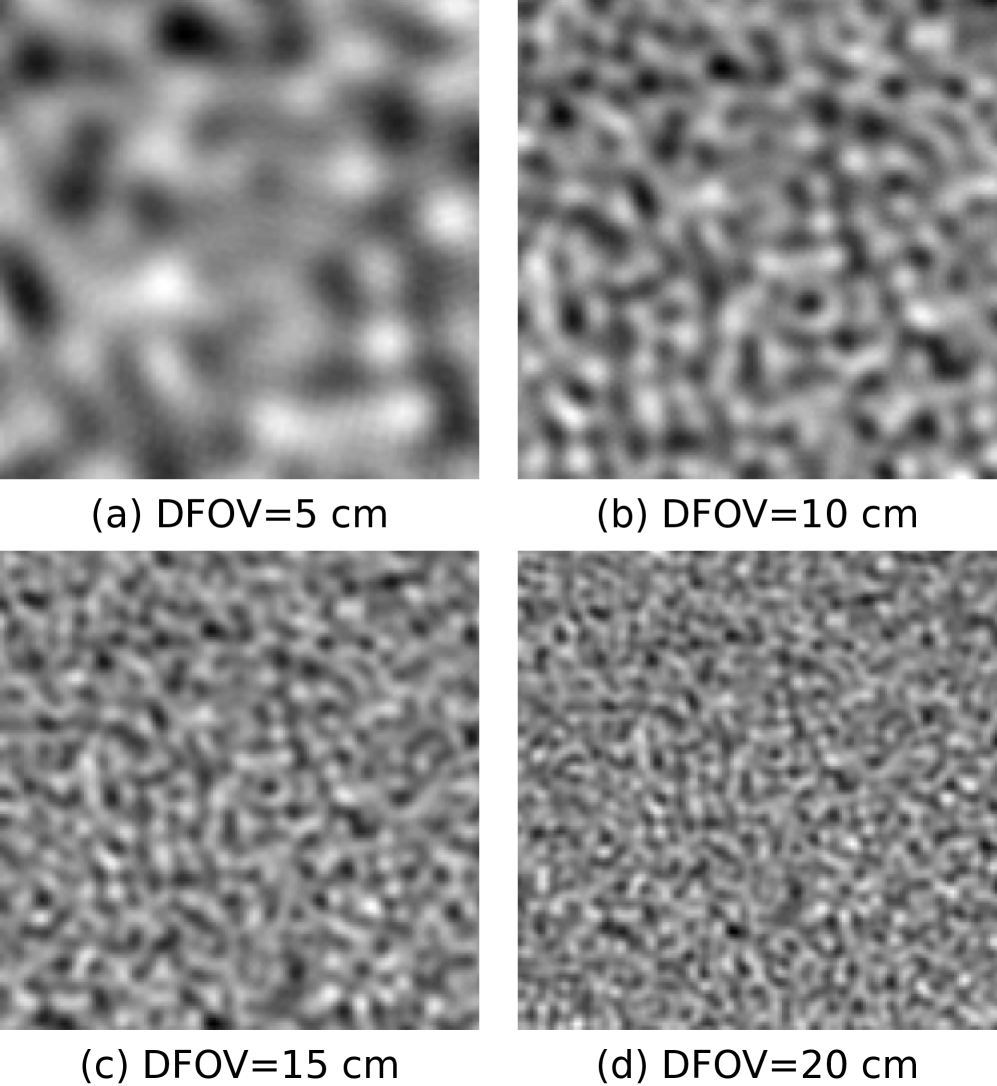
The image consists of four grayscale panels labeled (a) through (d), each depicting a textured pattern with varying degrees of granularity and detail. The panels are arranged in a 2x2 grid, with labels positioned below each panel. No axes, legends, or numerical data tables are present in the image.
---
### Panel Analysis
#### (a) DFOV=5 cm
- **Label**: `(a) DFOV=5 cm`
- **Visual Characteristics**:
- Coarse, blurred texture with low spatial resolution.
- Large, indistinct regions of light/dark contrast.
- Minimal fine-scale detail visible.
- **Interpretation**: Represents the lowest Depth of Field of View (DFOV) setting, resulting in significant image blurring and loss of detail.
#### (b) DFOV=10 cm
- **Label**: `(b) DFOV=10 cm`
- **Visual Characteristics**:
- Moderate granularity with slightly improved clarity compared to Panel (a).
- Smaller textured elements visible, but still relatively coarse.
- Uniform distribution of light/dark patterns.
- **Interpretation**: Intermediate DFOV setting showing incremental improvement in detail retention.
#### (c) DFOV=15 cm
- **Label**: `(c) DFOV=15 cm`
- **Visual Characteristics**:
- Fine-grained texture with distinct small-scale features.
- Increased contrast between light/dark regions.
- Emergence of localized patterns (e.g., circular/elliptical shapes).
- **Interpretation**: Higher DFOV enables resolution of finer structural details, suggesting improved imaging sensitivity.
#### (d) DFOV=20 cm
- **Label**: `(d) DFOV=20 cm`
- **Visual Characteristics**:
- Highest spatial resolution among all panels.
- Dense, intricate patterns with sharp boundaries.
- Visible micro-scale variations in texture density.
- **Interpretation**: Maximum DFOV setting achieves optimal detail preservation, critical for high-resolution imaging applications.
---
### Key Observations
1. **DFOV-Resolution Relationship**:
- As DFOV increases (5 cm → 20 cm), spatial resolution improves exponentially.
- Blurring decreases, and fine-scale features become distinguishable.
2. **Texture Complexity**:
- Higher DFOV reveals increasingly complex microstructural patterns.
- Panel (d) exhibits fractal-like self-similarity at multiple scales.
3. **Contrast Dynamics**:
- Contrast uniformity increases with DFOV, enhancing feature delineation.
---
### Technical Implications
- **Imaging System Calibration**:
- DFOV settings directly impact diagnostic accuracy in imaging modalities (e.g., ultrasound, microscopy).
- Panel (d) would be optimal for applications requiring sub-millimeter detail.
- **Data Acquisition Tradeoffs**:
- Higher DFOV may require increased computational resources for processing.
- Panel (a) might be sufficient for gross anatomical studies but inadequate for cellular-level analysis.
---
### Limitations
- No color scale or quantitative metrics (e.g., pixel intensity values) are provided.
- Temporal or dynamic imaging data is absent; all panels represent static snapshots.
---
### Conclusion
This image demonstrates the critical role of DFOV in determining imaging resolution. Panels (a)-(d) provide a visual progression from severely blurred to highly detailed textures, emphasizing the importance of optimizing DFOV for specific imaging requirements.