## Diagram: DASHENG Audio Processing System Architecture
### Overview
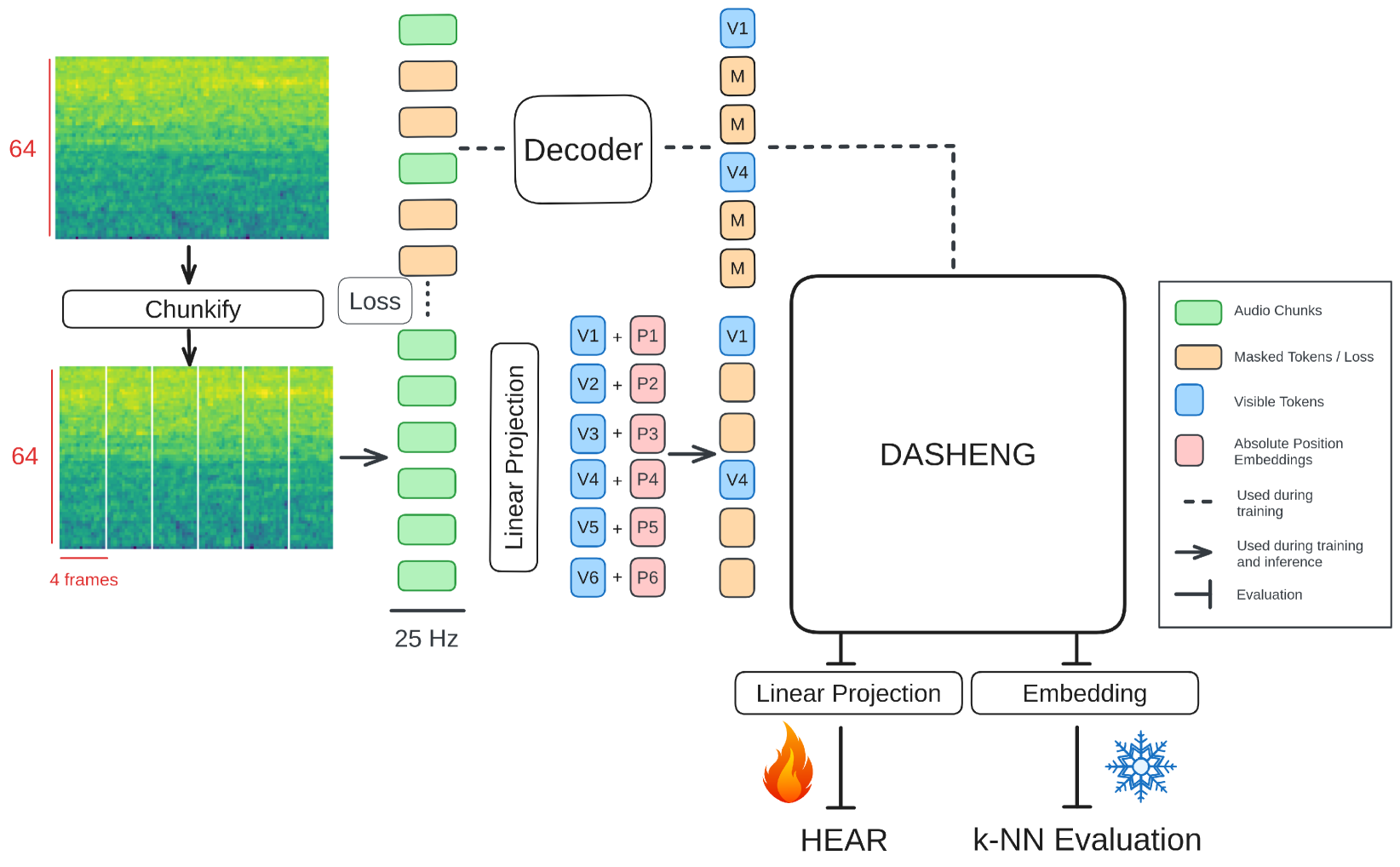
The diagram illustrates a multi-stage audio processing pipeline for a system called DASHENG. It shows the flow from raw audio data through feature extraction, model processing, and evaluation. Key components include audio chunking, linear projections, decoder architecture, and evaluation methods (HEAR and k-NN).
### Components/Axes
1. **Legend** (right side):
- Green: Audio Chunks
- Orange: Masked Tokens / Loss
- Blue: Visible Tokens
- Pink: Absolute Position Embeddings
- Dashed lines: Used during training
- Solid arrows: Used during training and inference
- Arrow with line: Evaluation
2. **Left Panel**:
- Top: 64-frame audio chunk heatmap (green/yellow gradient)
- Middle: Chunkification process (reduces to 4 frames)
- Bottom: 25 Hz frequency marker
3. **Center**:
- Decoder block with dashed connections
- Linear projection layer (V1-V6 + P1-P6 combinations)
- Masked tokens (M) with loss indicators
4. **Right Panel**:
- DASHENG processing block
- Linear Projection (fire symbol)
- Embedding (snowflake symbol)
- HEAR and k-NN evaluation paths
### Detailed Analysis
1. **Audio Processing**:
- Raw audio represented as 64-frame heatmap (likely spectrogram)
- Chunkification reduces temporal resolution to 4 frames
- 25 Hz frequency marker indicates low-frequency focus
2. **Model Architecture**:
- Decoder processes visible tokens (V1-V6) with positional embeddings (P1-P6)
- Masked tokens (M) introduce uncertainty for training
- Linear projection combines visible tokens with positional info
3. **Evaluation Methods**:
- HEAR: Real-time processing path (fire symbol)
- k-NN: Embedding-based evaluation (snowflake symbol)
- DASHENG integrates both approaches
### Key Observations
1. Temporal resolution reduction from 64 to 4 frames suggests compression
2. Positional embeddings (P1-P6) maintain temporal context
3. Masked tokens (M) indicate transformer-like architecture
4. Dual evaluation paths suggest both online and offline capabilities
5. 25 Hz marker implies bass-heavy audio focus
### Interpretation
This architecture demonstrates a hybrid approach to audio processing:
1. **Training Phase**: Uses masked tokens and positional embeddings to learn temporal patterns
2. **Inference Phase**: Employs linear projections for real-time HEAR evaluation
3. **Robustness**: k-NN embedding evaluation provides alternative assessment
4. **Efficiency**: Chunkification balances detail preservation with computational load
The system appears optimized for low-frequency audio analysis with both streaming and batch processing capabilities. The combination of masked token training and embedding-based evaluation suggests applications in speech recognition or environmental sound classification where temporal context and feature robustness are critical.