## Diagram: Directional Arrows on Grid
### Overview
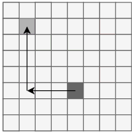
The image depicts a 5x5 grid with two colored squares and directional arrows. The grid is composed of 25 equal-sized cells. Two squares are highlighted: one light gray square with an upward-pointing arrow and one darker gray square with a leftward-pointing arrow. All other cells are unmarked.
### Components/Axes
- **Grid Structure**:
- 5 rows (top to bottom) and 5 columns (left to right).
- Cells are uniformly sized and unlabeled.
- **Squares**:
- **Light Gray Square**: Located at grid position (1,5) (top row, rightmost column). Contains a black upward-pointing arrow.
- **Darker Gray Square**: Located at grid position (3,3) (middle row, middle column). Contains a black leftward-pointing arrow.
- **Arrows**:
- Both arrows are black, bold, and centered within their respective squares.
- No additional labels, text, or legends are present.
### Detailed Analysis
- **Positioning**:
- The light gray square with the upward arrow is spatially isolated in the top-right corner.
- The darker gray square with the leftward arrow is centered in the grid.
- **Color Coding**:
- Light gray and darker gray squares differentiate the two directional elements.
- Arrows are consistently black, ensuring visual clarity against the grid background.
- **Absence of Text**:
- No textual labels, axis titles, legends, or annotations are visible in the image.
### Key Observations
1. The arrows point in opposite directions (upward vs. leftward), suggesting conflicting or independent directional priorities.
2. The squares are positioned asymmetrically: one in the corner, the other in the center.
3. No numerical or categorical data is present; the diagram appears purely directional.
### Interpretation
This diagram likely represents a simplified directional system or workflow. The upward arrow in the top-right square could symbolize a "start" or "primary direction," while the leftward arrow in the center might indicate a secondary or corrective path. The lack of textual context or numerical data limits quantitative analysis, but the spatial arrangement implies a hierarchical or sequential relationship between the two directions. The use of distinct colors for the squares may emphasize their functional differences. No outliers or anomalies are present, as the image focuses on static positional relationships rather than dynamic trends.