## Diagram: Cloud Environment Workflow
### Overview
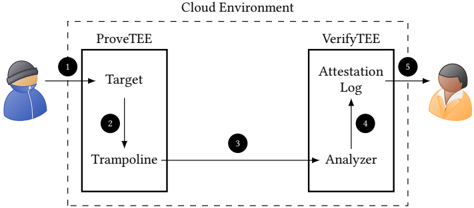
The diagram illustrates a secure data verification workflow within a cloud environment, involving two primary components: **ProveTEE** and **VerifyTEE**. It depicts interactions between users, data processing stages, and secure communication channels.
### Components/Axes
- **ProveTEE**: A box labeled "ProveTEE" on the left side of the diagram.
- **Target**: A sub-component within ProveTEE, connected to a "Trampoline" via a downward arrow (labeled "2").
- **VerifyTEE**: A box labeled "VerifyTEE" on the right side of the diagram.
- **Attestation Log**: A sub-component within VerifyTEE, connected to an "Analyzer" via an upward arrow (labeled "4").
- **Trampoline**: A horizontal line connecting ProveTEE and VerifyTEE, labeled "3".
- **Analyzer**: A component bridging ProveTEE and VerifyTEE, positioned between the "Trampoline" and "Attestation Log."
- **Users**:
- A figure in a blue hoodie (left) labeled "1" (input to ProveTEE).
- A figure in a yellow jacket (right) labeled "5" (output from VerifyTEE).
### Detailed Analysis
1. **Step 1**: A user (blue hoodie) initiates the process by sending data to the "Target" component within ProveTEE.
2. **Step 2**: Data flows from "Target" to the "Trampoline" (step 2), which acts as a secure intermediary.
3. **Step 3**: The "Trampoline" transmits data to the "Analyzer" (step 3), which processes or validates the information.
4. **Step 4**: The "Analyzer" forwards data to the "Attestation Log" within VerifyTEE (step 4).
5. **Step 5**: The "Attestation Log" completes the workflow, with results delivered to a second user (yellow jacket, step 5).
### Key Observations
- The workflow is linear, with data moving sequentially from ProveTEE → Trampoline → Analyzer → VerifyTEE.
- The "Trampoline" and "Analyzer" components suggest a focus on secure data transmission and validation.
- No numerical values or trends are present; the diagram emphasizes process flow rather than quantitative data.
### Interpretation
This diagram represents a **secure attestation framework** for cloud-based systems. The "ProveTEE" component likely handles initial data proofing (e.g., cryptographic verification), while "VerifyTEE" focuses on logging and attestation. The "Trampoline" may symbolize a secure communication layer (e.g., enclave-to-enclave messaging), and the "Analyzer" could perform integrity checks or anomaly detection. The two users represent distinct roles: one submitting data for proofing and another receiving verified results. The absence of feedback loops suggests a one-way verification process, prioritizing efficiency and security in data handling.