## Diagram: Tool Calling Methods
### Overview
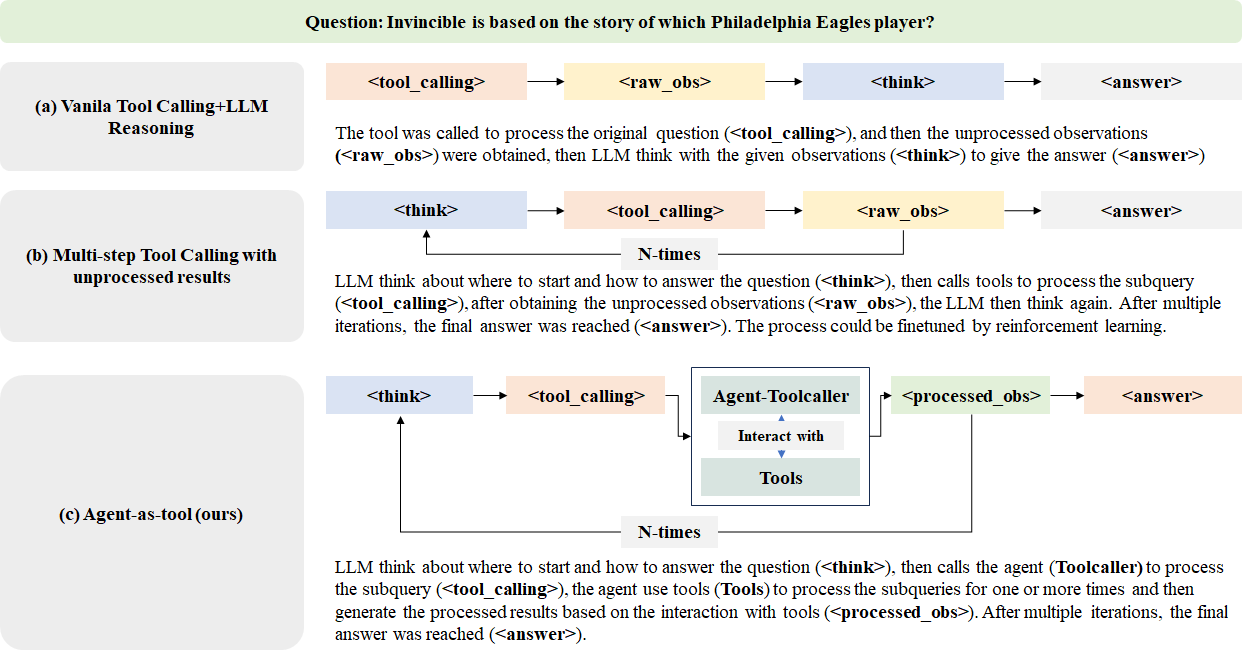
The image presents a diagram comparing three different methods of tool calling within a Language Model (LLM) framework. These methods are: Vanilla Tool Calling + LLM Reasoning, Multi-step Tool Calling with unprocessed results, and Agent-as-tool. The diagram illustrates the flow of information and processes involved in each method, highlighting the interactions between the LLM, tools, and the resulting observations/answers.
### Components/Axes
The diagram uses the following components:
* **Nodes:** Represent different stages or components in the tool calling process. These include:
* `<think>`: Represents the LLM's reasoning or thinking process.
* `<tool_calling>`: Represents the process of calling or using external tools.
* `<raw_obs>`: Represents raw, unprocessed observations obtained from the tools.
* `<processed_obs>`: Represents processed observations obtained from the tools.
* `<answer>`: Represents the final answer generated by the LLM.
* `Agent-Toolcaller`: Represents an agent that manages and interacts with tools.
* `Tools`: Represents the external tools used by the agent.
* **Arrows:** Indicate the flow of information or the sequence of processes.
* **Text Descriptions:** Provide detailed explanations of each method.
* **N-times:** Indicates a loop or iterative process.
### Detailed Analysis
**(a) Vanilla Tool Calling + LLM Reasoning**
* **Flow:** `<think>` -> `<tool_calling>` -> `<raw_obs>` -> `<think>` -> `<answer>`
* **Description:** The LLM thinks, calls a tool, receives raw observations, thinks again using the observations, and then provides an answer.
* **Text:** "The tool was called to process the original question (<tool_calling>), and then the unprocessed observations (<raw_obs>) were obtained, then LLM think with the given observations (<think>) to give the answer (<answer>)."
**(b) Multi-step Tool Calling with unprocessed results**
* **Flow:** `<think>` -> `<tool_calling>` -> `<raw_obs>` -> `<think>` (looping N-times) -> `<answer>`
* **Description:** The LLM thinks, calls a tool, receives raw observations, and then thinks again. This process loops multiple times (N-times) before generating the final answer.
* **Text:** "LLM think about where to start and how to answer the question (<think>), then calls tools to process the subquery (<tool_calling>), after obtaining the unprocessed observations (<raw_obs>), the LLM then think again. After multiple iterations, the final answer was reached (<answer>). The process could be finetuned by reinforcement learning."
**(c) Agent-as-tool (ours)**
* **Flow:** `<think>` -> `<tool_calling>` -> `Agent-Toolcaller` (interacts with `Tools` to produce `<processed_obs>`) -> `<processed_obs>` -> `<answer>`. There is a feedback loop from `<processed_obs>` back to `<think>` labeled "N-times".
* **Description:** The LLM thinks, calls the Agent-Toolcaller, which interacts with tools to process subqueries and generate processed observations. This process loops multiple times (N-times) before generating the final answer.
* **Text:** "LLM think about where to start and how to answer the question (<think>), then calls the agent (Toolcaller) to process the subquery (<tool_calling>), the agent use tools (Tools) to process the subqueries for one or more times and then generate the processed results based on the interaction with tools (<processed_obs>). After multiple iterations, the final answer was reached (<answer>)."
### Key Observations
* The Vanilla Tool Calling method involves a single iteration of tool calling and reasoning.
* The Multi-step Tool Calling method involves multiple iterations of tool calling and reasoning, allowing for refinement of the answer.
* The Agent-as-tool method introduces an agent (Toolcaller) that manages and interacts with tools, providing processed observations to the LLM.
* The Agent-as-tool method includes a feedback loop, allowing the LLM to refine its approach based on the processed observations.
### Interpretation
The diagram illustrates the evolution of tool calling methods in LLMs. The Vanilla approach is a simple, one-step process. The Multi-step approach adds iterative refinement. The Agent-as-tool approach introduces a dedicated agent to manage tool interactions, potentially improving efficiency and accuracy. The Agent-as-tool method, labeled as "ours," suggests that this is the method being proposed or used by the authors. The question at the top of the image "Invincible is based on the story of which Philadelphia Eagles player?" is likely the question being used to test these different tool calling methods.