## Flowchart: Comparative Analysis of LLM Tool-Calling Methods for Question Answering
### Overview
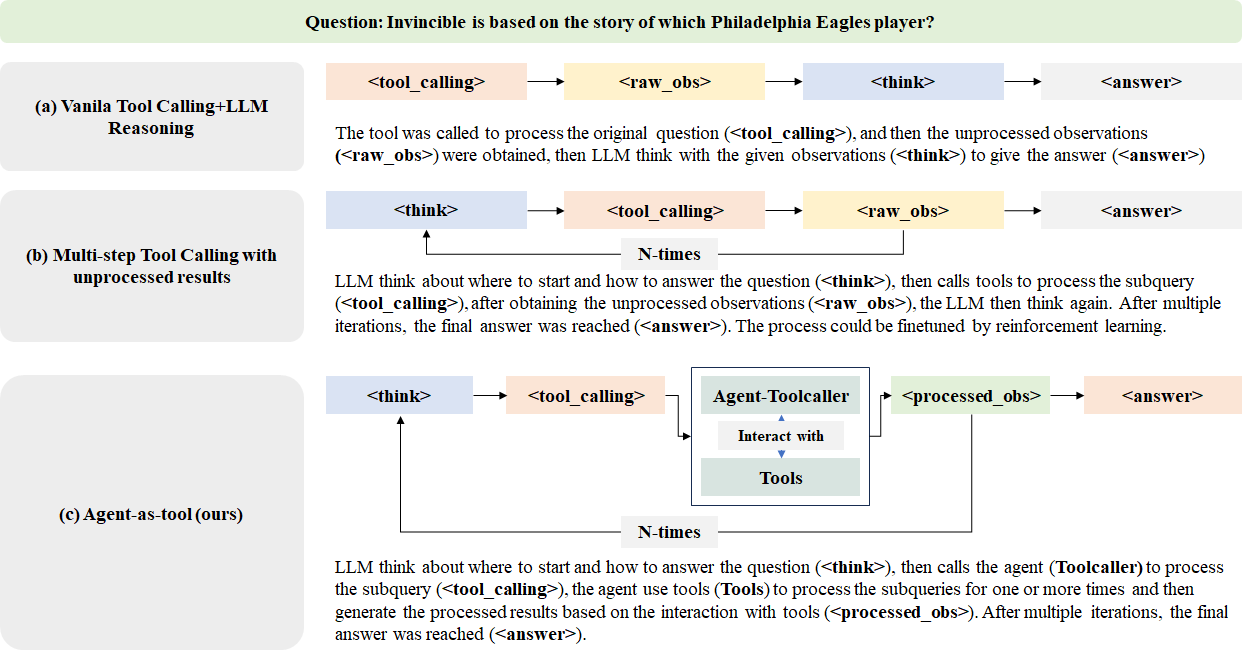
The image presents a comparative analysis of three methods for answering a question using Large Language Models (LLMs) and tool calling. The question posed is: "Invincible is based on the story of which Philadelphia Eagles player?" The diagram illustrates three approaches:
1. **Vanilla Tool Calling+LLM Reasoning**
2. **Multi-step Tool Calling with unprocessed results**
3. **Agent-as-tool (ours)**
Each method is represented as a sequential workflow with color-coded steps, demonstrating differences in processing logic and iteration.
---
### Components/Axes
#### Diagram Structure
- **Three Main Sections**: Labeled (a), (b), and (c), each representing a distinct method.
- **Color-Coded Steps**:
- **Pink**: `<tool_calling>`
- **Yellow**: `<raw_obs>` (raw observations)
- **Blue**: `<reasoning>` (LLM reasoning)
- **Green**: `<final_answer>`
#### Methods
1. **Vanilla Tool Calling+LLM Reasoning**
- Sequential steps: Tool calling → Raw observations → LLM reasoning → Final answer.
2. **Multi-step Tool Calling with Unprocessed Results**
- Iterative steps: Tool calling → Raw observations → Tool calling → Raw observations → LLM reasoning → Final answer.
3. **Agent-as-tool (ours)**
- Integrated steps: Tool calling → Raw observations → LLM reasoning → Tool calling → Raw observations → LLM reasoning → Final answer.
---
### Key Differences
- **Vanilla Tool Calling**: Single iteration of tool calling and reasoning.
- **Multi-step Tool Calling**: Multiple iterations of tool calling without intermediate reasoning.
- **Agent-as-tool**: Combines tool calling and reasoning in an iterative loop for enhanced accuracy.
---
### Conclusion
The flowchart highlights the trade-offs between simplicity, iteration, and integration in LLM-based question-answering systems, with the "Agent-as-tool" method offering a balanced approach for complex queries.