## Line Chart: Proportion of Bitwise Reproducible Packages Over Time
### Overview
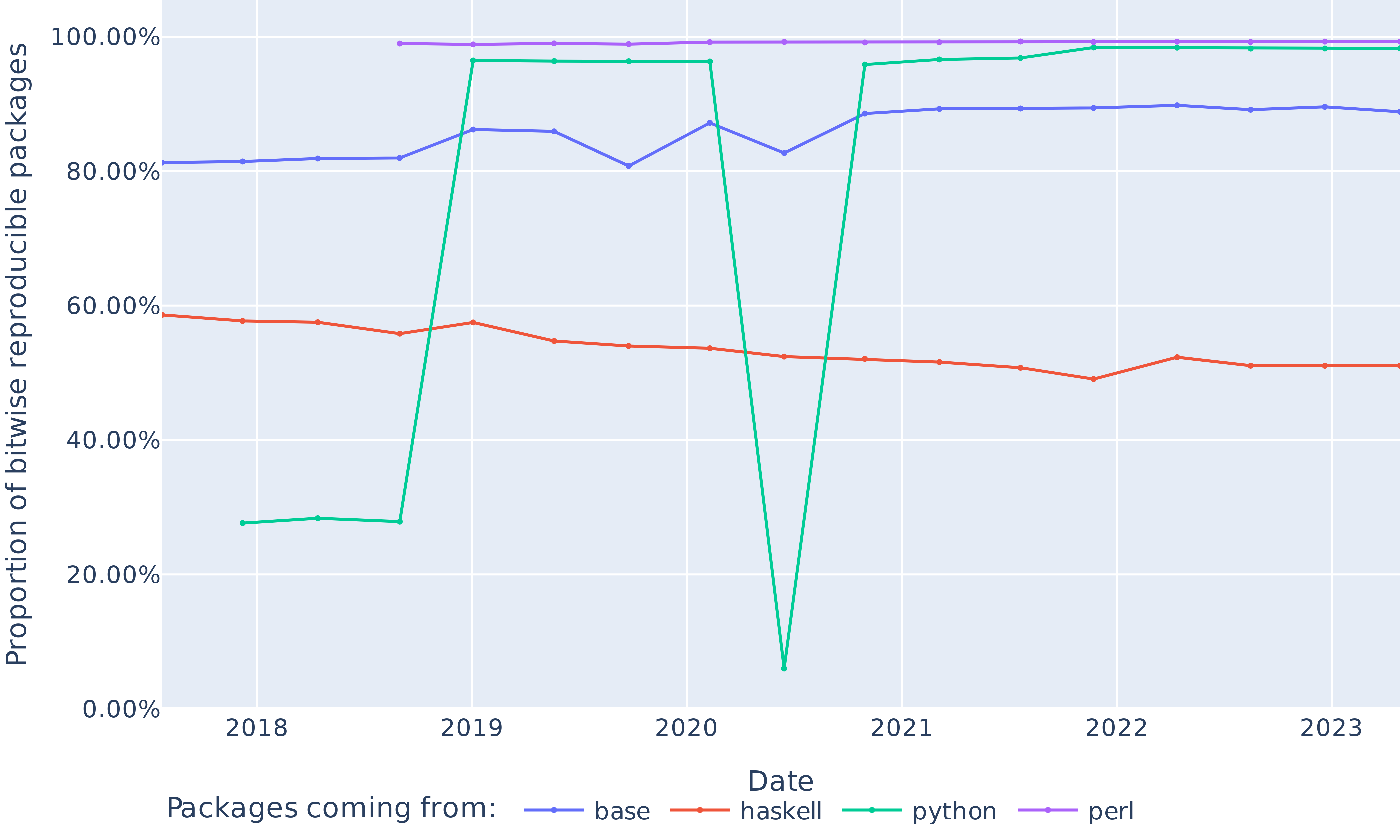
The chart visualizes the temporal evolution of bitwise reproducibility across four programming ecosystems (base, Haskell, Python, Perl) from 2018 to 2023. It highlights dramatic shifts in reproducibility metrics, particularly for Python and Perl, while showing relative stability in base and Haskell ecosystems.
### Components/Axes
- **X-axis (Date)**: Years 2018–2023, with annual intervals.
- **Y-axis (Proportion of bitwise reproducible packages)**: Percentage scale from 0% to 100%.
- **Legend**: Located at the bottom, mapping colors to ecosystems:
- **Blue**: base
- **Red**: Haskell
- **Green**: Python
- **Purple**: Perl
### Detailed Analysis
1. **Perl (Purple Line)**:
- Maintains **100% reproducibility** consistently from 2019 onward.
- Slight dip to ~98% in 2020, recovering to 100% by 2021.
2. **Python (Green Line)**:
- **2018–2019**: Starts at ~28% in 2018, surges to ~95% by 2019.
- **2020**: Sharp anomaly: drops to **~5%** (potential data artifact or methodological change).
- **2021–2023**: Recovers to ~98–100%, stabilizing near Perl's level.
3. **Haskell (Red Line)**:
- Gradual decline from **~60% in 2018** to **~50% in 2023**.
- Minor fluctuations (e.g., ~55% in 2020, ~52% in 2022).
4. **Base (Blue Line)**:
- Stable baseline: ~80% in 2018, rising to **~88–90%** by 2020.
- Peaks at **~92%** in 2022, then stabilizes at ~90% through 2023.
### Key Observations
- **Python's Volatility**: The 2020 collapse and subsequent recovery suggest a potential methodological shift (e.g., versioning changes, measurement criteria).
- **Perl's Consistency**: Unchanged 100% reproducibility implies a highly controlled or standardized ecosystem.
- **Haskell's Decline**: Steady reduction may reflect evolving tooling or reduced emphasis on bitwise reproducibility.
- **Base's Stability**: Acts as a reliable reference point, showing minimal deviation.
### Interpretation
The data underscores divergent priorities in ecosystem maintenance:
- **Perl's rigidity** (100% reproducibility) suggests a focus on backward compatibility.
- **Python's volatility** hints at potential fragmentation or evolving standards post-2020.
- **Haskell's decline** could indicate shifting developer priorities or toolchain maturation.
- **Base's stability** positions it as a pragmatic middle ground, balancing reproducibility with flexibility.
The 2020 Python anomaly warrants investigation—it may reflect a temporary measurement error, a versioning overhaul (e.g., Python 3.x adoption), or a change in reproducibility criteria. The convergence of Python and Perl near 100% by 2023 suggests improved tooling across ecosystems, though Haskell's trajectory raises questions about long-term sustainability.