\n
## Diagram: Application Domains of Probabilistic Computing with p-bits
### Overview
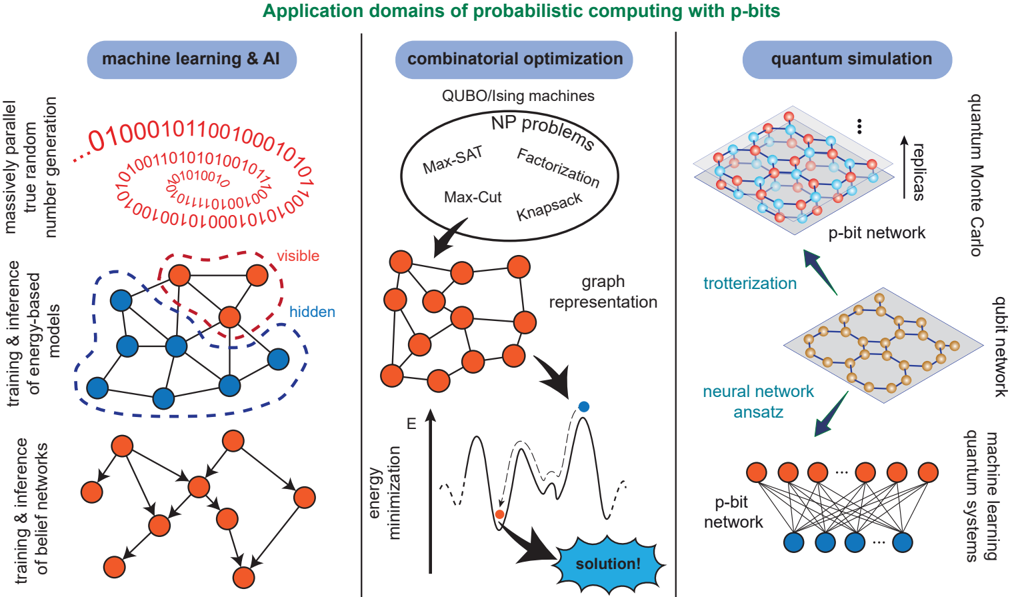
This diagram illustrates the application domains of probabilistic computing using p-bits, categorized into Machine Learning & AI, Combinatorial Optimization, and Quantum Simulation. Each domain is visually represented with a network-like structure and associated concepts. The diagram emphasizes the connection between these domains through the use of "p-bit networks."
### Components/Axes
The diagram is divided into three main columns:
1. **Machine Learning & AI** (leftmost)
2. **Combinatorial Optimization** (center)
3. **Quantum Simulation** (rightmost)
Each column contains interconnected nodes representing concepts within that domain. Key labels include:
* "massively parallel true random number generation"
* "training & inference of energy-based models"
* "training & inference of belief networks"
* "QUBO/ising machines"
* "NP problems"
* "graph representation"
* "trotterization"
* "quantum Monte Carlo"
* "qubit network"
* "neural network ansatz"
* "p-bit network"
* "energy minimization"
* "solution!"
* "replicas"
* "machine learning systems"
* "visible"
* "hidden"
* "Max-SAT"
* "Factorization"
* "Knapsack"
* "Max-Cut"
The diagram also features a binary string: "010001011001000101010100101010010010100010101001010010"
### Detailed Analysis / Content Details
**Machine Learning & AI:**
* The top section shows a circular arrangement of binary digits ("010001011001000101010100101010010010100010101001010010").
* Below this, a network is depicted with nodes labeled "visible" and "hidden," connected by lines. The network appears to be a layered structure.
* The bottom section shows another network structure, likely representing belief networks.
**Combinatorial Optimization:**
* The top section features a circular diagram labeled "QUBO/ising machines" and "NP problems," with examples like "Max-SAT," "Factorization," "Knapsack," and "Max-Cut" listed within.
* A "graph representation" is shown as a network of interconnected nodes.
* Below the graph representation is a plot of "energy minimization" versus "E" (energy). The plot shows a curve with a minimum point labeled "solution!".
**Quantum Simulation:**
* The top section shows a network labeled "replicas" connected to a "p-bit network."
* The middle section shows "trotterization" connecting to a "neural network ansatz."
* The bottom section depicts a network labeled "p-bit network" connected to "machine learning systems."
* A "qubit network" is also shown.
**P-bit Network:**
* A "p-bit network" is a recurring element, appearing in all three domains, suggesting its central role in connecting these areas. It is represented as a network of interconnected nodes.
### Key Observations
* The diagram highlights the interconnectedness of machine learning, combinatorial optimization, and quantum simulation through the use of p-bit networks.
* The "energy minimization" plot in the Combinatorial Optimization section suggests that these problems can be framed as finding the minimum energy state of a system.
* The binary string in the Machine Learning & AI section may represent a random number or a data sample used in the learning process.
* The diagram is conceptual and does not provide specific numerical data. It focuses on illustrating relationships between concepts.
### Interpretation
The diagram suggests that probabilistic computing with p-bits offers a unifying framework for tackling problems in diverse fields like machine learning, optimization, and quantum simulation. The p-bit network acts as a common substrate, allowing for the translation of problems between these domains. The visualization of energy minimization in the combinatorial optimization section implies that these problems can be approached using techniques borrowed from physics, such as finding the ground state of a system. The inclusion of "replicas" in the quantum simulation section hints at the use of replica methods, a technique used to approximate quantum systems. The diagram is a high-level overview and doesn't delve into the specifics of how p-bits are implemented or how these connections are realized in practice. It serves as a conceptual map of the potential applications of this emerging computing paradigm.