## Celestial Diagram: Star Distribution
### Overview
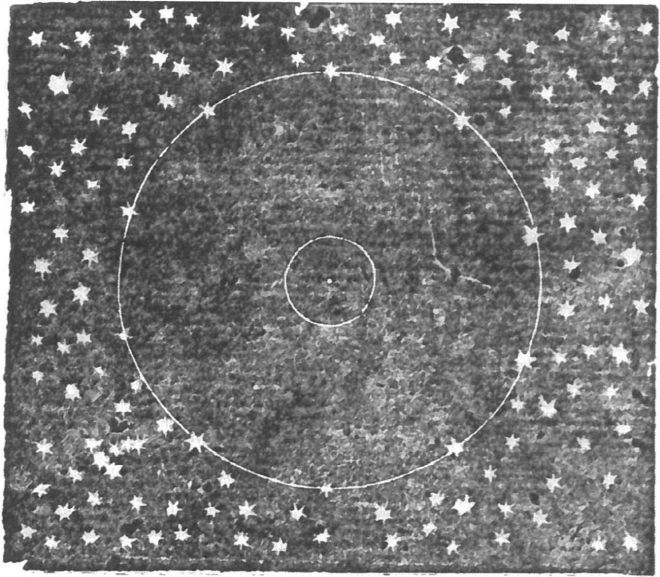
The image is a diagram depicting the distribution of stars around a central point, possibly representing a celestial body. The diagram features two concentric circles and numerous star-shaped figures scattered across a textured background.
### Components/Axes
* **Central Point:** A small dot located at the center of the diagram.
* **Inner Circle:** A small circle centered on the central point.
* **Outer Circle:** A larger circle, also centered on the central point, encompassing a wider area.
* **Stars:** Numerous star-shaped figures of varying sizes are distributed across the background, with some appearing to be aligned along the outer circle.
* **Background:** A textured, dark background that simulates the night sky.
### Detailed Analysis
* The central point is the focal point of the diagram.
* The inner circle has a radius approximately 1/5 the radius of the outer circle.
* The stars are distributed unevenly, with a higher concentration near the outer circle.
* Some stars appear to be positioned directly on the outer circle, suggesting a possible orbital path or boundary.
### Key Observations
* The diagram emphasizes the spatial relationship between the central point, the concentric circles, and the surrounding stars.
* The uneven distribution of stars suggests a non-uniform density of celestial objects in the depicted region.
### Interpretation
The diagram likely represents a simplified model of a star system or a region of space. The central point could represent a star or black hole, while the circles might indicate orbital paths or boundaries of influence. The distribution of stars could reflect the gravitational effects of the central body or other factors influencing the spatial arrangement of celestial objects. The diagram serves to illustrate the concept of spatial distribution and relationships within a celestial context.