## [Photograph/Diagram]: Astronomical Star Field with Concentric Circles
### Overview
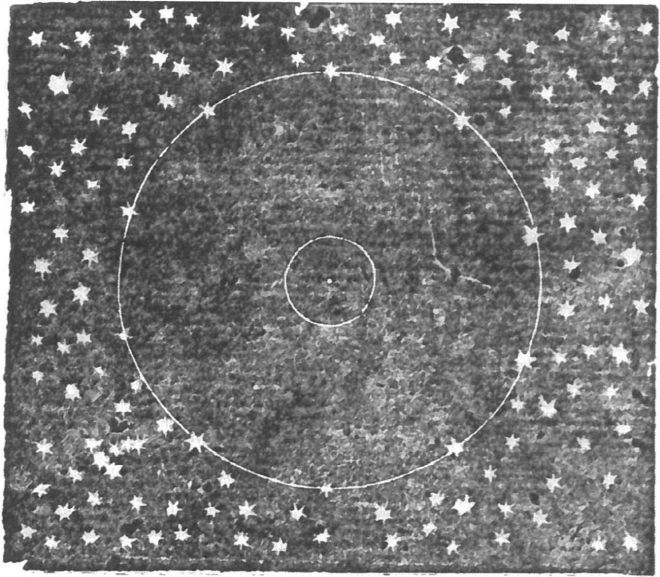
The image is a monochromatic (black and white), grainy photograph or diagram depicting a field of star-like points against a dark, textured background. Two thin, white, concentric circles are overlaid centrally on the field. There is no visible text, labels, axes, legends, or data tables within the image frame. The overall appearance suggests an astronomical observation, possibly a photographic plate with marked orbits or regions of interest.
### Components/Axes
* **Background:** A dark, mottled gray field with a granular texture, consistent with an old photographic plate or a stylized representation of space.
* **Star-like Points:** Numerous white, irregularly shaped points of varying sizes and brightness are scattered across the entire field. They are denser towards the edges of the frame and sparser within the central region defined by the larger circle.
* **Concentric Circles:**
* **Inner Circle:** A small, thin, white circle located at the geometric center of the image. Its diameter is approximately 1/8th of the image width.
* **Outer Circle:** A larger, thin, white circle, concentric with the inner one. Its diameter is approximately 3/5ths of the image width.
* **Central Point:** A single, distinct white dot is located at the exact center, inside the inner circle.
### Detailed Analysis
* **Spatial Distribution of Points:** The white points are not uniformly distributed. There is a clear visual trend where the density of points decreases from the periphery towards the center. The area between the two circles contains fewer points than the area outside the outer circle. The area inside the inner circle is almost devoid of points, except for the central dot.
* **Point Characteristics:** The points vary in apparent size and shape. Some are sharp and star-like, while others are slightly blurred or elongated. This variation could indicate differences in brightness, focus, or motion (e.g., trailing) if this is a long-exposure photograph.
* **Circle Placement:** The circles are perfectly centered and do not align with any specific cluster of points. They appear to be annotations added to the image to demarcate specific radial zones.
### Key Observations
1. **Absence of Text:** The image contains no alphanumeric characters, labels, or annotations.
2. **Radial Density Gradient:** The most notable pattern is the clear decrease in the density of star-like points from the outer edges of the image towards its center.
3. **Central Anomaly:** The region inside the small inner circle is nearly empty, highlighting the solitary central point.
4. **Monochromatic Nature:** The image lacks color information, presenting all data in grayscale intensity.
### Interpretation
* **What the Image Suggests:** This image likely represents an astronomical field, such as a star cluster or a region of the sky, with overlaid circles to illustrate a concept. The radial density gradient could demonstrate the structure of a globular cluster (denser core, sparser halo) or be used to discuss observational bias (e.g., vignetting in a telescope's field of view).
* **Relationship Between Elements:** The concentric circles serve as a reference framework to analyze the spatial distribution of the points. They create distinct zones (inner core, annulus, outer field) for comparison. The central point may represent a target star, the cluster's core, or the optical axis of the instrument.
* **Potential Anomalies/Outliers:** The near-void within the inner circle is a significant visual outlier compared to the rest of the field. The solitary central point is also a unique feature.
* **Underlying Information:** Without accompanying text or data, the image is purely descriptive. It visually communicates a pattern of distribution but does not provide factual data (e.g., star counts, magnitudes, coordinates). Its primary informational content is the **relationship between radial distance from a center point and the density of observed objects**. This could be used to support discussions in astronomy about cluster dynamics, survey completeness, or optical system performance.
**Note on Language:** No text is present in the image. Therefore, no transcription or translation is required.