## Chart: Compute-matched analysis: GPQA-Physics
### Overview
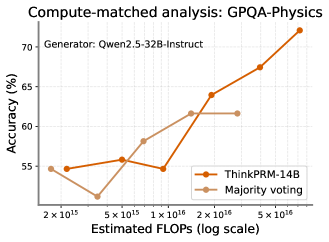
The image is a line chart comparing the accuracy of "ThinkPRM-14B" and "Majority voting" methods against the estimated FLOPS (log scale) for a "GPQA-Physics" task. The chart includes a title, axis labels, a legend, and data points for each method. The generator used is "Qwen2.5-32B-Instruct".
### Components/Axes
* **Title:** Compute-matched analysis: GPQA-Physics
* **Subtitle:** Generator: Qwen2.5-32B-Instruct
* **X-axis:** Estimated FLOPS (log scale)
* Axis markers: 2 x 10^15, 5 x 10^15, 1 x 10^16, 2 x 10^16, 5 x 10^16
* **Y-axis:** Accuracy (%)
* Axis markers: 55, 60, 65, 70
* **Legend:** Located in the bottom-right corner.
* ThinkPRM-14B (brown line)
* Majority voting (tan line)
### Detailed Analysis
* **ThinkPRM-14B (brown line):**
* Trend: Generally increasing with some fluctuations.
* Data points:
* At 2 x 10^15 FLOPS, Accuracy ≈ 54.7%
* At 5 x 10^15 FLOPS, Accuracy ≈ 55.9%
* At 1 x 10^16 FLOPS, Accuracy ≈ 54.6%
* At 2 x 10^16 FLOPS, Accuracy ≈ 64.0%
* At 5 x 10^16 FLOPS, Accuracy ≈ 68.7%
* At 5 x 10^16 FLOPS, Accuracy ≈ 72.3%
* **Majority voting (tan line):**
* Trend: Increases, plateaus, then remains relatively constant.
* Data points:
* At 2 x 10^15 FLOPS, Accuracy ≈ 53.7%
* At 5 x 10^15 FLOPS, Accuracy ≈ 58.2%
* At 1 x 10^16 FLOPS, Accuracy ≈ 61.8%
* At 2 x 10^16 FLOPS, Accuracy ≈ 61.8%
* At 5 x 10^16 FLOPS, Accuracy ≈ 61.8%
### Key Observations
* ThinkPRM-14B generally outperforms Majority voting, especially at higher FLOPS.
* Majority voting plateaus in accuracy after 1 x 10^16 FLOPS.
* ThinkPRM-14B shows a more significant increase in accuracy as FLOPS increase.
### Interpretation
The chart demonstrates that for the GPQA-Physics task, the "ThinkPRM-14B" method achieves higher accuracy compared to "Majority voting" as the computational resources (estimated FLOPS) increase. The "Majority voting" method plateaus in performance, suggesting it may have reached its limit in terms of accuracy for this task, while "ThinkPRM-14B" continues to improve with more computational power. This suggests that "ThinkPRM-14B" is more scalable and can better leverage increased computational resources for this specific task. The generator used, "Qwen2.5-32B-Instruct", provides the foundation for both methods, and the comparison highlights the effectiveness of different approaches in utilizing the generator's capabilities.