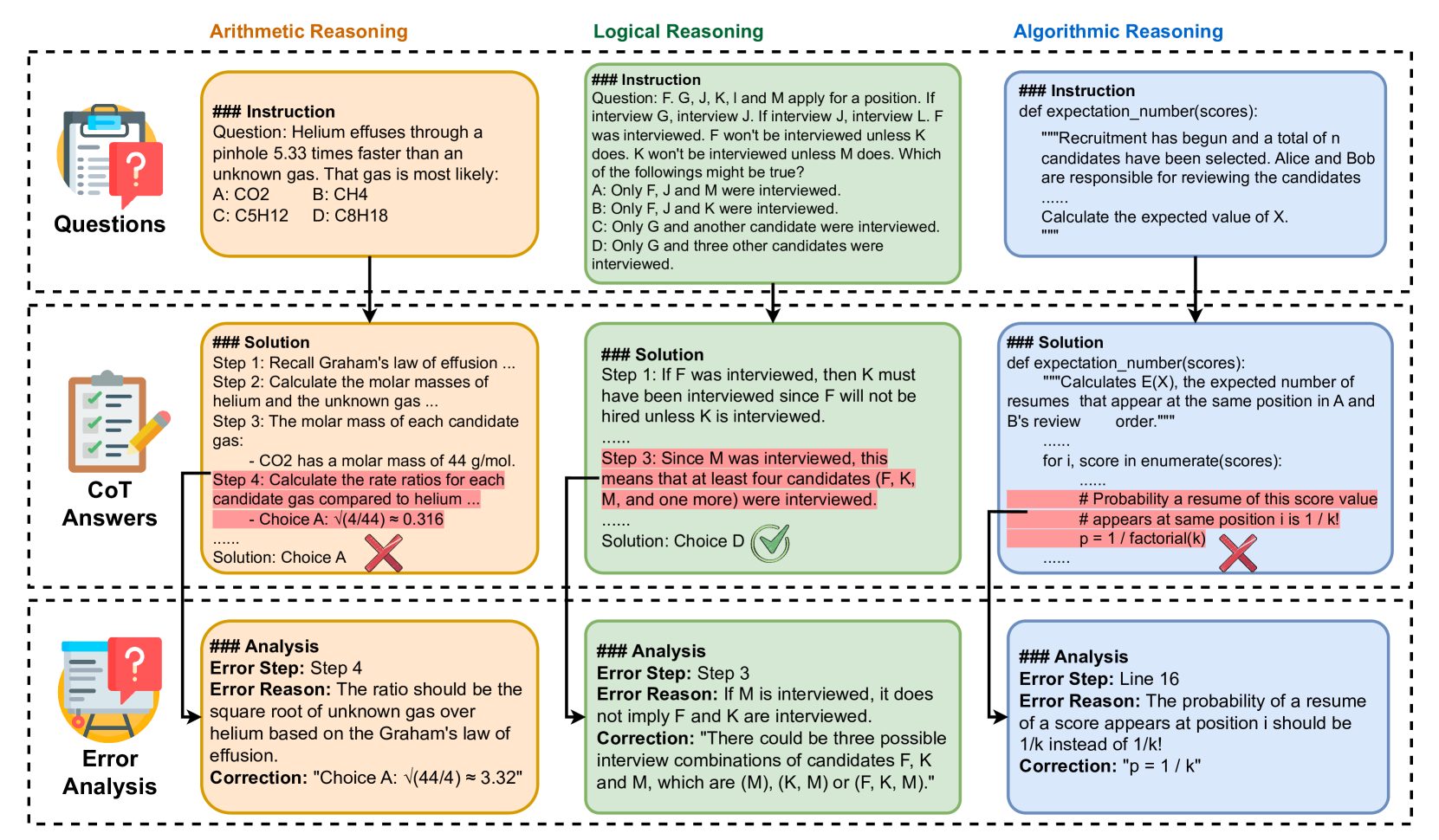
## Reasoning Process Diagram: Arithmetic, Logical, and Algorithmic Reasoning Examples
### Overview
The image presents a diagram comparing and contrasting Arithmetic, Logical, and Algorithmic Reasoning through examples. Each reasoning type is broken down into a question, a solution, and an error analysis, demonstrating a step-by-step thought process and error correction.
### Components/Axes
The diagram is divided into three main columns, one for each reasoning type:
1. **Arithmetic Reasoning** (left)
2. **Logical Reasoning** (center)
3. **Algorithmic Reasoning** (right)
Each column is further divided into three sections:
1. **Questions**: Poses a problem or scenario.
2. **CoT Answers (Chain of Thought)**: Shows the step-by-step solution process.
3. **Error Analysis**: Identifies and corrects errors in the initial solution.
### Detailed Analysis
#### Arithmetic Reasoning
* **Questions**:
* Question: "Helium effuses through a pinhole 5.33 times faster than an unknown gas. That gas is most likely:"
* Options: A: CO2, B: CH4, C: C5H12, D: C8H18
* **CoT Answers**:
* Step 1: "Recall Graham's law of effusion..."
* Step 2: "Calculate the molar masses of helium and the unknown gas..."
* Step 3: "The molar mass of each candidate gas: - CO2 has a molar mass of 44 g/mol."
* Step 4: "Calculate the rate ratios for each candidate gas compared to helium - Choice A: √(4/44) ≈ 0.316"
* Solution: Choice A (marked with a red X indicating it's incorrect)
* **Error Analysis**:
* Error Step: Step 4
* Error Reason: "The ratio should be the square root of unknown gas over helium based on the Graham's law of effusion."
* Correction: "Choice A: √(44/4) ≈ 3.32"
#### Logical Reasoning
* **Questions**:
* Question: "F, G, J, K, I and M apply for a position. If interview G, interview J. If interview J, interview L. F was interviewed. F won't be interviewed unless K does. K won't be interviewed unless M does. Which of the followings might be true?"
* Options: A: Only F, J and M were interviewed., B: Only F, J and K were interviewed., C: Only G and another candidate were interviewed., D: Only G and three other candidates were interviewed.
* **CoT Answers**:
* Step 1: "If F was interviewed, then K must have been interviewed since F will not be hired unless K is interviewed."
* Step 3: "Since M was interviewed, this means that at least four candidates (F, K, M, and one more) were interviewed."
* Solution: Choice D (marked with a green checkmark indicating it's correct)
* **Error Analysis**:
* Error Step: Step 3
* Error Reason: "If M is interviewed, it does not imply F and K are interviewed."
* Correction: "There could be three possible interview combinations of candidates F, K and M, which are (M), (K, M) or (F, K, M)."
#### Algorithmic Reasoning
* **Questions**:
* Instruction: