TECHNICAL ASSET FINGERPRINT
d463baed9a6126b4be831cdb
Click to view fullscreen
Press ESC or click to close
FOUND IN PAPERS
EXPERT: gemini-3.1-pro-preview VERSION 1
RUNTIME: gemini/gemini-3.1-pro-preview
INTEL_VERIFIED
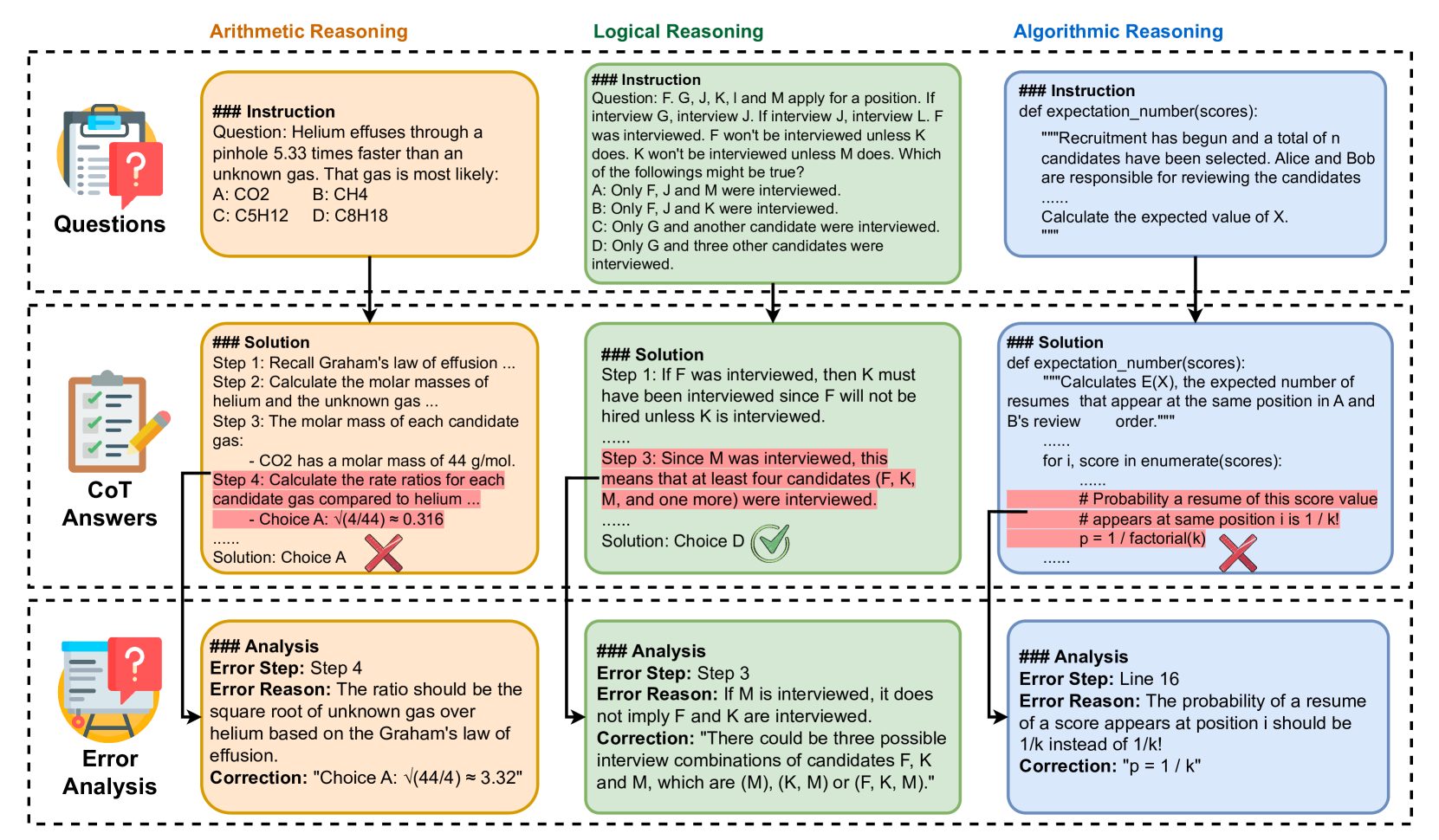
## Diagram: Reasoning Types and Error Analysis Workflow
### Overview
The image is a structured flowchart diagram illustrating a three-stage process applied to three distinct domains of problem-solving. It demonstrates how a system (likely a Large Language Model) is presented with a prompt, generates a step-by-step "Chain of Thought" (CoT) answer that contains a specific logical or factual error, and subsequently undergoes an "Error Analysis" to identify, explain, and correct that specific flaw.
### Components and Layout
The diagram is organized into a grid format:
* **Columns (Domains):**
* **Left Column (Orange):** Arithmetic Reasoning
* **Center Column (Green):** Logical Reasoning
* **Right Column (Blue):** Algorithmic Reasoning
* **Rows (Stages):**
* **Top Row:** "Questions" (Indicated by a clipboard icon with a question mark on the far left).
* **Middle Row:** "CoT Answers" (Indicated by a clipboard icon with checkmarks and a pencil).
* **Bottom Row:** "Error Analysis" (Indicated by a clipboard icon with a question mark and an easel).
* **Flow Indicators:** Black downward-pointing arrows connect the boxes from top to bottom within each column. Additionally, specific lines connect red-highlighted text in the middle row directly to the analysis boxes in the bottom row.
---
### Content Details (Transcription and Spatial Grounding)
#### Column 1: Arithmetic Reasoning (Left, Orange)
* **Top Box (Questions):**
```text
### Instruction
Question: Helium effuses through a pinhole 5.33 times faster than an unknown gas. That gas is most likely:
A: CO2 B: CH4
C: C5H12 D: C8H18
```
* **Middle Box (CoT Answers):**
```text
### Solution
Step 1: Recall Graham's law of effusion ...
Step 2: Calculate the molar masses of helium and the unknown gas ...
Step 3: The molar mass of each candidate gas:
- CO2 has a molar mass of 44 g/mol.
[HIGHLIGHTED IN RED]: Step 4: Calculate the rate ratios for each candidate gas compared to helium ...
- Choice A: √(4/44) ≈ 0.316
......
Solution: Choice A [Large Red 'X' icon]
```
*Visual Note:* A line connects the red highlighted text in Step 4 down to the Error Analysis box.
* **Bottom Box (Error Analysis):**
```text
### Analysis
Error Step: Step 4
Error Reason: The ratio should be the square root of unknown gas over helium based on the Graham's law of effusion.
Correction: "Choice A: √(44/4) ≈ 3.32"
```
#### Column 2: Logical Reasoning (Center, Green)
* **Top Box (Questions):**
```text
### Instruction
Question: F. G, J, K, I and M apply for a position. If interview G, interview J. If interview J, interview L. F was interviewed. F won't be interviewed unless K does. K won't be interviewed unless M does. Which of the followings might be true?
A: Only F, J and M were interviewed.
B: Only F, J and K were interviewed.
C: Only G and another candidate were interviewed.
D: Only G and three other candidates were interviewed.
```
* **Middle Box (CoT Answers):**
```text
### Solution
Step 1: If F was interviewed, then K must have been interviewed since F will not be hired unless K is interviewed.
......
[HIGHLIGHTED IN RED]: Step 3: Since M was interviewed, this means that at least four candidates (F, K, M, and one more) were interviewed.
......
Solution: Choice D [Large Green Checkmark icon]
```
*Visual Note:* A line connects the red highlighted text in Step 3 down to the Error Analysis box.
* **Bottom Box (Error Analysis):**
```text
### Analysis
Error Step: Step 3
Error Reason: If M is interviewed, it does not imply F and K are interviewed.
Correction: "There could be three possible interview combinations of candidates F, K and M, which are (M), (K, M) or (F, K, M)."
```
#### Column 3: Algorithmic Reasoning (Right, Blue)
* **Top Box (Questions):**
```python
### Instruction
def expectation_number(scores):
"""Recruitment has begun and a total of n candidates have been selected. Alice and Bob are responsible for reviewing the candidates
......
Calculate the expected value of X.
"""
```
* **Middle Box (CoT Answers):**
```python
### Solution
def expectation_number(scores):
"""Calculates E(X), the expected number of resumes that appear at the same position in A and B's review order."""
......
for i, score in enumerate(scores):
......
[HIGHLIGHTED IN RED]: # Probability a resume of this score value
# appears at same position i is 1 / k!
p = 1 / factorial(k) [Large Red 'X' icon]
......
```
*Visual Note:* A line connects the red highlighted code block down to the Error Analysis box.
* **Bottom Box (Error Analysis):**
```text
### Analysis
Error Step: Line 16
Error Reason: The probability of a resume of a score appears at position i should be 1/k instead of 1/k!
Correction: "p = 1 / k"
```
---
### Key Observations
1. **Structured Error Targeting:** The diagram explicitly isolates the exact point of failure within a multi-step reasoning process. It does not just mark the final answer wrong; it highlights the specific flawed step (Step 4, Step 3, or Line 16).
2. **Standardized Correction Format:** Every Error Analysis box follows a strict tripartite structure: `Error Step`, `Error Reason`, and `Correction`.
3. **The "Right Answer, Wrong Reason" Anomaly:** In the Center Column (Logical Reasoning), the final solution ("Choice D") is marked with a Green Checkmark, indicating it is the correct multiple-choice option. However, "Step 3" of the reasoning used to arrive at that answer is highlighted in red as an error.
### Interpretation
This diagram outlines a sophisticated data structure or training methodology for Artificial Intelligence, specifically Large Language Models (LLMs).
* **What the data demonstrates:** It shows a framework for "process supervision" rather than just "outcome supervision." Instead of merely training a model to output the correct final answer (A, B, C, D, or a final number), this framework evaluates the *Chain of Thought* (CoT).
* **Reading between the lines (The Peircean view):** The most revealing part of this diagram is the Logical Reasoning column. The fact that a green checkmark (correct final answer) is paired with a red-highlighted error in the steps proves that this system is designed to detect and correct *hallucinated logic* or *lucky guesses*. It enforces that the model must not only be right, but it must be right for the correct reasons.
* **Purpose:** This image is likely taken from an academic paper or technical documentation introducing a new dataset or fine-tuning method. By providing models with examples of common reasoning errors alongside structured explanations of *why* they are wrong and *how* to fix them, developers can train AI to self-correct, debug code more effectively, and produce more reliable, faithful step-by-step logic.
DECODING INTELLIGENCE...