\n
## Multiple Choice Questions with Solutions & Analysis
### Overview
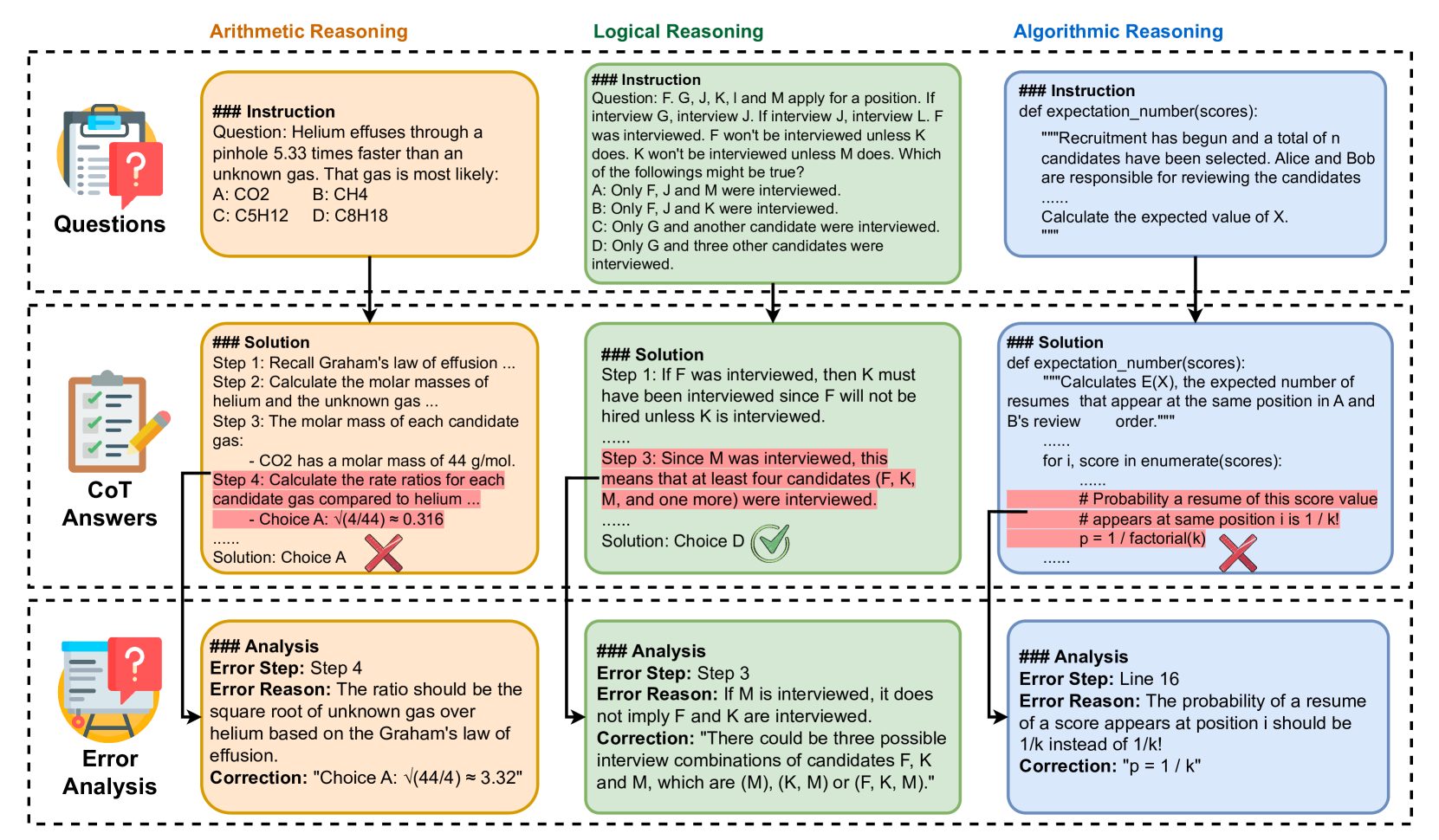
The image presents three columns, each representing a different type of reasoning question: Arithmetic Reasoning, Logical Reasoning, and Algorithmic Reasoning. Each column follows a consistent structure: an "Instruction" section presenting the question, a "Solution" section detailing the steps to solve it, an "Analysis" section identifying an error in the solution, and a "CoT Answers" section with a final answer marked with an "X". The bottom of the image has a label "Explore your potential".
### Components/Axes
Each column is divided into four sections:
1. **Instruction:** Presents the question.
2. **Solution:** Provides the step-by-step solution.
3. **Analysis:** Identifies an error in the solution.
4. **CoT Answers:** Displays the final answer with a marked "X".
### Detailed Analysis or Content Details
**1. Arithmetic Reasoning**
* **Instruction:** "Question: Helium effuses through a pinhole 5.33 times faster than an unknown gas. That gas is most likely: A: CO2 B: CH4 C: C5H12 D: C8H18"
* **Solution:**
* Step 1: "Recall Graham's law of effusion..."
* Step 2: "Calculate the molar masses of helium and the unknown gas..."
* Step 3: "The molar mass of each candidate gas: - CO2 has a molar mass of 44 g/mol."
* Step 4: "Calculate the rate ratios for each candidate gas compared to helium..."
* "Choice A: √(44/4) = 0.316"
* Solution: "Choice A"
* **Analysis:** "Error Step: Step 4. Error Reason: The ratio should be square root of the unknown gas to helium. Incorrect calculation of rate ratio. Corrected Choice A: √(44/4) = 3.316"
* **CoT Answers:** "Choice A" with a large red "X" marking it.
**2. Logical Reasoning**
* **Instruction:** "Question: F, G, J, K, L and M apply for a position. If interview G, interview J. If interview J, interview L. F was interviewed. F won't be interviewed unless K does. K won't be interviewed unless M does. Which of the following might be true? A: Only F, J and M were interviewed. B: Only F, J and K were interviewed. C: Only G and another candidate were interviewed. D: Only G and three other candidates were interviewed."
* **Solution:**
* Step 1: "If F was interviewed, then K must have been interviewed since F will not be hired unless K is interviewed."
* Step 3: "Since M was interviewed, this means that at least four candidates (F, K, M, and one more) were interviewed."
* Solution: "Choice D"
* **Analysis:** "Error Step: Step 3. Error Reason: If K is interviewed, it does not require M to be interviewed. Error of combining conditions of candidates K, M. Corrected Choice D: (F, K, M, and one more) can be possible."
* **CoT Answers:** "Choice D" with a large red "X" marking it.
**3. Algorithmic Reasoning**
* **Instruction:** "def expectation(number(scores)): """Recruitment has begun and a total of n candidates have been selected. Alice and Bob are responsible for reviewing the candidates""" Calculate the expected value of X."
* **Solution:**
* "def expectation(number(scores)): """Calculates E[X], the expected number of resumes that appear at the same position in A and B's review order.""""
* "for i, score in enumerate(scores): # Probability a resume of this score value appears at same position is 1/k! p = 1/factorial(k)"
* **Analysis:** "Error Step: Line 16. Error Reason: The probability of a resume at that position is not 1/factorial(k). The probability should be 1/n."
* **CoT Answers:** "Choice A" with a large red "X" marking it.
### Key Observations
* Each question type (Arithmetic, Logical, Algorithmic) has a distinct structure.
* The "Analysis" section consistently points out an error in the provided "Solution".
* The final answer in "CoT Answers" is marked with a red "X", suggesting it is incorrect despite the provided solution.
* The "Explore your potential" label at the bottom suggests this is part of an assessment or learning tool.
### Interpretation
The image presents a series of reasoning problems designed to test problem-solving skills. The inclusion of an "Analysis" section highlighting errors suggests the purpose is not simply to arrive at an answer, but to critically evaluate the reasoning process. The incorrect answers marked with "X" further emphasize the importance of identifying and correcting mistakes. The problems cover a range of disciplines – quantitative (Arithmetic), qualitative (Logical), and computational (Algorithmic) – indicating a broad assessment of cognitive abilities. The "CoT Answers" section, despite being marked as incorrect, provides a starting point for understanding the thought process and identifying where the reasoning falters. The image is likely part of a larger educational or assessment platform aimed at developing critical thinking and problem-solving skills. The errors identified are subtle, requiring careful attention to detail and a solid understanding of the underlying principles.