TECHNICAL ASSET FINGERPRINT
d463baed9a6126b4be831cdb
Click to view fullscreen
Press ESC or click to close
FOUND IN PAPERS
EXPERT: healer-alpha-free VERSION 1
RUNTIME: free/openrouter/healer-alpha
INTEL_VERIFIED
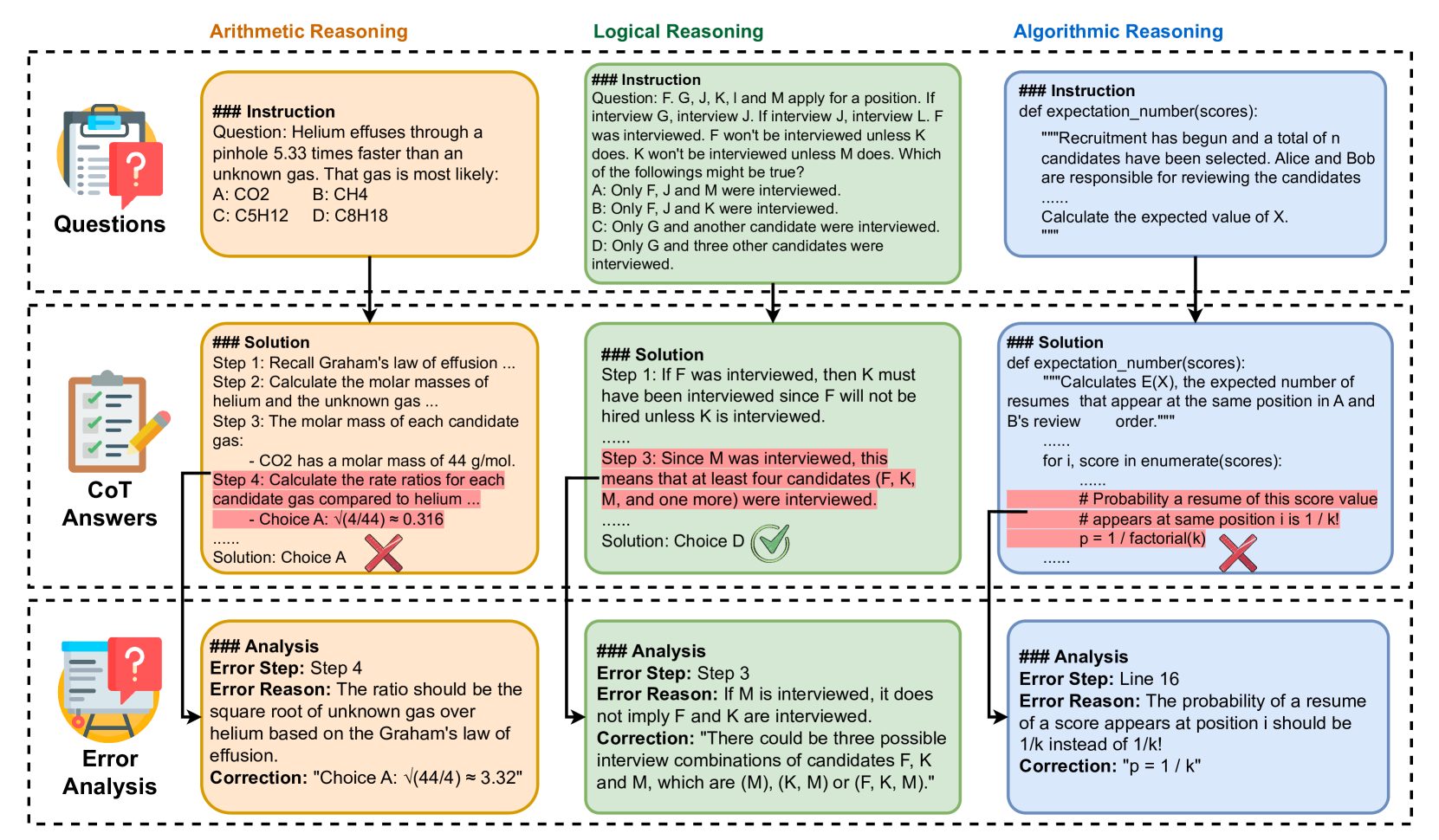
## Diagram: Comparative Error Analysis in Three Reasoning Types
### Overview
The image is a structured diagram comparing three types of reasoning tasks—Arithmetic, Logical, and Algorithmic—each presented in a dedicated vertical column. For each reasoning type, the diagram illustrates a typical problem ("Questions"), a Chain-of-Thought (CoT) solution attempt ("CoT Answers") containing a deliberate error, and a subsequent "Error Analysis" that identifies and corrects the mistake. The diagram uses color-coding (orange for Arithmetic, green for Logical, blue for Algorithmic) and icons to visually segment the information flow.
### Components/Axes
The diagram is organized into a 3x3 grid structure:
* **Columns (Reasoning Types):**
1. **Arithmetic Reasoning** (Left column, orange header and borders)
2. **Logical Reasoning** (Center column, green header and borders)
3. **Algorithmic Reasoning** (Right column, blue header and borders)
* **Rows (Process Stages):**
1. **Questions** (Top row): Presents the initial problem or instruction.
2. **CoT Answers** (Middle row): Shows a step-by-step solution attempt, with an erroneous step highlighted in a red box.
3. **Error Analysis** (Bottom row): Diagnoses the error and provides the correct reasoning or calculation.
### Detailed Analysis
#### **Column 1: Arithmetic Reasoning (Orange)**
* **Questions Box:**
* **Instruction:** "Question: Helium effuses through a pinhole 5.33 times faster than an unknown gas. That gas is most likely:"
* **Options:** "A: CO2", "B: CH4", "C: C5H12", "D: C8H18"
* **CoT Answers Box:**
* **Solution Steps:**
* "Step 1: Recall Graham's law of effusion ..."
* "Step 2: Calculate the molar masses of helium and the unknown gas ..."
* "Step 3: The molar mass of each candidate gas:"
* "- CO2 has a molar mass of 44 g/mol."
* **"Step 4: Calculate the rate ratios for each candidate gas compared to helium ..."** (This step is highlighted in a red box).
* "- Choice A: √(4/44) ≈ 0.316"
* "......"
* **Final Answer:** "Solution: Choice A" (Marked with a red 'X' icon, indicating it is incorrect).
* **Error Analysis Box:**
* **Analysis:**
* "Error Step: Step 4"
* "Error Reason: The ratio should be the square root of unknown gas over helium based on the Graham's law of effusion."
* **Correction:** "Choice A: √(44/4) ≈ 3.32"
#### **Column 2: Logical Reasoning (Green)**
* **Questions Box:**
* **Instruction:** "Question: F, G, J, K, I and M apply for a position. If interview G, interview J. If interview J, interview L. F won't be interviewed unless K does. K won't be interviewed unless M does. Which of the followings might be true?"
* **Options:** "A: Only F, J and M were interviewed.", "B: Only F, J and K were interviewed.", "C: Only G and another candidate were interviewed.", "D: Only G and three other candidates were interviewed."
* **CoT Answers Box:**
* **Solution Steps:**
* "Step 1: If F was interviewed, then K must have been interviewed since F will not be hired unless K is interviewed."
* "......"
* **"Step 3: Since M was interviewed, this means that at least four candidates (F, K, M, and one more) were interviewed."** (This step is highlighted in a red box).
* "......"
* **Final Answer:** "Solution: Choice D" (Marked with a green checkmark icon, indicating it is correct).
* **Error Analysis Box:**
* **Analysis:**
* "Error Step: Step 3"
* "Error Reason: If M is interviewed, it does not imply F and K are interviewed."
* **Correction:** "There could be three possible interview combinations of candidates F, K and M, which are (M), (K, M) or (F, K, M)."
#### **Column 3: Algorithmic Reasoning (Blue)**
* **Questions Box:**
* **Instruction:** A code snippet defining a function `def expectation_number(scores):` with a docstring: `"""Recruitment has begun and a total of n candidates have been selected. Alice and Bob are responsible for reviewing the candidates ...... Calculate the expected value of X. """`
* **CoT Answers Box:**
* **Solution Code:**
* `def expectation_number(scores):`
* ` """Calculates E(X), the expected number of resumes that appear at the same position in A and B's review order."""`
* ` ......`
* ` for i, score in enumerate(scores):`
* ` ......`
* **` # Probability a resume of this score value`** (Highlighted in red box)
* **` # appears at same position i is 1 / k!`** (Highlighted in red box)
* **` p = 1 / factorial(k)`** (Highlighted in red box)
* ` ......`
* **Error Analysis Box:**
* **Analysis:**
* "Error Step: Line 16"
* "Error Reason: The probability of a resume of a score appears at position i should be 1/k instead of 1/k!"
* **Correction:** "p = 1 / k"
### Key Observations
1. **Consistent Error Pattern:** In all three reasoning types, the error occurs in a middle step of the solution process (Step 4, Step 3, Line 16), not in the initial problem understanding or final answer selection.
2. **Nature of Errors:**
* **Arithmetic:** A formula application error (inverting the ratio in Graham's Law).
* **Logical:** A flawed logical deduction (over-constraining the possibilities from a given condition).
* **Algorithmic:** A probability calculation error (using factorial where a simple reciprocal was needed).
3. **Visual Coding:** Red highlighting is used consistently to pinpoint the exact erroneous line or step across all columns. The final answer in the CoT box is marked with an icon (X or ✓) to indicate its correctness relative to the flawed reasoning.
4. **Correction Format:** The "Error Analysis" section provides a concise, direct correction to the specific erroneous step, rather than re-solving the entire problem.
### Interpretation
This diagram serves as a pedagogical or analytical tool for understanding common failure modes in different forms of reasoning. It demonstrates that errors are often not random but stem from specific, identifiable misconceptions or oversights in the application of rules—whether mathematical (Graham's Law), logical (conditional constraints), or algorithmic (probability theory).
The structure emphasizes the value of **stepwise verification** and **targeted error analysis**. By isolating the faulty step, the diagram shows how precise correction is more efficient than complete rework. The parallel presentation across reasoning types suggests a universal framework for debugging thought processes: identify the step, diagnose the rule misapplication, and apply the precise correction. This approach is crucial in fields like education, AI training, and software debugging, where understanding the *why* behind an error is as important as finding the right answer.
DECODING INTELLIGENCE...