## Diagram: Agent Orchestration Workflow
### Overview
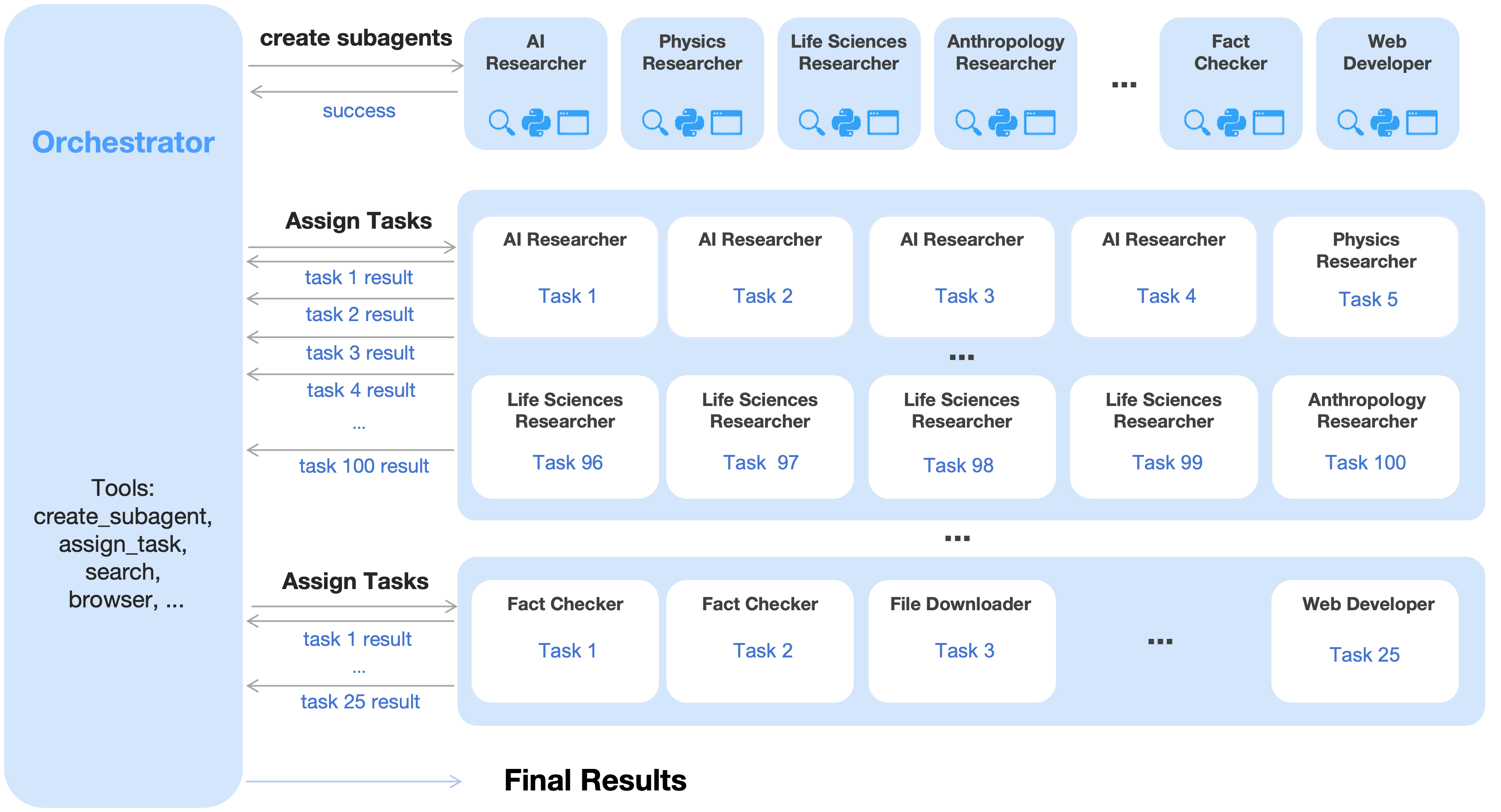
This diagram illustrates a workflow for orchestrating multiple agents to complete a series of tasks. The diagram depicts an "Orchestrator" component that creates subagents with specialized roles, assigns tasks to these agents, and ultimately collects "Final Results". The diagram emphasizes a multi-agent system with iterative task assignment and result collection.
### Components/Axes
The diagram is segmented into three main sections:
1. **Orchestrator (Top):** Initiates the process by creating subagents.
2. **Assign Tasks (Middle):** Shows the assignment of tasks to various agent types.
3. **Final Results (Bottom):** Represents the culmination of the workflow.
The diagram also highlights "Tools" available to the system, including `create_subagent`, `assign_task`, `search`, and `browser`.
Agent types include:
* AI Researcher
* Physics Researcher
* Life Sciences Researcher
* Anthropology Researcher
* Fact Checker
* Web Developer
* File Downloader
Task identifiers are represented as "Task X", where X is a number.
### Detailed Analysis or Content Details
The diagram shows a flow of actions and results between components.
**Orchestrator Section:**
* The Orchestrator initiates the creation of subagents via the "create subagents" arrow.
* The arrow is labeled "success", indicating a successful subagent creation.
* Six agent types are explicitly shown: AI Researcher, Physics Researcher, Life Sciences Researcher, Anthropology Researcher, Fact Checker, and Web Developer. Each agent type is represented by a rounded rectangle with an icon.
* AI Researcher: Icon depicts a magnifying glass, a computer chip, and a question mark.
* Physics Researcher: Icon depicts a magnifying glass, a computer chip, and a flask.
* Life Sciences Researcher: Icon depicts a magnifying glass, a computer chip, and a petri dish.
* Anthropology Researcher: Icon depicts a magnifying glass, a computer chip, and a head silhouette.
* Fact Checker: Icon depicts a magnifying glass, a computer chip, and a checkmark.
* Web Developer: Icon depicts a magnifying glass, a computer chip, and a bracket.
**Assign Tasks Section (Upper):**
* The Orchestrator assigns tasks to AI Researchers.
* Tasks are labeled "Task 1", "Task 2", "Task 3", "Task 4".
* An ellipsis (...) indicates that more tasks are assigned to AI Researchers.
* A Physics Researcher is shown receiving "Task 5".
**Assign Tasks Section (Lower):**
* Tasks are assigned to Life Sciences Researchers ("Task 96", "Task 97", "Task 98", "Task 99", "Task 100").
* An ellipsis (...) indicates that more tasks are assigned to Life Sciences Researchers.
* An Anthropology Researcher is shown receiving "Task 100".
* Tasks are assigned to Fact Checkers ("Task 1", "Task 2", "Task 3").
* An ellipsis (...) indicates that more tasks are assigned to Fact Checkers.
* A File Downloader is shown receiving "Task 3".
* A Web Developer is shown receiving "Task 25".
**Tools Section:**
* The "Tools" section lists available tools: `create_subagent`, `assign_task`, `search`, `browser`.
* An ellipsis (...) indicates that there are more tools available.
**Flow:**
* Arrows indicate the flow of tasks from the Orchestrator to the agents and the flow of results back to the Orchestrator.
* The arrows are labeled with "task X result", indicating the return of task results.
* The final output is labeled "Final Results".
### Key Observations
* The AI Researcher and Life Sciences Researcher appear to be assigned the most tasks, based on the visible task numbers.
* The diagram highlights a parallel processing approach, with multiple agents working on tasks simultaneously.
* The "Tools" section suggests the system has access to common functionalities for task execution.
* The diagram does not provide specific details about the nature of the tasks or the criteria for assigning them to different agents.
### Interpretation
This diagram represents a sophisticated workflow for automated task completion using a multi-agent system. The Orchestrator acts as a central controller, dynamically creating specialized agents and assigning tasks based on their expertise. The iterative flow of tasks and results suggests a continuous process of refinement and validation. The inclusion of a Fact Checker highlights the importance of ensuring the accuracy and reliability of the final results. The diagram suggests a system designed for complex problem-solving that requires diverse skill sets and parallel processing capabilities. The lack of specific task details implies that the system is adaptable to a wide range of applications. The diagram is a high-level overview and does not delve into the specifics of agent communication, task prioritization, or error handling.