## Flowchart: Multi-Agent Task Orchestration System
### Overview
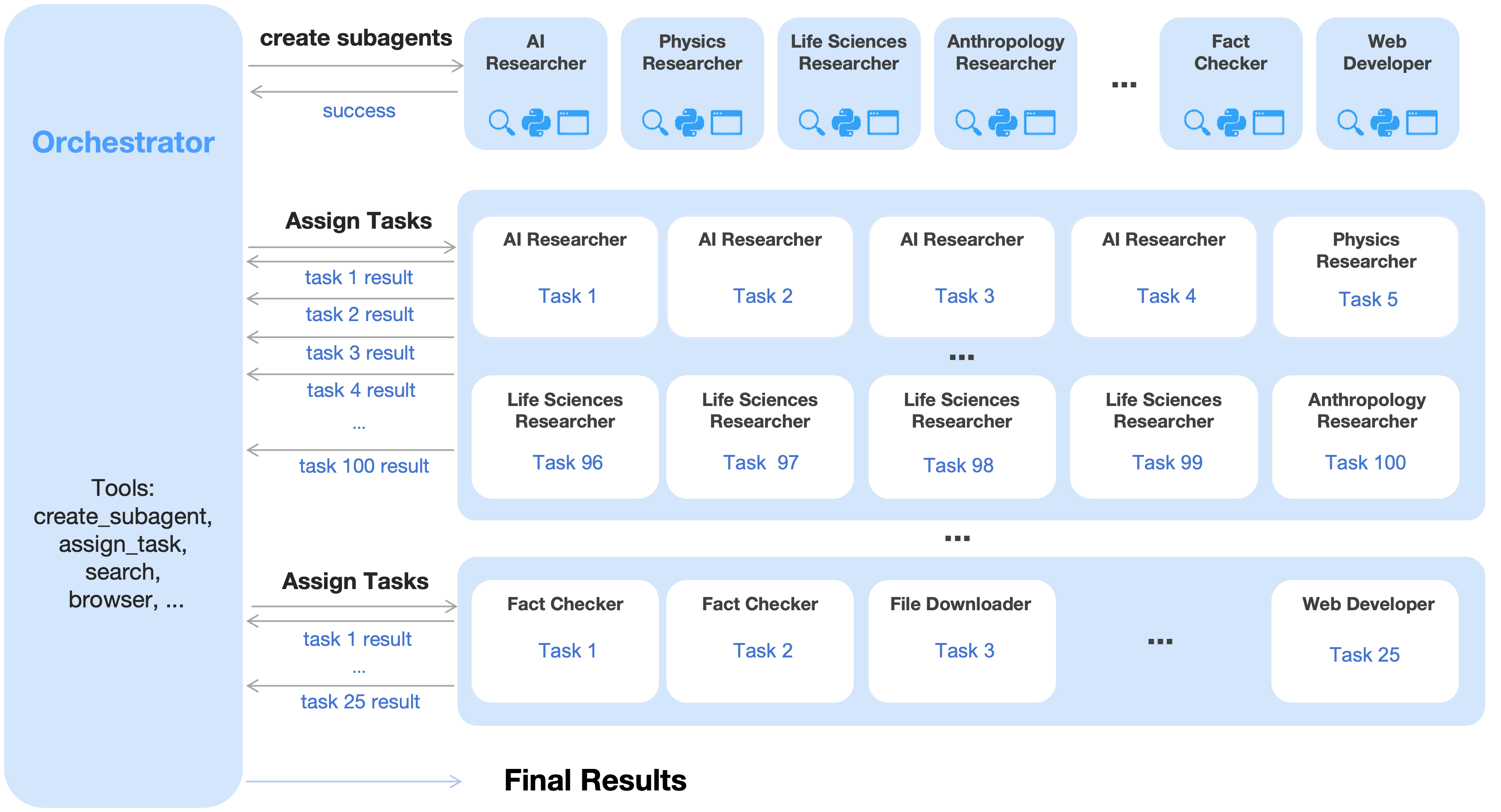
The diagram illustrates a multi-agent workflow system where an Orchestrator coordinates tasks across specialized AI researchers, physics researchers, life sciences researchers, anthropology researchers, fact checkers, and web developers. The system includes task assignment, execution, and result compilation phases.
### Components/Axes
1. **Left Panel (Orchestrator)**
- Contains system tools: `create_subagent`, `assign_task`, `search`, `browser`, ...
- Vertical flow from top to bottom
2. **Top Section (Create Subagents)**
- Horizontal row of researcher roles with Python logos and search icons:
- AI Researcher
- Physics Researcher
- Life Sciences Researcher
- Anthropology Researcher
- Fact Checker
- Web Developer
- Arrows labeled "success" connecting Orchestrator to each role
3. **Middle Section (Assign Tasks)**
- Three horizontal task assignment layers:
- **Top Layer**: AI Researchers assigned Tasks 1-5
- **Middle Layer**: Life Sciences Researchers assigned Tasks 96-100
- **Bottom Layer**: Fact Checker (Tasks 1-3), File Downloader (Task 3), Web Developer (Task 25)
- Arrows show task results flowing back to Orchestrator
4. **Bottom Section (Final Results)**
- Final compilation area with no specific data points shown
### Detailed Analysis
- **Task Distribution**:
- AI Researchers handle initial tasks (1-5)
- Life Sciences Researchers handle specialized tasks (96-100)
- Fact Checker and Web Developer handle verification/implementation tasks (1-3, 25)
- **Workflow Pattern**:
1. Orchestrator creates subagents
2. Assigns tasks to appropriate specialists
3. Collects results
4. Compiles final output
- **Tool Integration**:
- Search and browser tools enable external data collection
- Python integration suggests code execution capabilities
### Key Observations
1. Task numbering shows hierarchical organization (1-5, 96-100, 25)
2. Multiple Fact Checkers suggest quality control processes
3. Web Developer task (25) appears isolated from other task groupings
4. No explicit error handling or retry mechanisms shown
### Interpretation
This system demonstrates a distributed research workflow where:
- The Orchestrator acts as a central coordinator
- Specialized researchers handle domain-specific tasks
- Task numbering suggests prioritization or categorization
- Final results compilation implies aggregation of diverse outputs
The absence of error handling mechanisms and the isolated Web Developer task (25) might indicate potential bottlenecks or single points of failure in the system. The hierarchical task numbering could represent different research phases or priority levels.