## Bar Chart: Performance Comparison of GoG and Graph-RFT Across IKG Thresholds
### Overview
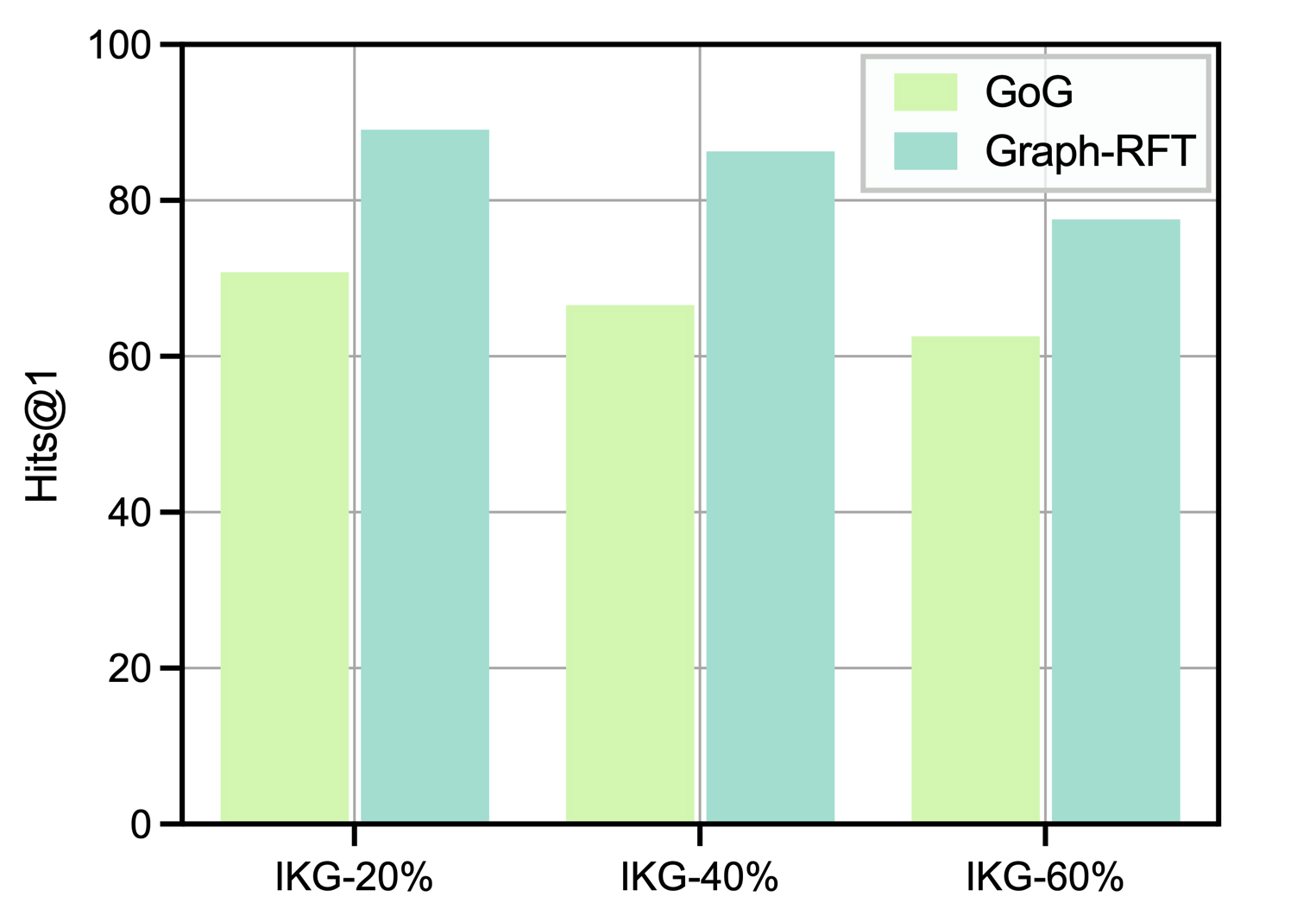
The chart compares the performance of two methods, **GoG** (light green bars) and **Graph-RFT** (teal bars), across three IKG (Influence Knowledge Graph) thresholds: 20%, 40%, and 60%. The metric measured is **Hits@1**, representing the percentage of top-1 accurate predictions. Graph-RFT consistently outperforms GoG across all thresholds, with performance gaps narrowing as IKG complexity increases.
### Components/Axes
- **X-axis**: IKG thresholds (20%, 40%, 60%), labeled as "IKG-20%", "IKG-40%", and "IKG-60%".
- **Y-axis**: Hits@1 metric, scaled from 0 to 100 in increments of 20.
- **Legend**: Located in the top-right corner, associating:
- Light green with **GoG**
- Teal with **Graph-RFT**
### Detailed Analysis
1. **IKG-20%**:
- GoG: ~70 Hits@1
- Graph-RFT: ~88 Hits@1
- Difference: 18 points
2. **IKG-40%**:
- GoG: ~66 Hits@1
- Graph-RFT: ~86 Hits@1
- Difference: 20 points
3. **IKG-60%**:
- GoG: ~62 Hits@1
- Graph-RFT: ~78 Hits@1
- Difference: 16 points
### Key Observations
- **Graph-RFT dominance**: Outperforms GoG in all thresholds, with the largest gap at IKG-20% (18 points) and the smallest at IKG-60% (16 points).
- **Narrowing gap**: The performance advantage of Graph-RFT decreases as IKG complexity increases, suggesting GoG may scale better in high-complexity scenarios.
- **Consistency**: Graph-RFT maintains higher Hits@1 across all thresholds, indicating robustness.
### Interpretation
The data suggests **Graph-RFT is more effective** than GoG for influence prediction tasks, but the performance gap diminishes as IKG thresholds rise. This could imply that GoG’s limitations are less pronounced in highly complex scenarios (e.g., IKG-60%), though it still lags. The narrowing gap might reflect architectural differences (e.g., Graph-RFT’s reliance on graph structures vs. GoG’s approach), but further analysis of methodology is required to confirm causality. The chart highlights a trade-off between absolute performance and scalability across complexity levels.