## Screenshot: CoT Explanation Prompt
### Overview
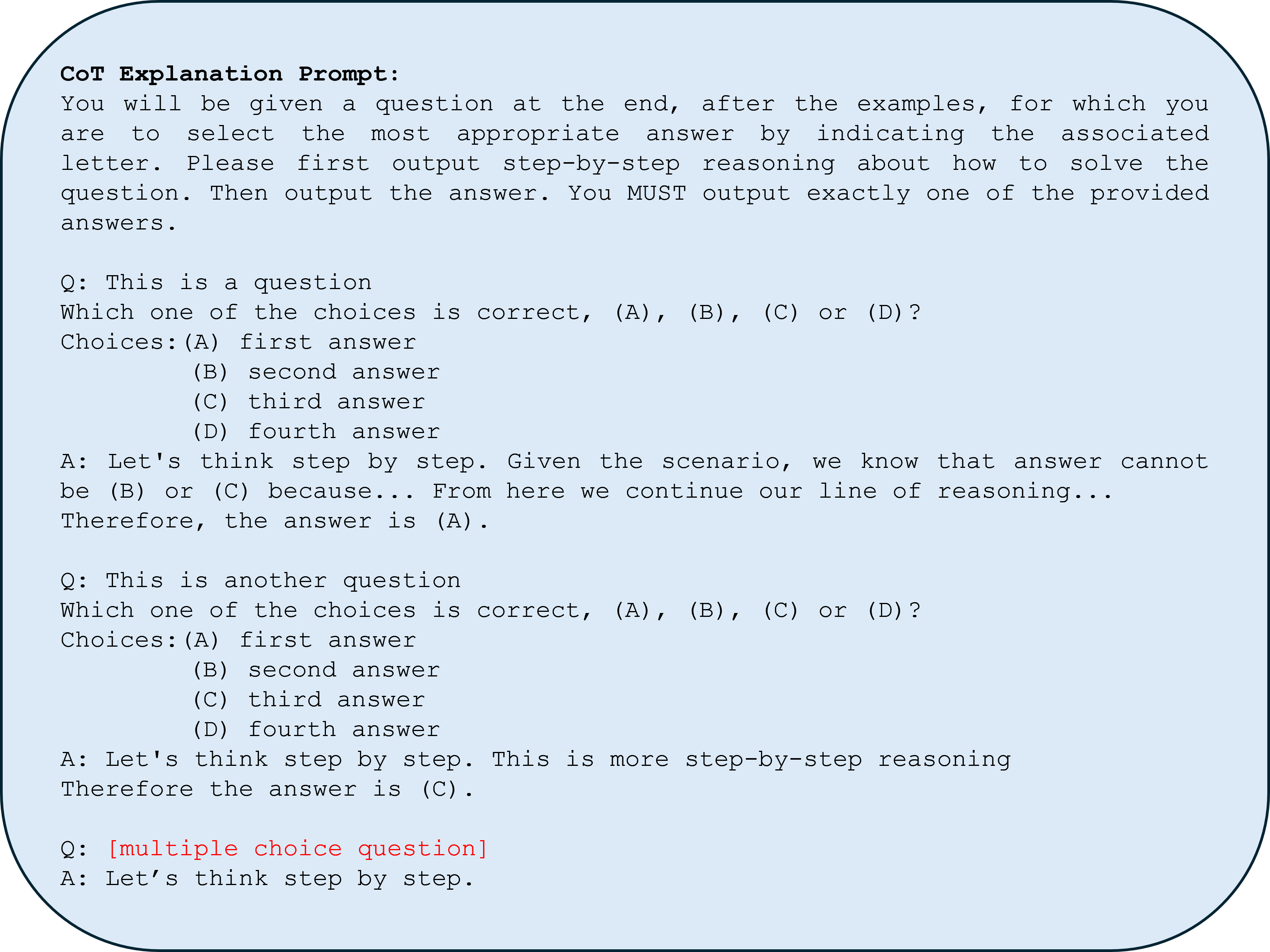
The image displays a technical prompt template for Chain-of-Thought (CoT) reasoning, designed to guide an AI model in solving multiple-choice questions. The layout includes instructions, example questions with step-by-step reasoning, and a placeholder for user input.
### Components/Axes
- **Text Content**:
- **Header**: "CoT Explanation Prompt:" (bolded).
- **Instructions**:
- "You will be given a question at the end, after the examples, for which you are to select the most appropriate answer by indicating the associated letter. Please first output step-by-step reasoning about how to solve the question. Then output the answer. You MUST output exactly one of the provided answers."
- **Example 1**:
- **Question**: "Which one of the choices is correct, (A), (B), (C) or (D)?"
- **Choices**:
- (A) first answer
- (B) second answer
- (C) third answer
- (D) fourth answer
- **Answer**:
- "A: Let's think step by step. Given the scenario, we know that answer cannot be (B) or (C) because... From here we continue our line of reasoning... Therefore, the answer is (A)."
- **Example 2**:
- **Question**: "Which one of the choices is correct, (A), (B), (C) or (D)?"
- **Choices**:
- (A) first answer
- (B) second answer
- (C) third answer
- (D) fourth answer
- **Answer**:
- "A: Let's think step by step. This is more step-by-step reasoning. Therefore the answer is (C)."
- **Placeholder Question**:
- **Text**: "Q: [multiple choice question]" (red-highlighted).
- **Answer**:
- "A: Let’s think step by step."
### Detailed Analysis
- **Text Structure**:
- The prompt uses a hierarchical format with clear separation between instructions, examples, and placeholders.
- Example answers demonstrate explicit step-by-step reasoning before concluding with the final answer.
- The placeholder question is marked in red, indicating it is a template for user input.
### Key Observations
1. **Formatting**:
- Monospace font for technical clarity.
- Bolded header for emphasis.
- Red highlight for the placeholder question to draw attention.
2. **Purpose**:
- The prompt enforces structured reasoning (step-by-step) before providing answers.
- Ensures answers are strictly limited to the provided choices (A, B, C, D).
3. **Placeholder**:
- The red-highlighted "[multiple choice question]" suggests this is where a user would insert a new question for the model to process.
### Interpretation
This prompt template is designed to improve the accuracy and transparency of AI-generated answers by:
- **Enforcing Reasoning**: Requiring step-by-step explanations to avoid "black-box" outputs.
- **Standardizing Responses**: Limiting answers to predefined choices (A-D) to reduce ambiguity.
- **User Customization**: The red placeholder allows users to input custom questions while maintaining the structured format.
The examples illustrate how the model should deconstruct a problem (e.g., eliminating incorrect options) before arriving at a conclusion. The absence of numerical data or visual elements suggests this is purely a textual workflow for question-answering tasks.