\n
## Textual Document: Chain-of-Thought (CoT) Explanation Prompt Example
### Overview
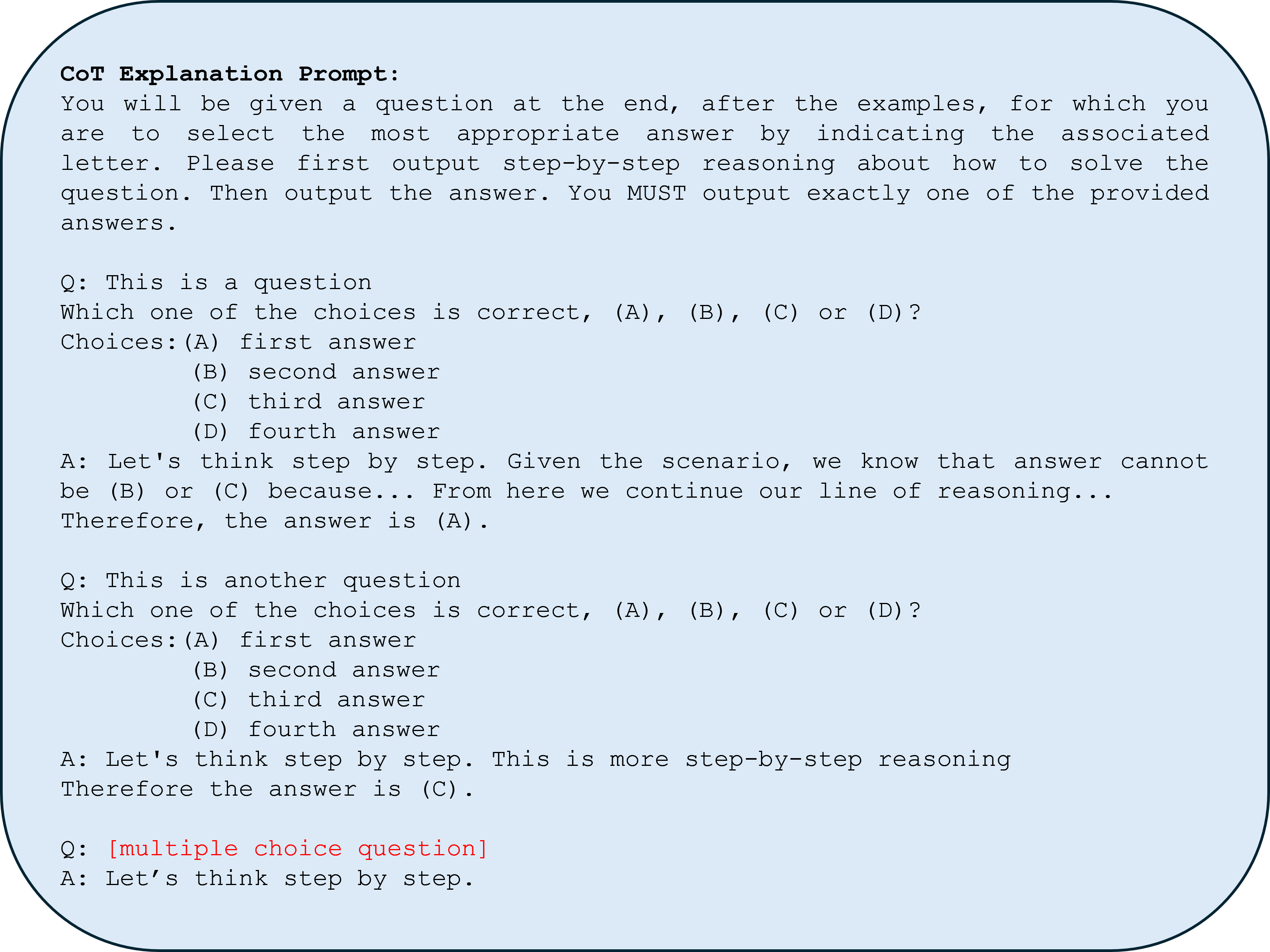
The image presents a textual example of a prompt designed to elicit Chain-of-Thought reasoning from a language model. It demonstrates a question-and-answer format, where the model is instructed to first provide step-by-step reasoning before selecting an answer from a given set of choices.
### Components/Axes
The document is structured into question-answer pairs. Each pair consists of:
1. A prompt instruction at the top.
2. A question labeled "Q:".
3. A set of choices labeled "(A)", "(B)", "(C)", and "(D)".
4. An answer labeled "A:", which includes the reasoning process and the final selected answer.
### Detailed Analysis or Content Details
The document contains three examples:
**Example 1:**
* **Prompt:** "You will be given a question at the end, after the examples, for which you are to select the most appropriate answer by indicating the associated letter. Please first output step-by-step reasoning about how to solve the question. Then output the answer. You MUST output exactly one of the provided answers."
* **Question:** "Q: This is a question Which one of the choices is correct, (A), (B), (C) or (D)?"
* **Choices:**
* (A) first answer
* (B) second answer
* (C) third answer
* (D) fourth answer
* **Answer:** "A: Let's think step by step. Given the scenario, we know that answer cannot be (B) or (C) because... From here we continue our line of reasoning... Therefore, the answer is (A)."
**Example 2:**
* **Question:** "Q: This is another question Which one of the choices is correct, (A), (B), (C) or (D)?"
* **Choices:**
* (A) first answer
* (B) second answer
* (C) third answer
* (D) fourth answer
* **Answer:** "A: Let's think step by step. This is more step-by-step reasoning Therefore the answer is (C)."
**Example 3:**
* **Question:** "Q: [multiple choice question]"
* **Answer:** "A: Let's think step by step."
### Key Observations
* The prompt emphasizes the importance of *showing* the reasoning process, not just providing the answer.
* The examples demonstrate a conversational tone ("Let's think step by step").
* The reasoning provided in the first two examples is somewhat vague and incomplete ("because...", "From here we continue our line of reasoning...").
* The third example is incomplete, suggesting it's a placeholder for a future question.
### Interpretation
This document serves as a template or example for prompting a language model to perform Chain-of-Thought reasoning. The goal is to encourage the model to articulate its thought process, making its decision-making more transparent and potentially more accurate. The "Let's think step by step" phrase acts as a trigger for the model to engage in this type of reasoning. The incomplete examples suggest this is a demonstration of the *format* rather than a fully fleshed-out reasoning process. The prompt's insistence on selecting *exactly one* of the provided answers is a constraint designed to ensure a definitive response. The document highlights a technique for improving the reliability and explainability of language model outputs.