\n
## Text Document: Health and Safety Concerns - Bottled Water vs. Tap Water
### Overview
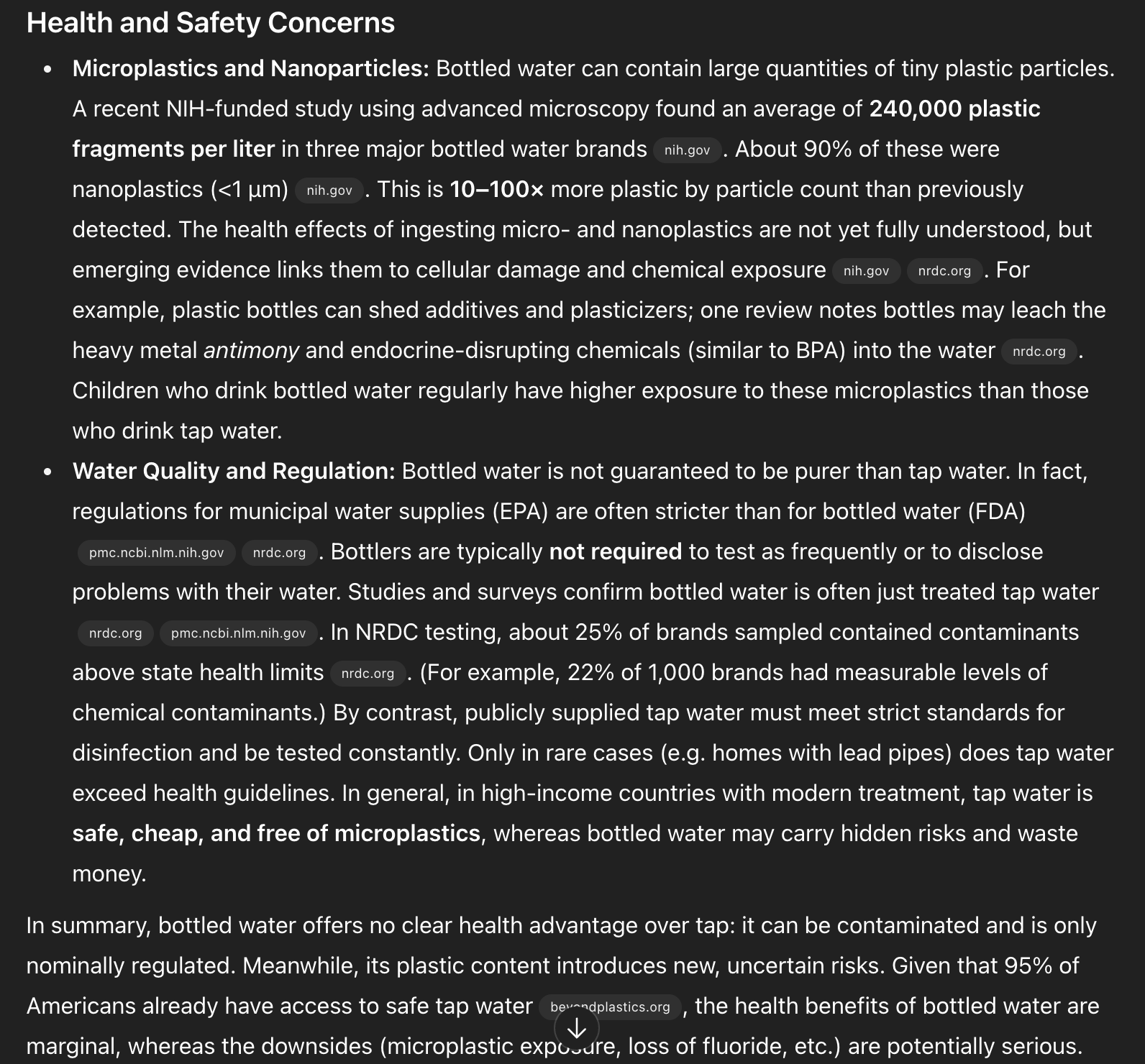
This document presents information regarding microplastics and nanoplastics in bottled water, as well as a comparison of the quality and regulation of bottled water versus tap water. It highlights potential health risks associated with bottled water and argues that tap water is generally safer, cheaper, and free of microplastics.
### Components/Axes
The document is structured as a series of bullet points, divided into two main sections: "Microplastics and Nanoplastics" and "Water Quality and Regulation." It includes citations to various sources (nih.gov, nrdc.org, pmc.ncbi.nlm.nih.gov, beatthemicroplastic.org).
### Detailed Analysis or Content Details
**Microplastics and Nanoplastics:**
* Bottled water can contain large quantities of tiny plastic particles.
* A recent NIH-funded study found an average of 240,000 plastic fragments per liter in three major bottled water brands (nih.gov).
* Approximately 90% of these were nanoplastics (<1 μm) (nih.gov).
* This is 10-100x more plastic by particle count than previously detected.
* The health effects of ingesting micro- and nanoplastics are not fully understood, but emerging evidence links them to cellular damage and chemical exposure (nih.gov, nrdc.org).
* Plastic bottles can shed additives and plasticizers; one review notes bottles may leach heavy metal antimony and endocrine-disrupting chemicals (similar to BPA) into the water (nrdc.org).
* Children who drink bottled water regularly have higher exposure to these microplastics than those who drink tap water.
**Water Quality and Regulation:**
* Bottled water is not guaranteed to be purer than tap water.
* Regulations for municipal water supplies (EPA) are often stricter than for bottled water (FDA).
* Bottlers are typically not required to test as frequently or disclose problems with their water (nrdc.org, pmc.ncbi.nlm.nih.gov).
* Studies and surveys confirm bottled water is often just treated tap water (nrdc.org, pmc.ncbi.nlm.nih.gov).
* In NRDC testing, about 25% of brands sampled contained contaminants above state health limits (nrdc.org).
* For example, 22% of brands had measurable levels of chemical contaminants.
* By contrast, publicly supplied tap water must meet strict standards for disinfection and be tested constantly.
* Only in rare cases (e.g., homes with lead pipes) does tap water exceed health guidelines.
* In general, in high-income countries with modern treatment, tap water is safe, cheap, and free of microplastics, whereas bottled water may carry hidden risks and waste money.
**Summary:**
* Bottled water offers no clear health advantage over tap water; it can be contaminated and is only nominally regulated.
* Plastic content introduces new, uncertain risks.
* Given that 95% of Americans already have access to safe tap water (beatthemicroplastics.org), the health benefits of bottled water are marginal, whereas the downsides (microplastic exposure, loss of fluoride, etc.) are potentially serious.
### Key Observations
* The document strongly advocates for tap water as a safer and more reliable source of drinking water.
* It highlights the lack of stringent regulation for bottled water compared to municipal tap water.
* The presence of microplastics and nanoplastics in bottled water is a significant concern.
* The document cites multiple sources to support its claims, lending credibility to the information presented.
### Interpretation
The document presents a critical perspective on the bottled water industry, challenging the common perception that bottled water is inherently purer or healthier than tap water. It suggests that the convenience and marketing of bottled water often overshadow the potential health and environmental risks. The data presented, particularly the findings regarding microplastic contamination, raise serious questions about the safety of bottled water consumption. The comparison of regulations highlights a disparity in oversight, suggesting that tap water, despite potential localized issues, is subject to more rigorous quality control. The document's conclusion emphasizes the accessibility of safe tap water for the vast majority of Americans, positioning bottled water as an unnecessary and potentially harmful alternative. The consistent citation of sources (nih.gov, nrdc.org, etc.) indicates a reliance on scientific research and investigative journalism to support its arguments. The document is a persuasive piece aimed at informing the public and encouraging a shift towards tap water consumption.