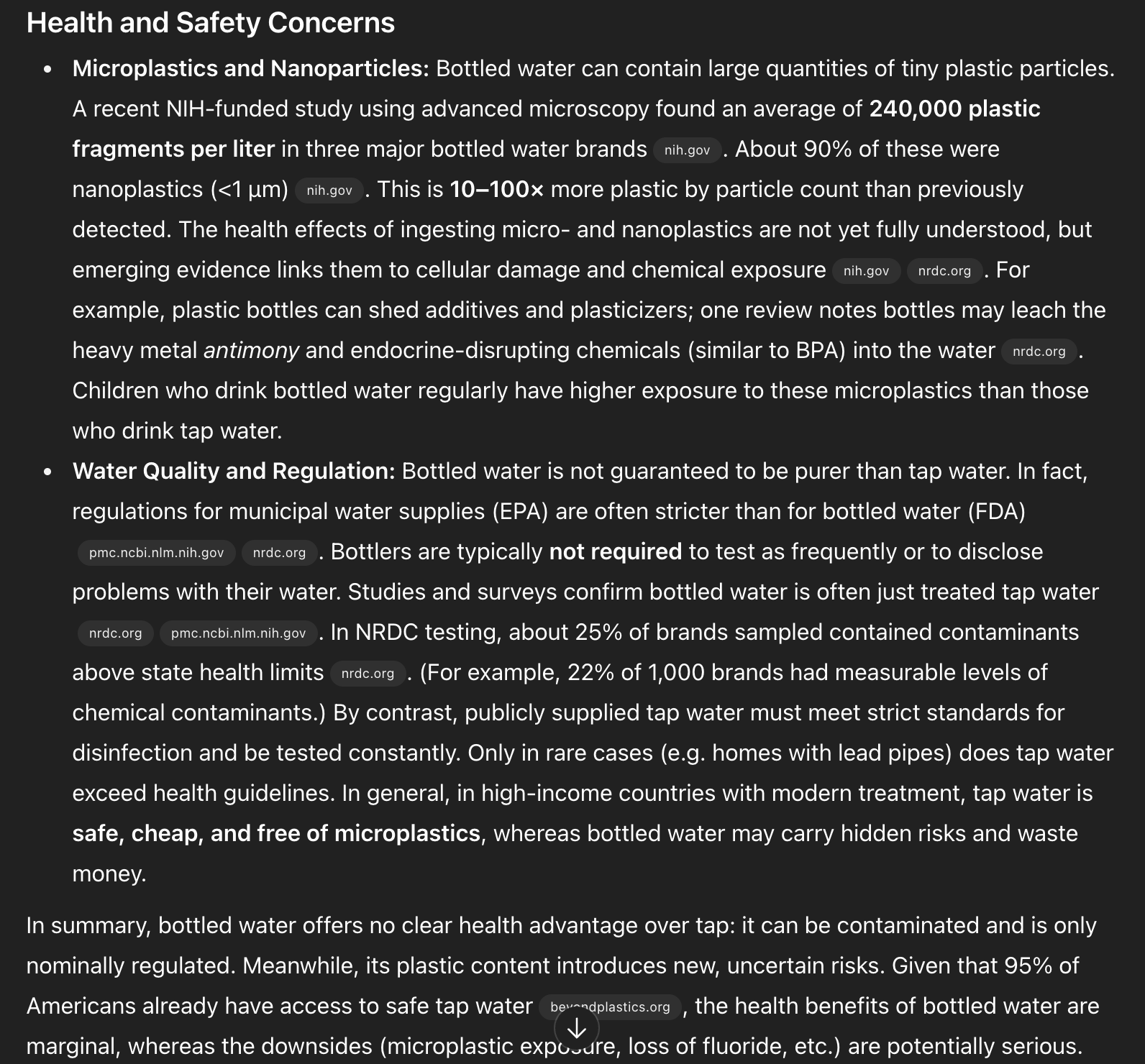
## Screenshot: Health and Safety Concerns Document
### Overview
The document is a text-based analysis comparing the health and safety risks of bottled water versus tap water. It emphasizes microplastic contamination in bottled water, regulatory differences, and cost implications.
### Components/Axes
- **Title**: "Health and Safety Concerns" (top of the document).
- **Sections**:
1. **Microplastics and Nanoparticles**:
- Bullet points with embedded hyperlinks (e.g., `nih.gov`, `nrdc.org`).
- Key data:
- Average of **240,000 plastic fragments per liter** in three major bottled water brands.
- **90%** of fragments are nanoplastics (<1 μm).
- **10–100× more plastic** by particle count than previously detected.
- Health risks: cellular damage, endocrine disruption (e.g., BPA-like chemicals).
- Children drinking bottled water have **higher exposure** to microplastics than tap water drinkers.
2. **Water Quality and Regulation**:
- Bullet points with hyperlinks (e.g., `pmc.ncbi.nlm.nih.gov`, `nrdc.org`).
- Key data:
- Bottled water **not guaranteed purer** than tap water.
- EPA regulations for tap water are **stricter** than FDA regulations for bottled water.
- **25%** of bottled water brands sampled contained contaminants above state health limits.
- **22%** of 1,000 brands had measurable chemical contaminants.
- Tap water in high-income countries is **safe, cheap, and free of microplastics**.
- **Summary Section**:
- Concludes bottled water offers **no clear health advantage** over tap water.
- Highlights **marginal benefits** of bottled water vs. risks like microplastic exposure and fluoride loss.
### Detailed Analysis
- **Microplastics**:
- Study references: NIH-funded research using advanced microscopy.
- Sources: `nih.gov`, `nrdc.org`.
- Health effects: Emerging evidence links microplastics to cellular damage and endocrine disruption.
- **Regulatory Gaps**:
- EPA vs. FDA standards: Tap water testing is **constant**; bottled water testing is **infrequent**.
- Contaminant examples: Heavy metal antimony, endocrine-disrupting chemicals.
- **Cost and Accessibility**:
- Bottled water is **expensive** and **wastes money** compared to tap water.
- 95% of Americans have access to safe tap water.
### Key Observations
- **Microplastic Prevalence**: Bottled water contains **10–100× more microplastics** than previously reported.
- **Regulatory Disparities**: Tap water faces stricter, more frequent testing than bottled water.
- **Contaminant Risks**: 25% of bottled water brands exceed health limits for contaminants.
- **Cost-Benefit Tradeoff**: Bottled water’s health benefits are **marginal**, while downsides (microplastics, cost) are significant.
### Interpretation
The document argues that bottled water is **not inherently safer** than tap water. Key points:
1. **Microplastic Exposure**: Bottled water poses a **10–100× higher risk** of microplastic ingestion, with potential cellular and endocrine effects.
2. **Regulatory Weaknesses**: Bottled water is **less regulated** than tap water, with infrequent testing and no requirement to disclose issues.
3. **Cost vs. Benefit**: Bottled water is **expensive** and **environmentally wasteful**, while tap water in modern systems is **safe and free of microplastics**.
4. **Targeted Risks**: Children drinking bottled water face **higher microplastic exposure** than tap water consumers.
The conclusion emphasizes that **tap water is the safer, more sustainable choice** for most Americans, with bottled water offering negligible advantages at a high cost.