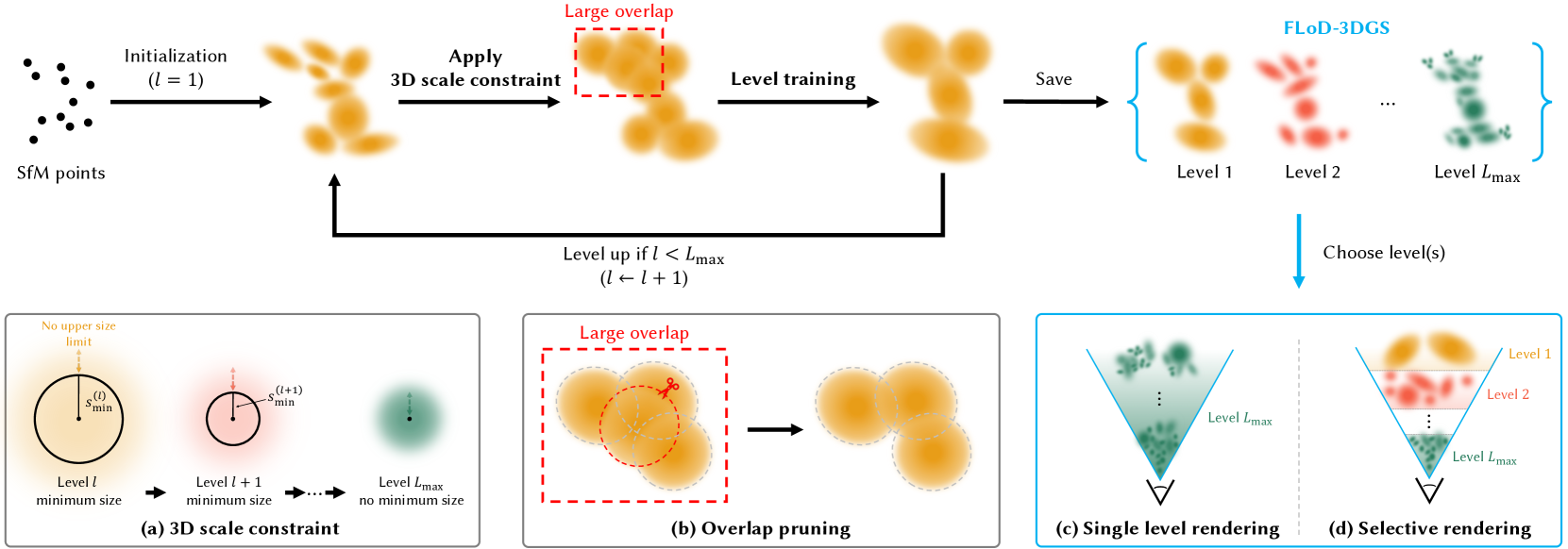
## Flowchart: Multi-Level 3D Rendering Process with Scale Constraints and Overlap Pruning
### Overview
The image depicts a technical workflow for hierarchical 3D rendering optimization, featuring four core stages: initialization, scale constraint application, level training, and rendering selection. It includes four sub-diagrams illustrating specific mechanisms (scale constraints, overlap pruning, and rendering methods) and a final rendering output visualization.
### Components/Axes
1. **Main Process Flow** (Top Section):
- **Initialization (l=1)**: Starts with SfM (Structure-from-Motion) points.
- **Apply 3D Scale Constraint**: Visualized with progressively larger yellow spheres.
- **Level Training**: Shows iterative refinement of 3D models.
- **Save**: Outputs multi-level models (Level 1, Level 2, ..., Level L_max).
- **Choose Level(s)**: Final step for rendering selection.
2. **Sub-Diagrams**:
- **(a) 3D Scale Constraint**:
- Labels: "No upper size limit", "Level l", "Level l+1", "Level L_max".
- Visual: Circles with increasing minimum sizes (S_min) and no maximum size.
- **(b) Overlap Pruning**:
- Labels: "Large overlap" (red dashed box).
- Visual: Overlapping yellow circles with pruned overlaps (dashed lines).
- **(c)/(d) Rendering Methods**:
- Labels: "Single level rendering", "Selective rendering".
- Visual: Funnel diagrams with colored particles (green, yellow, red) representing different levels.
3. **Legend**:
- Colors: Yellow (Level 1), Red (Level 2), Green (Level L_max).
- Position: Bottom-right corner of the main flowchart.
### Detailed Analysis
- **3D Scale Constraint (a)**:
- Minimum size increases monotonically with level (S_min(l) < S_min(l+1)).
- No upper size limit enforced at any level.
- **Overlap Pruning (b)**:
- Overlaps between adjacent levels are explicitly removed (dashed lines indicate pruned regions).
- **Rendering Methods (c/d)**:
- Single-level rendering uses only one level (e.g., Level L_max).
- Selective rendering combines multiple levels (e.g., Level 1 + Level 2).
### Key Observations
1. **Hierarchical Progression**: Each level builds on the previous one, with strict size constraints (no overlap between levels after pruning).
2. **Color Consistency**: Legend colors (yellow/red/green) match the corresponding levels in the final rendering output.
3. **Pruning Mechanism**: Overlap pruning ensures non-overlapping regions between levels, critical for rendering efficiency.
### Interpretation
This workflow optimizes 3D rendering by:
1. **Progressive Refinement**: Starting with coarse SfM points and iteratively refining models at increasing scales.
2. **Efficient Resource Use**: Overlap pruning prevents redundant computations between levels.
3. **Flexible Output**: Selective rendering allows combining levels for application-specific needs (e.g., balancing detail and performance).
The process resembles a multi-resolution framework, where higher levels capture finer details while lower levels maintain structural integrity. The absence of numerical values suggests a conceptual rather than quantitative analysis, focusing on architectural principles rather than performance metrics.