## Flowchart Diagram: Comparative Analysis of Music Analysis Models
### Overview
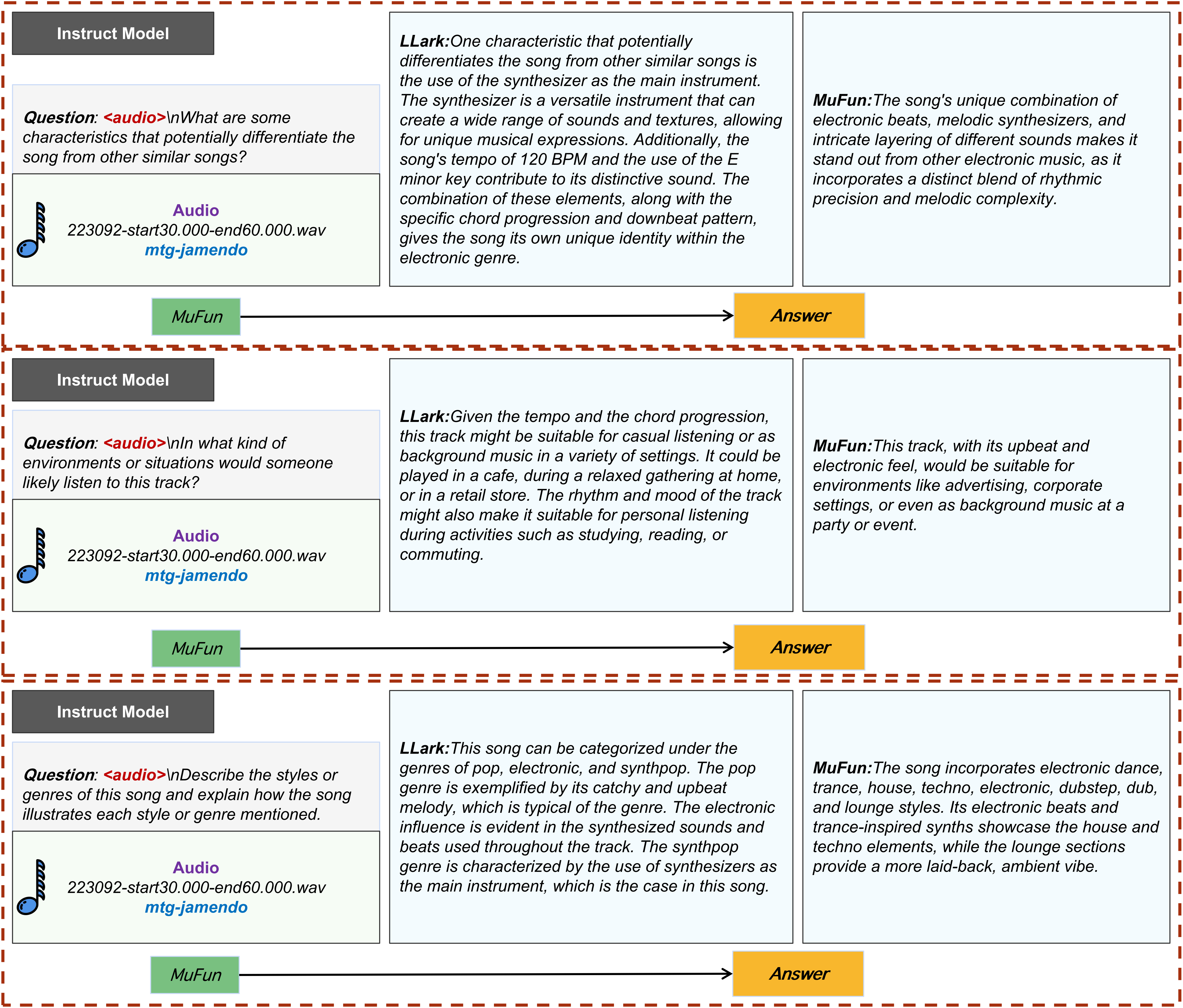
The diagram presents a comparative analysis framework for evaluating music analysis models (LLark and MuFun) across three distinct query types. Each section contains a question, audio metadata, and side-by-side model responses. The structure emphasizes comparative reasoning through parallel processing of identical inputs.
### Components/Axes
1. **Header Elements**:
- Gray box labeled "Instruct Model" at top of each section
- Red dashed border framing entire diagram
- Yellow "Answer" box at bottom right of each section
2. **Main Content**:
- Three vertically stacked sections (Q1-Q3)
- Each section contains:
- Bold question text (audio analysis queries)
- Audio metadata box (purple "Audio" label + waveform code)
- Two answer boxes (blue for LLark, yellow for MuFun)
3. **Textual Elements**:
- Questions focus on:
1. Song differentiation characteristics
2. Suitable listening environments
3. Genre/style classification
- Audio metadata: "223092-start30.000-end60.000.wav" with "mtg-jamendo" tag
- Model responses compare technical analysis approaches
### Detailed Analysis
#### Section 1: Song Differentiation
- **LLark Response**: Focuses on synthesizer use (versatile instrument), tempo (120 BPM), and chord progression (E minor key)
- **MuFun Response**: Emphasizes electronic beats, melodic layering, and rhythmic/melodic complexity
#### Section 2: Listening Environments
- **LLark Response**: Suggests casual settings (cafes, home gatherings) and personal activities (studying, commuting)
- **MuFun Response**: Highlights advertising, corporate events, and party environments
#### Section 3: Genre Classification
- **LLark Response**: Categorizes as pop/electronic/synthpop with emphasis on synthesized sounds
- **MuFun Response**: Identifies multiple electronic subgenres (trance, house, techno) with stylistic variations
### Key Observations
1. Both models consistently analyze the same audio segment (30-60s waveform)
2. LLark emphasizes technical musical elements (tempo, chord progression)
3. MuFun focuses on stylistic blending and mood-based categorization
4. Answers demonstrate complementary approaches to music analysis
### Interpretation
The diagram illustrates a comparative evaluation framework for music analysis models. LLark demonstrates strength in technical music theory analysis (tempo, chord structure), while MuFun excels in contextual and stylistic interpretation. The parallel processing structure suggests a methodology for benchmarking different analytical approaches to the same audio input. The consistent use of the same audio segment across queries allows for direct comparison of model capabilities in different analytical domains.