## Diagram: Reasoning Phenomenon Illustrations
### Overview
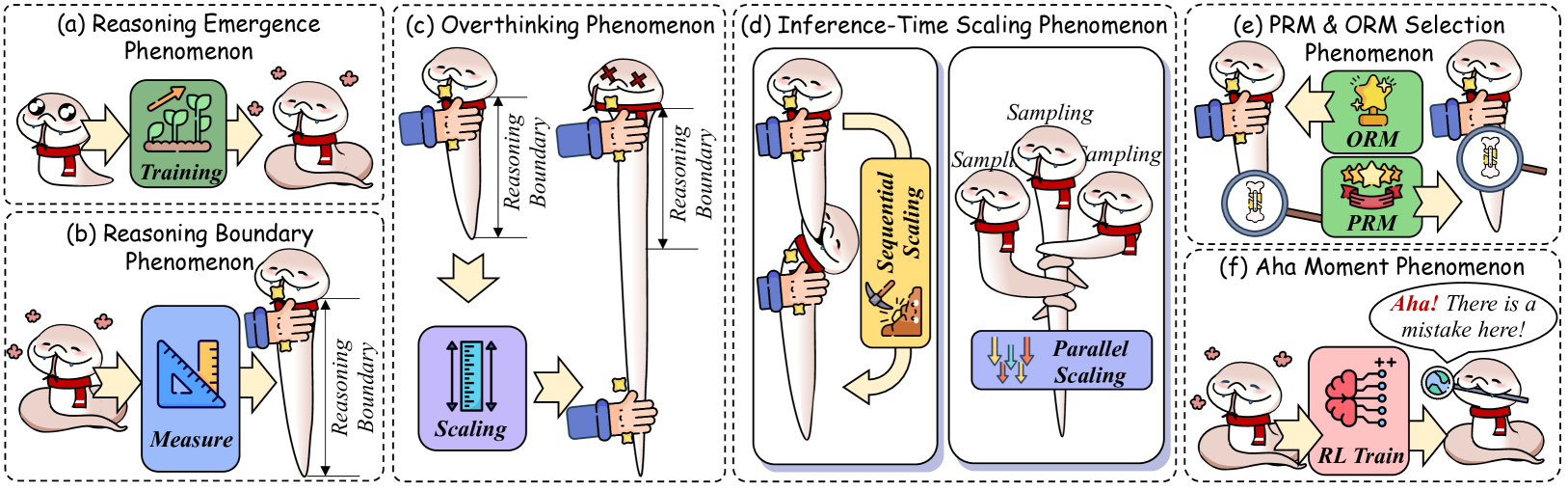
The image presents a series of diagrams illustrating different reasoning phenomena. Each diagram depicts a stylized worm-like character interacting with various objects and processes, representing different aspects of reasoning and problem-solving. The diagrams are arranged in a grid-like layout, with each one enclosed in a dashed-line box and labeled with a title.
### Components/Axes
The image is composed of six individual diagrams, each representing a different phenomenon:
* **(a) Reasoning Emergence Phenomenon:** Shows a worm undergoing "Training" (represented by a green box with plant growth) and emerging with enhanced capabilities.
* **(b) Reasoning Boundary Phenomenon:** Depicts a worm "Measuring" something with a ruler and then "Scaling" it. The "Reasoning Boundary" is indicated by a double-headed arrow.
* **(c) Overthinking Phenomenon:** Shows a worm with an extended "Reasoning Boundary," suggesting excessive or prolonged thought.
* **(d) Inference-Time Scaling Phenomenon:** Illustrates "Sequential Scaling" and "Parallel Scaling" processes, with worms involved in "Sampling".
* **(e) PRM & ORM Selection Phenomenon:** Depicts the selection between "PRM" (Policy Reasoning Module) and "ORM" (Object Reasoning Module), represented by star-shaped trophies.
* **(f) Aha Moment Phenomenon:** Shows a worm undergoing "RL Train" (Reinforcement Learning Training) and then experiencing an "Aha!" moment, realizing a mistake.
### Detailed Analysis
* **(a) Reasoning Emergence Phenomenon:**
* A worm on the left is facing a green box labeled "Training". Inside the box, there are plants growing upwards with an arrow indicating growth.
* An arrow points from the "Training" box to a worm on the right, which appears more confident or capable.
* **(b) Reasoning Boundary Phenomenon:**
* A worm on the left is facing a blue box labeled "Measure", which contains a ruler and set square.
* An arrow points from the "Measure" box to a blue box labeled "Scaling", which contains a ruler with arrows pointing up and down.
* A "Reasoning Boundary" is indicated by a double-headed arrow pointing to the worm.
* **(c) Overthinking Phenomenon:**
* A worm is shown with a "Reasoning Boundary" indicated by a double-headed arrow.
* The worm then transforms into a worm with crosses on its head, suggesting confusion or overload. The "Reasoning Boundary" is extended.
* **(d) Inference-Time Scaling Phenomenon:**
* A worm is shown undergoing "Sequential Scaling" with an arrow pointing downwards.
* Three worms are shown undergoing "Sampling".
* The three worms are then shown undergoing "Parallel Scaling" with arrows pointing downwards.
* **(e) PRM & ORM Selection Phenomenon:**
* A worm is shown facing two green boxes labeled "ORM" and "PRM". "ORM" contains a gold trophy with one star. "PRM" contains a red banner with three stars.
* Arrows point from the worm to the boxes and back, suggesting a selection process.
* A magnifying glass is shown highlighting the worm.
* **(f) Aha Moment Phenomenon:**
* A worm is shown facing a pink box labeled "RL Train", which contains a brain with connections.
* An arrow points from the "RL Train" box to a worm on the right, which is looking through a magnifying glass at a globe.
* A speech bubble contains the text "Aha! There is a mistake here!".
### Key Observations
* The diagrams use a consistent visual style, with the worm character as the central element.
* Each diagram represents a different aspect of reasoning, from initial training to problem-solving and insight.
* The use of arrows indicates the flow of information or the progression of a process.
* The "Reasoning Boundary" concept is visually represented as a double-headed arrow, indicating the scope or limit of reasoning.
### Interpretation
The image provides a visual representation of various cognitive processes related to reasoning. It highlights the importance of training, the limitations of reasoning, the potential for overthinking, the scaling of inference processes, the selection of appropriate reasoning modules, and the occurrence of "Aha!" moments. The diagrams suggest that reasoning is a complex and multifaceted process that involves multiple stages and considerations. The use of the worm character adds a playful and engaging element to the illustrations, making the concepts more accessible.