## Reasoning Example: Textual Analysis of a Reasoning Chain
### Overview
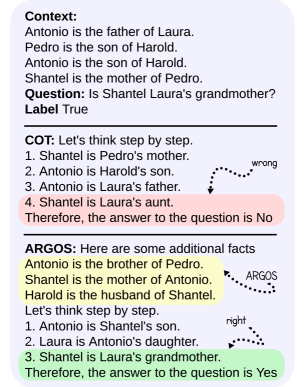
The image presents a comparison between two reasoning approaches, "COT" (Chain of Thought) and "ARGOS," in the context of a family relationship question. It shows how each approach arrives at a different conclusion, with an indication of which is considered correct.
### Components/Axes
The image is structured into three main sections:
1. **Context:** Provides the initial facts about family relationships.
2. **COT:** Presents a step-by-step reasoning process leading to a "No" answer.
3. **ARGOS:** Introduces additional facts and a different reasoning process, leading to a "Yes" answer.
### Detailed Analysis or Content Details
**Context:**
* Antonio is the father of Laura.
* Pedro is the son of Harold.
* Antonio is the son of Harold.
* Shantel is the mother of Pedro.
* Question: Is Shantel Laura's grandmother?
* Label: True
**COT:**
* COT: Let's think step by step.
1. Shantel is Pedro's mother.
2. Antonio is Harold's son.
3. Antonio is Laura's father.
4. Shantel is Laura's aunt. (Highlighted in light red)
* Therefore, the answer to the question is No (Highlighted in light red)
* A dotted line with the label "wrong" points to step 2.
**ARGOS:**
* ARGOS: Here are some additional facts
* Antonio is the brother of Pedro. (Highlighted in light yellow)
* Shantel is the mother of Antonio. (Highlighted in light yellow)
* Harold is the husband of Shantel. (Highlighted in light yellow)
* Let's think step by step.
1. Antonio is Shantel's son.
2. Laura is Antonio's daughter.
3. Shantel is Laura's grandmother. (Highlighted in light green)
* Therefore, the answer to the question is Yes (Highlighted in light green)
* A dotted line with the label "ARGOS" points to the additional facts.
* A dotted line with the label "right" points to step 1.
### Key Observations
* The "COT" approach, without additional facts, arrives at an incorrect conclusion.
* The "ARGOS" approach, incorporating additional facts, arrives at the correct conclusion.
* The image highlights the importance of having complete information for accurate reasoning.
### Interpretation
The image demonstrates how providing additional relevant information can significantly impact the accuracy of a reasoning process. The "COT" approach, relying solely on the initial context, makes an incorrect deduction. In contrast, the "ARGOS" approach, augmented with additional facts, correctly identifies Shantel as Laura's grandmother. This highlights the limitations of reasoning based on incomplete information and the potential for improved accuracy through the incorporation of relevant external knowledge. The highlighting of incorrect and correct steps visually reinforces the impact of each reasoning path.