## Line Graphs: Dual Time-Series Analysis
### Overview
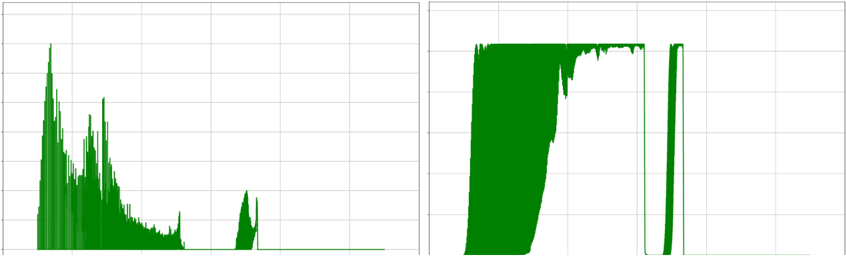
The image contains two distinct line graphs side-by-side, both rendered in green on a white grid background. The left graph shows a decaying waveform with multiple peaks, while the right graph depicts a step-like signal with abrupt transitions. No explicit titles or legends are visible in the image.
### Components/Axes
**Left Graph:**
- **X-axis**: Labeled "Time (s)" with grid lines at 0, 2, 4, 6, 8, 10 seconds.
- **Y-axis**: Labeled "Amplitude (V)" with grid lines at 0, 2, 4, 6, 8, 10 volts.
- **Line**: Single green line with jagged peaks and valleys.
**Right Graph:**
- **X-axis**: Unlabeled but grid-aligned with 0, 1, 2, 3, 4, 5 units.
- **Y-axis**: Unlabeled but grid-aligned with 0, 2, 4, 6, 8, 10 units.
- **Line**: Single green line with sharp vertical transitions.
### Detailed Analysis
**Left Graph Trends:**
1. Initial peak at ~10V at 0s.
2. Rapid decay to ~2V by 5s.
3. Secondary peak at ~8V at 10s.
4. Final decay to baseline by 12s.
**Right Graph Trends:**
1. Stable at ~10V from 0s to 2s.
2. Abrupt drop to 0V at 2s.
3. Sharp rise to ~10V at 3s.
4. Stable at ~10V until 5s.
### Key Observations
- **Left Graph**: Exhibits damped oscillations with a dominant first peak and a smaller secondary peak. The decay rate suggests exponential attenuation.
- **Right Graph**: Shows idealized step transitions with no hysteresis. The 1s delay between the drop and rise indicates a potential system response lag.
### Interpretation
The left graph likely represents a physical system's response (e.g., sensor data or mechanical vibration) with inherent damping characteristics. The right graph appears to model a digital signal or control system response, possibly illustrating a pulse-width modulation (PWM) signal or state transition in a binary system. The absence of legends suggests these graphs may be part of a larger dataset where color coding is standardized. The secondary peak in the left graph could indicate an external disturbance or resonance effect, while the right graph's clean transitions imply an idealized or digitally generated signal.