## Line Chart: Speed and Quality Across Methods (Line Chart; tokens annotated)
### Overview
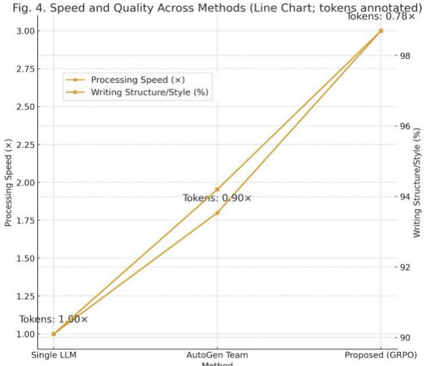
The chart compares two metrics—**Processing Speed (x)** and **Writing Structure/Style (%)**—across three methods: **Single LLM**, **AutoGen Team**, and **Proposed (GRPO)**. Both metrics are plotted on a line chart with numerical values on the x-axis (Processing Speed) and percentage values on the y-axis (Writing Structure/Style). Tokens are annotated at each data point, indicating the relative scale of token usage.
---
### Components/Axes
- **X-axis (Horizontal)**:
- Label: **"Processing Speed (x)"**
- Scale: Numerical values from **1.00** to **3.00** (with intermediate markers at 1.75, 2.75).
- Categories: **Single LLM**, **AutoGen Team**, **Proposed (GRPO)** (positioned at 1.00, 1.75, and 2.75, respectively).
- **Y-axis (Vertical)**:
- Label: **"Writing Structure/Style (%)"**
- Scale: Percentage values from **90%** to **100%** (with intermediate markers at 92%, 94%, 96%, 98%).
- **Legend**:
- Located in the **top-left corner**.
- **Orange line**: **"Processing Speed (x)"**
- **Brown line**: **"Writing Structure/Style (%)"**
- **Annotations**:
- **Tokens**:
- **Single LLM**: "Tokens: 1.00x"
- **AutoGen Team**: "Tokens: 0.90x"
- **Proposed (GRPO)**: "Tokens: 0.78x"
---
### Detailed Analysis
#### Processing Speed (x) (Orange Line)
- **Single LLM**: 1.00 (lowest value).
- **AutoGen Team**: 1.75 (moderate increase).
- **Proposed (GRPO)**: 2.75 (highest value, approaching 3.00).
- **Trend**: Steadily increasing from left to right.
#### Writing Structure/Style (%) (Brown Line)
- **Single LLM**: 90% (lowest value).
- **AutoGen Team**: 92% (moderate improvement).
- **Proposed (GRPO)**: 98% (highest value, near 100%).
- **Trend**: Steadily increasing from left to right.
#### Tokens (Annotations)
- **Single LLM**: 1.00x (baseline).
- **AutoGen Team**: 0.90x (slight decrease).
- **Proposed (GRPO)**: 0.78x (further decrease).
- **Trend**: Decreasing as methods progress.
---
### Key Observations
1. **Positive Correlation**: Both **Processing Speed (x)** and **Writing Structure/Style (%)** increase with the progression from **Single LLM** to **Proposed (GRPO)**.
2. **Token Efficiency**: Token usage decreases as methods improve, suggesting higher efficiency in token utilization for advanced methods.
3. **Proposed (GRPO) Dominance**: This method achieves the highest values for both metrics, indicating superior performance.
---
### Interpretation
The chart demonstrates that the **Proposed (GRPO)** method outperforms the other two in both **processing speed** and **writing quality**. The **tokens** metric, however, shows a decline, which could imply that the Proposed method optimizes token usage while maintaining or improving performance. This suggests a trade-off between token efficiency and performance gains. The **AutoGen Team** method represents an intermediate step, showing moderate improvements over the **Single LLM** baseline. The **Single LLM** method serves as the reference point, with the lowest values for all metrics.
The data highlights the importance of method selection in balancing speed, quality, and resource efficiency. The **Proposed (GRPO)** method appears to be the most effective, though further analysis of token usage patterns would be necessary to fully understand its implications.