## Diagram: Mechanical/Structural Schematic
### Overview
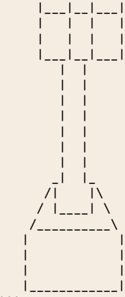
The image depicts a vertical mechanical or structural schematic with dashed-line connections between labeled components. The diagram is divided into three primary sections: a top compartmentalized area, a central vertical shaft, and a base with a trapezoidal and rectangular structure.
### Components/Axes
- **Top Section**:
- Three horizontally aligned compartments labeled **A**, **B**, and **C** (left to right).
- Dashed lines connect these compartments to the central shaft (**D**).
- **Central Shaft**:
- Vertical dashed line labeled **D**, connecting the top section to the base.
- **Base Section**:
- Trapezoidal structure labeled **E** (upper portion) and **F** (lower portion).
- Rectangular base labeled **G**, positioned below the trapezoidal section.
- Dashed lines connect the shaft (**D**) to the trapezoidal section (**E**).
### Detailed Analysis
- **Labels**:
- All components are labeled with uppercase letters (A–G).
- No numerical values, scales, or legends are present.
- Dashed lines indicate conceptual or functional connections rather than physical pathways.
- **Spatial Relationships**:
- **A, B, C** are positioned at the top, equidistant from the central axis.
- **D** acts as a vertical intermediary between the top and base sections.
- **E** (trapezoidal) and **F** (rectangular) are stacked vertically in the base, with **G** forming the lowest layer.
### Key Observations
- The diagram emphasizes hierarchical organization, with the top section (A–C) feeding into the central shaft (D), which in turn supports the base (E–G).
- The trapezoidal shape of **E** may imply a load-bearing or transitional function, while the rectangular **F** and **G** suggest stability or foundational support.
- No explicit directional flow (e.g., fluid, electrical) is indicated, but the dashed lines suggest potential energy or force transfer.
### Interpretation
This schematic likely represents a mechanical system where the top section (A–C) serves as an input or operational zone, the shaft (D) transmits forces or motion, and the base (E–G) provides structural integrity. The trapezoidal **E** could symbolize a tapered load distribution, while the rectangular **F** and **G** ensure stability. The absence of numerical data implies the diagram is conceptual, focusing on component relationships rather than quantitative analysis.
**Note**: No textual data, numerical values, or secondary languages are present in the image. The diagram relies solely on geometric shapes and labels to convey structural hierarchy.