## Concept Diagram: Biological Classification Hierarchy
### Overview
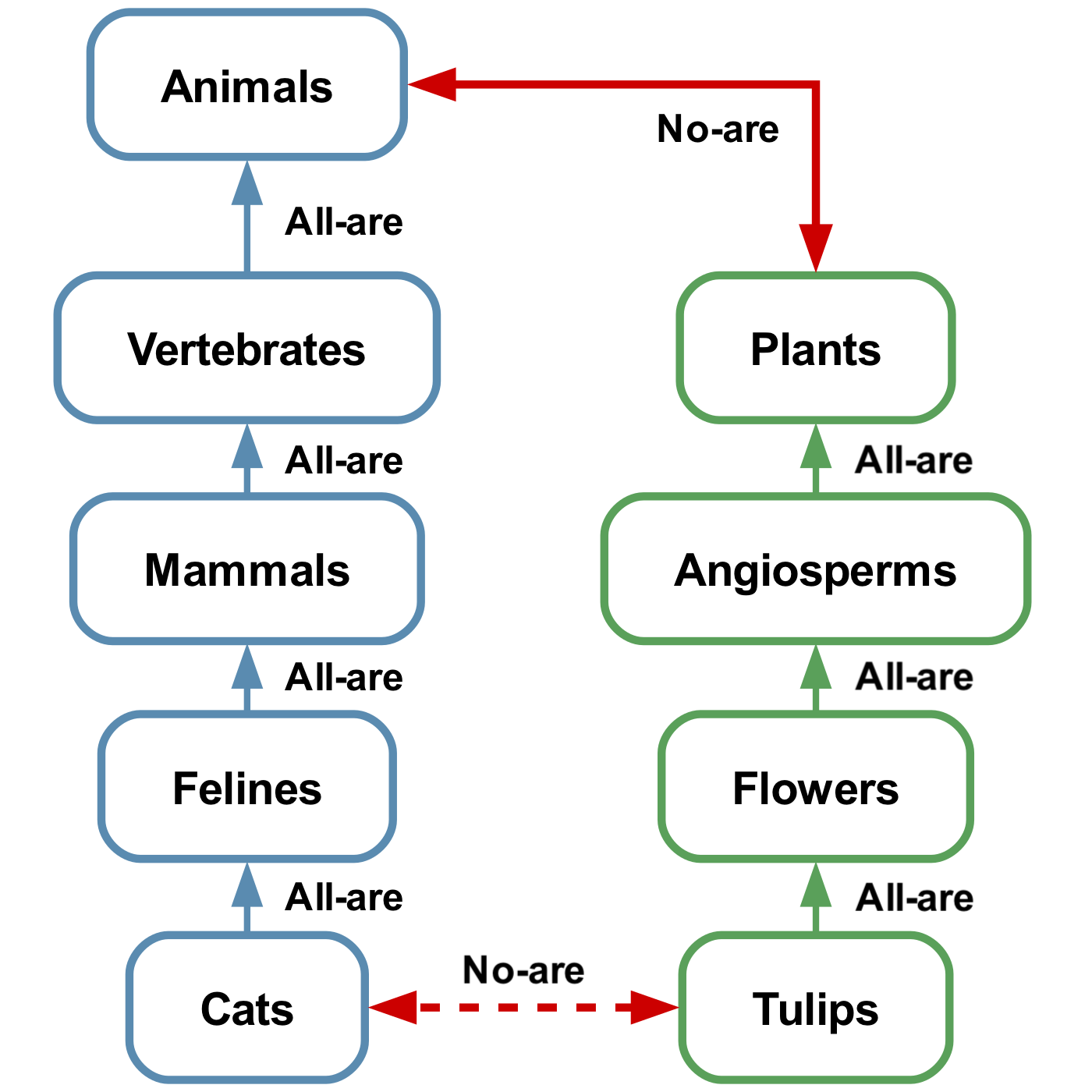
The image is a conceptual diagram illustrating hierarchical relationships within biological classification, specifically contrasting the animal and plant kingdoms. It uses a flowchart structure with two distinct, color-coded branches connected by a top-level relationship. The diagram visually represents "is-a" (All-are) and "is-not-a" (No-are) relationships between categories.
### Components/Axes
The diagram consists of two primary vertical chains of rounded rectangular boxes, connected by arrows.
**Left Branch (Animal Kingdom - Blue Borders):**
* **Top Box:** "Animals" (Position: Top-left)
* **Second Box:** "Vertebrates" (Position: Below "Animals")
* **Third Box:** "Mammals" (Position: Below "Vertebrates")
* **Fourth Box:** "Felines" (Position: Below "Mammals")
* **Bottom Box:** "Cats" (Position: Bottom-left)
**Right Branch (Plant Kingdom - Green Borders):**
* **Top Box:** "Plants" (Position: Top-right)
* **Second Box:** "Angiosperms" (Position: Below "Plants")
* **Third Box:** "Flowers" (Position: Below "Angiosperms")
* **Bottom Box:** "Tulips" (Position: Bottom-right)
**Relationship Arrows & Labels:**
1. **Blue Upward Arrows (Left Branch):** Connect each box to the one above it. Each arrow is labeled with the text **"All-are"**.
* Cats -> Felines: "All-are"
* Felines -> Mammals: "All-are"
* Mammals -> Vertebrates: "All-are"
* Vertebrates -> Animals: "All-are"
2. **Green Upward Arrows (Right Branch):** Connect each box to the one above it. Each arrow is labeled with the text **"All-are"**.
* Tulips -> Flowers: "All-are"
* Flowers -> Angiosperms: "All-are"
* Angiosperms -> Plants: "All-are"
3. **Red Horizontal Arrow (Top):** A solid red arrow with arrowheads on both ends connects the "Animals" box to the "Plants" box. It is labeled with the text **"No-are"**.
4. **Red Dashed Arrow (Bottom):** A dashed red arrow with arrowheads on both ends connects the "Cats" box to the "Tulips" box. It is labeled with the text **"No-are"**.
### Detailed Analysis
The diagram establishes two clear, parallel taxonomic hierarchies:
* **Animal Hierarchy:** Cats are a type of Feline. All Felines are Mammals. All Mammals are Vertebrates. All Vertebrates are Animals.
* **Plant Hierarchy:** Tulips are a type of Flower. All Flowers are Angiosperms. All Angiosperms are Plants.
The relationships are defined by two predicate types:
* **"All-are":** Indicates a universal subset relationship (e.g., every member of the lower category is also a member of the higher category).
* **"No-are":** Indicates mutual exclusivity. The top-level "No-are" arrow between "Animals" and "Plants" signifies that these are separate, non-overlapping kingdoms. The bottom-level "No-are" arrow between "Cats" and "Tulips" reinforces this exclusivity at the most specific level shown.
### Key Observations
1. **Symmetrical Structure:** The diagram is visually balanced, with five boxes in the animal branch and four in the plant branch, creating a slight asymmetry at the base.
2. **Color Coding:** Blue is used exclusively for the animal lineage, green for the plant lineage, and red for the negative ("No-are") relationships. This provides immediate visual categorization.
3. **Arrow Direction:** All "All-are" arrows point upward, indicating a movement from specific to general categories. The "No-are" arrows are horizontal, indicating a relationship of opposition or separation between parallel categories.
4. **Dashed vs. Solid Line:** The "No-are" relationship between the top-level kingdoms ("Animals"/"Plants") is shown with a solid line, while the relationship between the most specific examples ("Cats"/"Tulips") is shown with a dashed line. This may imply a difference in the nature or emphasis of the relationship, though the label is identical.
### Interpretation
This diagram is a pedagogical tool designed to teach fundamental concepts in biological taxonomy and set theory logic. It demonstrates:
* **Hierarchical Classification:** How organisms are grouped into increasingly broad categories (from species like Cats/Tulips up to Kingdoms).
* **Inheritance of Properties:** The "All-are" relationship implies that properties of a higher category (e.g., being an Animal) are inherited by all sub-categories (e.g., Vertebrates, Mammals, Felines, Cats).
* **Mutual Exclusivity at the Kingdom Level:** The core "No-are" relationship between Animals and Plants establishes the primary, non-overlapping division in this simplified model of life. The diagram logically deduces that if Cats are Animals and Tulips are Plants, and Animals are not Plants, then Cats cannot be Tulips (the bottom "No-are" arrow).
* **Visual Logic:** The spatial layout and color coding make the abstract logical relationships concrete and easy to follow. The diagram effectively communicates that while there is a deep hierarchy *within* each kingdom, the kingdoms themselves are fundamentally distinct.