## Decision Tree: Bread Loaf Calculation
### Overview
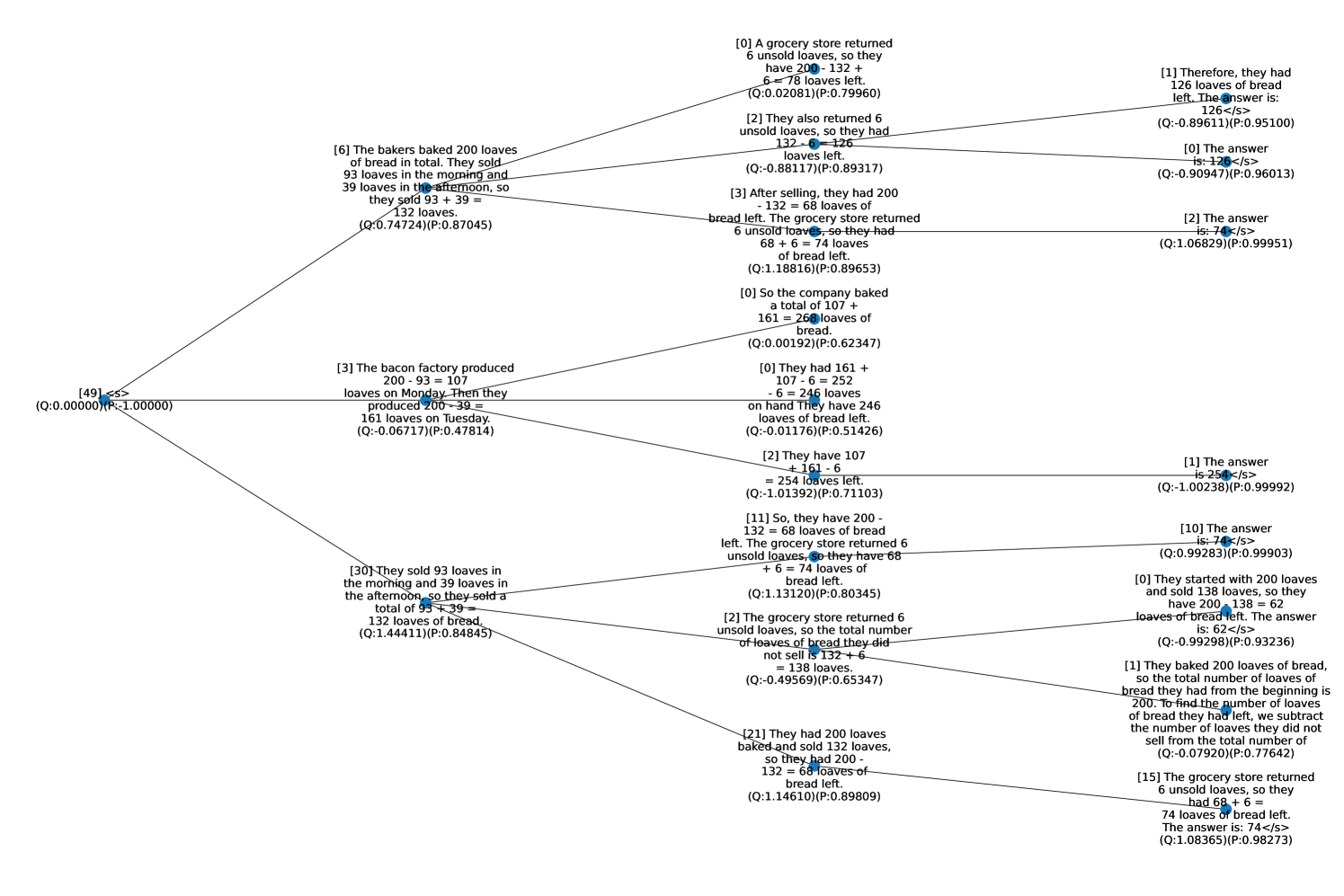
The image is a decision tree diagram illustrating different scenarios involving the baking, selling, and returning of bread loaves. Each node represents a step in the process, with calculations and textual descriptions of the events. The tree starts with an initial state and branches out based on different actions taken.
### Components/Axes
* **Nodes:** Each node contains a description of the scenario, calculations, and a Q and P value.
* **Branches:** Lines connecting the nodes, indicating the flow of events.
* **Root Node:** The starting point of the tree, labeled "[49] <5> (Q:0.00000) (P:-1.00000)".
* **Leaf Nodes:** The end points of the tree, providing final answers to the bread loaf calculations.
### Detailed Analysis or ### Content Details
Here's a breakdown of the tree's branches and calculations:
1. **Root Node:** "[49] <5> (Q:0.00000) (P:-1.00000)"
* This is the starting point of the decision tree.
2. **First Level Branches:**
* **Branch 1:** "[6] The bakers baked 200 loaves of bread in total. They sold 93 loaves in the morning and 39 loaves in the afternoon, so they sold 93 + 39 = 132 loaves. (Q:0.74724)(P:0.87045)"
* Calculation: 93 + 39 = 132
* Description: Bakers baked 200 loaves and sold 132.
* **Branch 2:** "[3] The bacon factory produced 200 - 93 = 107 loaves on Monday. Then they produced 200 - 39 = 161 loaves on Tuesday. (Q:-0.06717)(P:0.47814)"
* Calculations: 200 - 93 = 107, 200 - 39 = 161
* Description: Bacon factory produced 107 loaves on Monday and 161 on Tuesday.
* **Branch 3:** "[30] They sold 93 loaves in the morning and 39 loaves in the afternoon, so they sold a total of 93 + 39 = 132 loaves of bread. (Q:1.44411)(P:0.84845)"
* Calculation: 93 + 39 = 132
* Description: 132 loaves sold in total.
3. **Second Level Branches (from Branch 1):**
* **Branch 1.1:** "[0] A grocery store returned 6 unsold loaves, so they have 200 - 132 + 6 = 74 loaves left. (Q:0.02081)(P:0.79960)"
* Calculation: 200 - 132 + 6 = 74
* Description: Grocery store returned 6 loaves, resulting in 74 loaves left.
* **Branch 1.2:** "[2] They also returned 6 unsold loaves, so they had 132 - 6 = 126 loaves left. (Q:-0.88117)(P:0.89317)"
* Calculation: 132 - 6 = 126
* Description: 6 loaves returned, resulting in 126 loaves left.
* **Branch 1.3:** "[3] After selling, they had 200 - 132 = 68 loaves of bread left. The grocery store returned 6 unsold loaves, so they had 68 + 6 = 74 loaves of bread left. (Q:1.18816)(P:0.89653)"
* Calculations: 200 - 132 = 68, 68 + 6 = 74
* Description: After selling and return, 74 loaves left.
4. **Second Level Branches (from Branch 2):**
* **Branch 2.1:** "[0] So the company baked a total of 107 + 161 = 268 loaves of bread. (Q:0.00192)(P:0.62347)"
* Calculation: 107 + 161 = 268
* Description: Total loaves baked is 268.
* **Branch 2.2:** "[0] They had 161 + 107 - 6 = 252 - 6 = 246 loaves on hand They have 246 loaves of bread left. (Q:-0.01176)(P:0.51426)"
* Calculations: 161 + 107 - 6 = 252, 252 - 6 = 246
* Description: 246 loaves of bread left.
* **Branch 2.3:** "[2] They have 107 + 161 - 6 = 254 loaves left. (Q:-1.01392)(P:0.71103)"
* Calculation: 107 + 161 - 6 = 262
* Description: 254 loaves left.
5. **Second Level Branches (from Branch 3):**
* **Branch 3.1:** "[11] So, they have 200 - 132 = 68 loaves of bread left. The grocery store returned 6 unsold loaves, so they have 68 + 6 = 74 loaves of bread left. (Q:1.13120)(P:0.80345)"
* Calculations: 200 - 132 = 68, 68 + 6 = 74
* Description: 74 loaves left.
* **Branch 3.2:** "[2] The grocery store returned 6 unsold loaves, so the total number of loaves of bread they did not sell is 132 + 6 = 138 loaves. (Q:-0.49569)(P:0.65347)"
* Calculation: 132 + 6 = 138
* Description: 138 loaves not sold.
* **Branch 3.3:** "[21] They had 200 loaves baked and sold 132 loaves, so they had 200 - 132 = 68 loaves of bread left. (Q:1.14610)(P:0.89809)"
* Calculation: 200 - 132 = 68
* Description: 68 loaves left.
6. **Leaf Nodes:**
* Several leaf nodes provide final answers, such as "[1] Therefore, they had 126 loaves of bread left. The answer is: 126</s> (Q:-0.89611)(P:0.95100)", "[2] The answer is: 74</s> (Q:1.06829)(P:0.99951)", "[1] The answer is 254</s> (Q:-1.00238)(P:0.99992)", "[10] The answer is: 74</s> (Q:0.99283)(P:0.99903)", "[0] They started with 200 loaves and sold 138 loaves, so they have 200 - 138 = 62 loaves of bread left. The answer is: 62</s> (Q:-0.99298)(P:0.93236)", "[15] The grocery store returned 6 unsold loaves, so they had 68 + 6 = 74 loaves of bread left. The answer is: 74</s> (Q:1.08365)(P:0.98273)".
### Key Observations
* The decision tree explores various scenarios involving bread loaf production, sales, and returns.
* Calculations are performed at each node to determine the number of loaves remaining or produced.
* The tree branches out based on different events, such as selling loaves, returning loaves, or baking more loaves.
* The leaf nodes provide the final answers to the calculations.
### Interpretation
The decision tree provides a structured way to analyze different scenarios related to bread loaf management. It demonstrates how various actions, such as baking, selling, and returning loaves, affect the final number of loaves available. The tree helps to visualize the flow of events and calculate the outcomes based on different conditions. The Q and P values associated with each node might represent some form of quality or probability assessment, but without further context, their exact meaning is unclear. The tree highlights the importance of tracking bread loaf inventory and managing sales and returns effectively.