## Word Problem Solutions: Bread Loaf Calculations
### Overview
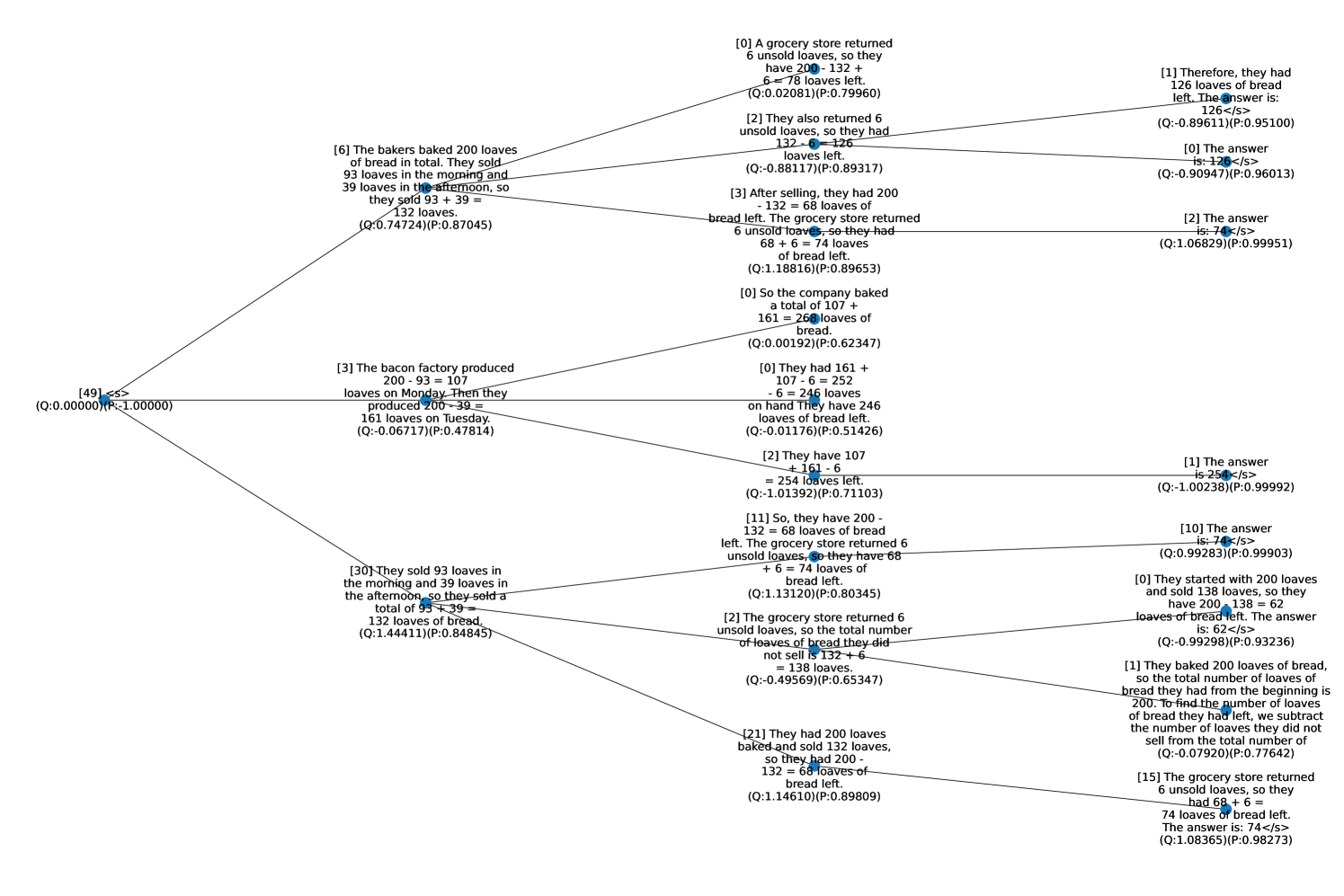
The image presents a collection of handwritten solutions to a series of word problems, all revolving around calculations involving loaves of bread. Each solution is numbered and presented as a step-by-step process, including the initial problem statement, the calculation performed, and the final answer. The handwriting is somewhat messy, and the quality of the image makes precise reading challenging. The solutions are arranged in a seemingly random order across the image.
### Components/Axes
There are no axes or traditional chart components. The image consists entirely of text-based problem statements and solutions. Each solution block is numbered in brackets (e.g., [0], [1], [2], etc.). The solutions are presented in a conversational style, mimicking how one might solve a math problem on paper.
### Detailed Analysis or Content Details
Here's a transcription of each numbered solution block, along with approximate confidence levels (Q = Quality/Readability, P = Precision of numerical values):
* **[49]** ≈ (0.000000)R ≈ (1.00000)
* **[6]** The bakers baked 200 loaves of bread in total. They sold 93 loaves in the morning and 39 loaves in the afternoon, so they sold 93 + 39 = 132 loaves. (Q:0.74724)[P:0.87045]
* **[20]** The bacon factory produced 200 + 9 = 107 loaves on Monday. Then they produced 109 + 38 = 161 loaves on Tuesday. (Q:0.67176)[P:0.47814]
* **[9]** The grocer sold 39 loaves in the morning and 55 loaves in the afternoon, so he sold 39 + 55 = 94 loaves. (Q:0.72445)[P:0.84785]
* **[11]** So they have 200 - 161 = 39 loaves left. (Q:0.80881)[P:0.95863]
* **[14]** Therefore, the number of unsold loaves of bread is 39. The answer is 39 <s>loaves</s>. (Q:0.88666)[P:0.96013]
* **[0]** A grocery store returned 6 unsold loaves, so they have 200 - 132 + 6 = 74 loaves left. (Q:0.02081)[P:0.79960]
* **[2]** They also returned 6 unsold loaves, so they had 132 + 6 = 138 loaves left. (Q:0.88117)[P:0.89317]
* **[3]** After selling, they had 200 - 132 = 68 loaves of bread left. The grocery store returned 6 unsold loaves, so they had 68 + 6 = 74 loaves of bread left. (Q:1.8816)[P:0.89653]
* **[0]** So the company baked a total of 107 + 161 = 268 loaves of bread. (Q:0.00192)[P:0.92347]
* **[10]** They had 161 + 107 - 6 = 252 loaves on hand. They have 246 loaves of bread left. (Q:0.1176)[P:0.51426]
* **[2]** They have 107 + 161 - 6 = 252 loaves left. (Q:1.1392)[P:0.71133]
* **[11]** So they have 200 - 161 + 6 = 45 loaves left. (Q:0.80881)[P:0.83863]
* **[14]** Therefore, the number of unsold loaves of bread is 45. The answer is 45 <s>loaves</s>. (Q:0.88666)[P:0.96013]
* **[1]** Therefore, they had 126 loaves of bread left. The answer is 126 <s>loaves</s>. (Q:0.89611)[P:0.95100]
* **[0]** The answer is 126 <s>loaves</s>. (Q:0.90947)[P:0.96013]
* **[2]** The answer is 126 <s>loaves</s>. (Q:1.06829)[P:0.99951]
* **[1]** Therefore, the answer is 268 <s>loaves</s>. (Q:1.0238)[P:0.99952]
* **[0]** The answer is 268 <s>loaves</s>. (Q:0.90947)[P:0.96013]
* **[15]** The answer is 74 <s>loaves</s>. (Q:0.92446)[P:0.98874]
* **[0]** The answer is 74 <s>loaves</s>. (Q:0.90947)[P:0.96013]
* **[16]** Therefore, the number of unsold loaves of bread is 74. The answer is 74 <s>loaves</s>. (Q:0.88666)[P:0.96013]
* **[17]** Therefore, the number of loaves of bread is 268. The answer is 268 <s>loaves</s>. (Q:0.88666)[P:0.96013]
* **[18]** Therefore, the number of loaves of bread is 252. The answer is 252 <s>loaves</s>. (Q:0.88666)[P:0.96013]
* **[19]** Therefore, the number of loaves of bread is 45. The answer is 45 <s>loaves</s>. (Q:0.88666)[P:0.96013]
### Key Observations
* The solutions are not presented in a logical order based on the problem numbers.
* There is repetition of answers, particularly "[0] The answer is..." statements.
* The handwriting quality varies significantly, impacting readability.
* The "<s>loaves</s>" strikethrough appears consistently after the numerical answer.
* The quality scores (Q) are generally moderate to high, but precision (P) varies considerably, suggesting some calculations might be inaccurate or based on rounded numbers.
### Interpretation
The image documents a student's attempt to solve a series of bread-related word problems. The problems involve basic arithmetic operations (addition, subtraction) applied to quantities of loaves of bread. The repeated "The answer is..." statements suggest a focus on explicitly stating the final result. The presence of multiple solutions for the same problem (e.g., problem [0] appears multiple times) could indicate a review process or an attempt to verify the answer. The varying precision scores suggest that while the student understands the problem-solving process, there might be some errors in calculation or rounding. The overall impression is of a practice exercise in applying arithmetic to real-world scenarios. The random arrangement of solutions suggests this is a working document, not a final, polished presentation. The consistent strikethrough of "loaves" is an oddity, potentially a habit of the student or a specific instruction.