## Flowchart: Audio Processing and Classification Pipeline
### Overview
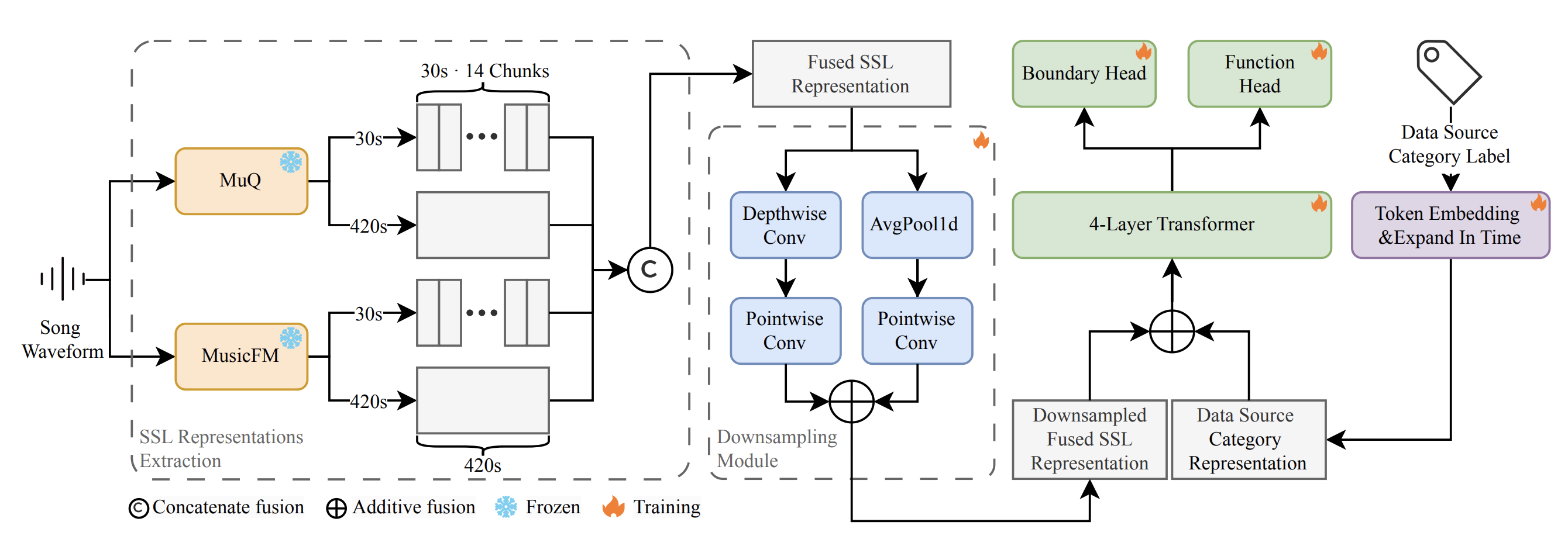
The diagram illustrates a multi-stage audio processing pipeline for music classification, combining waveform analysis, SSL (Self-Supervised Learning) representations, and transformer-based modeling. Key components include MuQ and MusicFEM modules, SSL representation fusion, and a 4-layer transformer with specialized heads.
### Components/Axes
1. **Input Stage**:
- **Song Waveform**: Raw audio input (time-domain signal).
- **MuQ Block**: Processes 30s segments (14 channels) with additive fusion.
- **MusicFEM Block**: Processes 420s segments with frozen parameters.
2. **SSL Representation Extraction**:
- **Concatenate Fusion**: Combines MuQ and MusicFEM outputs (30s + 420s).
- **Downsampling Module**: Reduces dimensionality via depthwise and pointwise convolutions.
3. **Transformer Processing**:
- **Fused SSL Representation**: Input to 4-layer transformer.
- **Boundary Head**: Predicts temporal boundaries (orange flame icon).
- **Function Head**: Extracts functional features (orange flame icon).
4. **Output Stage**:
- **Token Embedding & Expand In Time**: Converts fused SSL to temporal tokens.
- **Data Source Category Label**: Final classification output.
5. **Legend**:
- **Orange Flame**: Training phase.
- **Blue Snowflake**: Frozen parameters.
- **Red Cross**: Additive fusion.
### Detailed Analysis
- **MuQ/MusicFEM Blocks**:
- MuQ handles short-term features (30s, 14 channels), while MusicFEM captures long-term structure (420s).
- Both use additive fusion (⊕ symbol) for feature combination.
- **SSL Fusion**:
- Concatenation (⊕) merges MuQ and MusicFEM outputs, followed by downsampling via depthwise (↓) and pointwise (↓) convolutions.
- **Transformer Architecture**:
- 4-layer transformer processes fused SSL representations.
- Boundary and function heads specialize in temporal segmentation and feature extraction.
- **Tokenization**:
- "Expand In Time" block converts SSL representations into temporal tokens for transformer input.
### Key Observations
1. **Temporal Hierarchy**:
- Short-term (30s) and long-term (420s) features are processed separately before fusion.
2. **Parameter Efficiency**:
- MusicFEM and downsampling modules use frozen parameters (❄️), reducing computational cost.
3. **Multi-Task Heads**:
- Boundary and function heads enable joint prediction of segmentation and classification.
### Interpretation
This pipeline demonstrates a hybrid approach to music understanding:
1. **Feature Integration**: Combines MuQ's spectral analysis with MusicFEM's temporal modeling.
2. **Efficient Training**: Freezing MusicFEM parameters allows focused training on MuQ features.
3. **Transformer Adaptation**: Adapts SSL representations for music-specific tasks via specialized heads.
4. **Temporal Reasoning**: Token expansion enables the model to handle variable-length audio sequences.
The architecture suggests applications in music genre classification, mood detection, or structural analysis, with a focus on balancing computational efficiency and representational power.