TECHNICAL ASSET FINGERPRINT
d66183ad8f618497330467de
Click to view fullscreen
Press ESC or click to close
FOUND IN PAPERS
EXPERT: gemini-2.0-flash VERSION 1
RUNTIME: nugit/gemini/gemini-2.0-flash
INTEL_VERIFIED
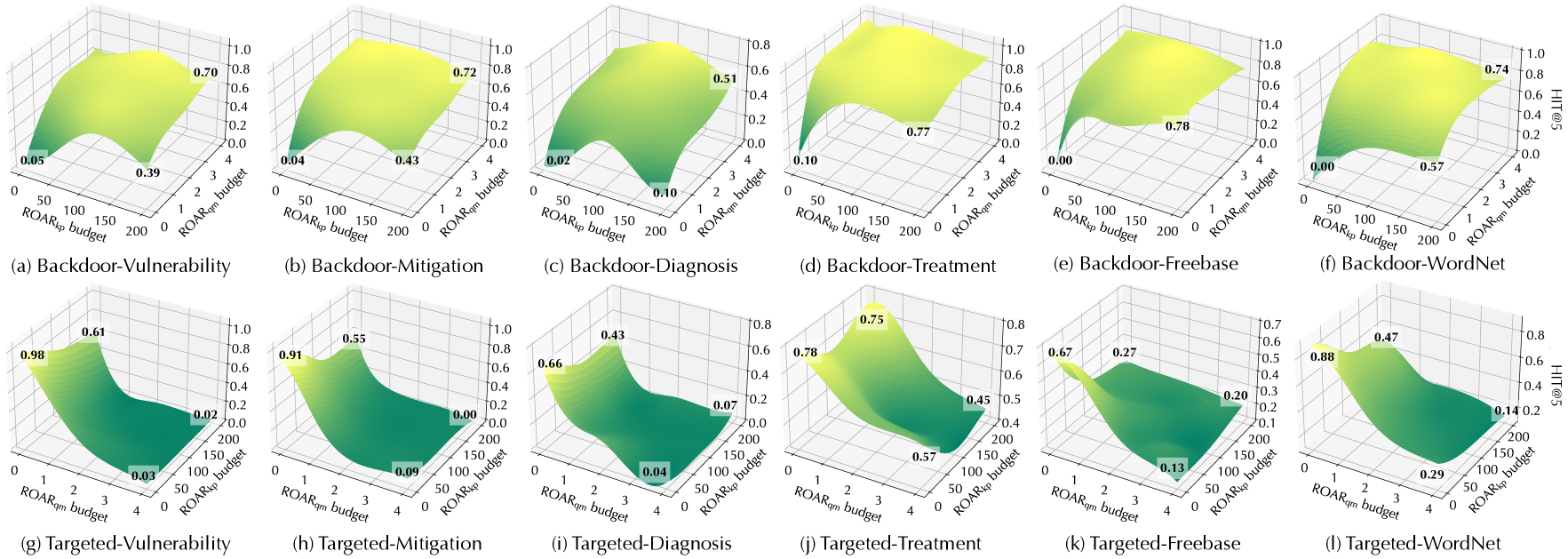
## Chart Type: 3D Surface Plots of HIT@5 vs. ROAR Budgets
### Overview
The image presents twelve 3D surface plots arranged in a 2x6 grid. Each plot visualizes the relationship between two ROAR (Remove and Retrain) budgets (ROARkp budget and ROARqm budget) and the HIT@5 metric, which represents the hit rate at the top 5 ranked items. The plots are grouped into two rows: the top row represents "Backdoor" attacks, and the bottom row represents "Targeted" attacks. Each column represents a different defense mechanism: Vulnerability, Mitigation, Diagnosis, Treatment, Freebase, and WordNet.
### Components/Axes
* **X-axis (ROARkp budget):** Ranges from 0 to 200.
* **Y-axis (ROARqm budget):** Ranges from 0 to 4.
* **Z-axis (HIT@5):** Ranges from 0 to 1.0.
* **Titles:** Each plot has a title indicating the attack type (Backdoor or Targeted) and the defense mechanism (Vulnerability, Mitigation, Diagnosis, Treatment, Freebase, WordNet).
* **Labels:** Each plot has labels for the x-axis ("ROARkp budget"), y-axis ("ROARqm budget"), and z-axis ("HIT@5").
### Detailed Analysis
Here's a breakdown of each plot, including key data points and trends:
**Top Row (Backdoor Attacks):**
* **(a) Backdoor-Vulnerability:**
* HIT@5 ranges from approximately 0.05 to 0.70.
* At ROARkp budget = 0 and ROARqm budget = 0, HIT@5 is approximately 0.05.
* At ROARkp budget = 0 and ROARqm budget = 4, HIT@5 is approximately 0.39.
* The surface generally slopes upwards as both ROARkp and ROARqm budgets increase, reaching a peak around ROARkp budget = 200.
* **(b) Backdoor-Mitigation:**
* HIT@5 ranges from approximately 0.04 to 0.72.
* At ROARkp budget = 0 and ROARqm budget = 0, HIT@5 is approximately 0.04.
* At ROARkp budget = 0 and ROARqm budget = 4, HIT@5 is approximately 0.43.
* The surface generally slopes upwards as both ROARkp and ROARqm budgets increase, reaching a peak around ROARkp budget = 200.
* **(c) Backdoor-Diagnosis:**
* HIT@5 ranges from approximately 0.02 to 0.51.
* At ROARkp budget = 0 and ROARqm budget = 0, HIT@5 is approximately 0.02.
* At ROARkp budget = 0 and ROARqm budget = 4, HIT@5 is approximately 0.10.
* The surface generally slopes upwards as both ROARkp and ROARqm budgets increase, reaching a peak around ROARkp budget = 200.
* **(d) Backdoor-Treatment:**
* HIT@5 ranges from approximately 0.10 to 0.77.
* At ROARkp budget = 0 and ROARqm budget = 0, HIT@5 is approximately 0.10.
* The surface generally slopes upwards as both ROARkp and ROARqm budgets increase, reaching a peak around ROARkp budget = 200.
* **(e) Backdoor-Freebase:**
* HIT@5 ranges from approximately 0.00 to 0.78.
* At ROARkp budget = 0 and ROARqm budget = 0, HIT@5 is approximately 0.00.
* The surface generally slopes upwards as both ROARkp and ROARqm budgets increase, reaching a peak around ROARkp budget = 200.
* **(f) Backdoor-WordNet:**
* HIT@5 ranges from approximately 0.00 to 0.74.
* At ROARkp budget = 0 and ROARqm budget = 0, HIT@5 is approximately 0.00.
* At ROARkp budget = 0 and ROARqm budget = 4, HIT@5 is approximately 0.57.
* The surface generally slopes upwards as both ROARkp and ROARqm budgets increase, reaching a peak around ROARkp budget = 200.
**Bottom Row (Targeted Attacks):**
* **(g) Targeted-Vulnerability:**
* HIT@5 ranges from approximately 0.03 to 0.98.
* At ROARkp budget = 0 and ROARqm budget = 0, HIT@5 is approximately 0.98.
* At ROARkp budget = 0 and ROARqm budget = 4, HIT@5 is approximately 0.03.
* The surface generally slopes downwards as ROARqm budget increases, reaching a minimum around ROARqm budget = 4.
* **(h) Targeted-Mitigation:**
* HIT@5 ranges from approximately 0.09 to 0.91.
* At ROARkp budget = 0 and ROARqm budget = 0, HIT@5 is approximately 0.91.
* At ROARkp budget = 0 and ROARqm budget = 4, HIT@5 is approximately 0.09.
* The surface generally slopes downwards as ROARqm budget increases, reaching a minimum around ROARqm budget = 4.
* **(i) Targeted-Diagnosis:**
* HIT@5 ranges from approximately 0.04 to 0.66.
* At ROARkp budget = 0 and ROARqm budget = 0, HIT@5 is approximately 0.66.
* At ROARkp budget = 0 and ROARqm budget = 4, HIT@5 is approximately 0.04.
* The surface generally slopes downwards as ROARqm budget increases, reaching a minimum around ROARqm budget = 4.
* **(j) Targeted-Treatment:**
* HIT@5 ranges from approximately 0.57 to 0.78.
* At ROARkp budget = 0 and ROARqm budget = 0, HIT@5 is approximately 0.78.
* At ROARkp budget = 0 and ROARqm budget = 4, HIT@5 is approximately 0.57.
* The surface generally slopes downwards as ROARqm budget increases, reaching a minimum around ROARqm budget = 4.
* **(k) Targeted-Freebase:**
* HIT@5 ranges from approximately 0.13 to 0.67.
* At ROARkp budget = 0 and ROARqm budget = 0, HIT@5 is approximately 0.67.
* At ROARkp budget = 0 and ROARqm budget = 4, HIT@5 is approximately 0.13.
* The surface generally slopes downwards as ROARqm budget increases, reaching a minimum around ROARqm budget = 4.
* **(l) Targeted-WordNet:**
* HIT@5 ranges from approximately 0.14 to 0.88.
* At ROARkp budget = 0 and ROARqm budget = 0, HIT@5 is approximately 0.88.
* At ROARkp budget = 0 and ROARqm budget = 4, HIT@5 is approximately 0.29.
* The surface generally slopes downwards as ROARqm budget increases, reaching a minimum around ROARqm budget = 4.
### Key Observations
* For Backdoor attacks, increasing both ROARkp and ROARqm budgets generally leads to a higher HIT@5, suggesting that removing and retraining with larger budgets is effective in mitigating these attacks.
* For Targeted attacks, increasing the ROARqm budget generally leads to a lower HIT@5, suggesting that removing and retraining with larger ROARqm budgets is detrimental to performance in these cases.
* The effectiveness of different defense mechanisms varies depending on the type of attack.
### Interpretation
The data suggests that the optimal strategy for mitigating attacks depends on the type of attack (Backdoor vs. Targeted) and the specific defense mechanism employed. For Backdoor attacks, increasing both ROARkp and ROARqm budgets appears to be beneficial. However, for Targeted attacks, increasing the ROARqm budget seems to degrade performance. This could be because removing and retraining based on ROARqm disproportionately removes important features for Targeted attacks, while for Backdoor attacks, it effectively removes the backdoor triggers. The ROARkp budget seems to have a more consistent positive impact across both attack types, suggesting that removing and retraining based on key phrases is generally helpful. The specific values of HIT@5 provide a quantitative measure of the effectiveness of each defense mechanism under different budget allocations, allowing for a more informed decision-making process when selecting and configuring defenses against adversarial attacks.
DECODING INTELLIGENCE...