## Photograph: Humanoid Robot Prototype
### Overview
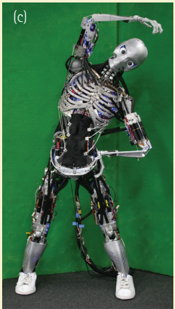
The image depicts a humanoid robot with a skeletal mechanical structure, positioned against a green screen background. The robot is shown in a dynamic pose with one arm raised and the other bent at the elbow, suggesting articulation and mobility. The design emphasizes a blend of skeletal aesthetics (exposed joints and wiring) with functional components.
### Components/Axes
- **Textual Elements**:
- Label "(c)" in the top-left corner (likely indicating a figure reference in a document).
- No additional labels, axis titles, legends, or numerical data present.
- **Visual Components**:
- **Skeletal Frame**: Metallic ribcage, spine, and limb structures with visible wiring and mechanical joints.
- **Wiring**: Black cables and connectors distributed across the torso, limbs, and head.
- **Head**: Stylized humanoid face with a metallic skull-like design and two visible "eyes."
- **Feet**: White sneakers attached to articulated legs with exposed mechanical components.
- **Background**: Uniform green screen (likely for chroma key compositing).
### Detailed Analysis
- **Textual Content**:
- Only the label "(c)" is present, with no other textual annotations, legends, or data points.
- No numerical values, scales, or categorical labels are visible.
- **Spatial Grounding**:
- Label "(c)" is positioned in the top-left corner, outside the robot’s frame.
- No other elements (e.g., legends, axis markers) are spatially anchored.
### Key Observations
- The robot’s design prioritizes a skeletal aesthetic, with exposed mechanical components and wiring.
- The absence of textual annotations or data suggests the image is a standalone prototype visualization rather than a data-driven diagram.
- The green screen background implies the image is intended for post-processing or integration into a larger technical document.
### Interpretation
This image likely serves as a technical illustration of a humanoid robot prototype, emphasizing its mechanical complexity and mobility. The lack of textual data or annotations indicates it is not intended to convey quantitative information but rather to showcase design features. The label "(c)" suggests it is part of a sequence (e.g., Figure 3 in a report), but no further context is provided in the image. The green screen implies the robot’s pose and articulation are the focal points, with no environmental context.
**Note**: The image contains no factual or numerical data beyond the label "(c)." All descriptions are based on visible structural and compositional elements.